Truthahn-Salzlake über Nacht
A savory-sweet wet brine built on kosher salt, brown sugar, apple cider, citrus, and woodsy herbs that seasons a whole turkey from the inside out while it rests overnight in the refrigerator. The salt loosens muscle proteins so the bird holds onto its juices in the oven, which means moist breast meat even at a full 165°F. Simmer a small concentrate, chill it down with ice water, submerge the turkey for 12 to 16 hours, and you are set up for the juiciest roast of the year.
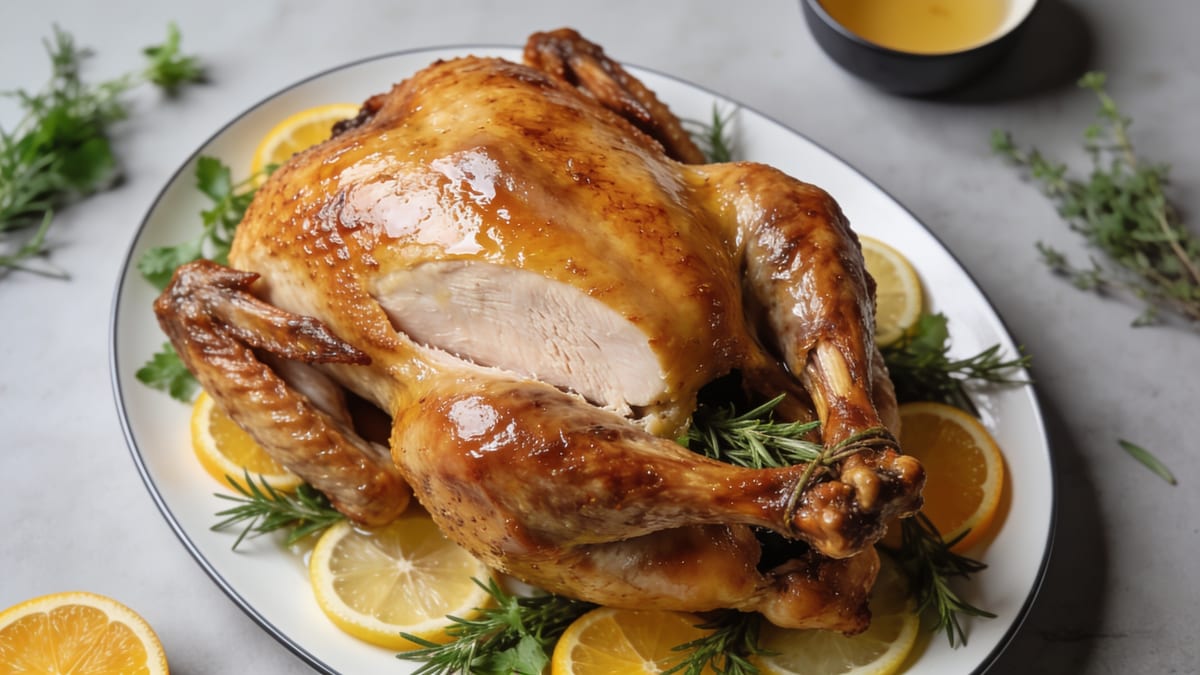
Simmer 2 quarts of water with 360 g Morton kosher salt (or 3 cups Diamond Crystal), 200 g brown sugar, garlic, peppercorns, bay, rosemary, thyme, sage, and two quartered oranges for 10 minutes until the salt dissolves, then kill the heat and stir in 4 cups of cold apple cider, the remaining 4 quarts of ice-cold water, and about 8 cups of ice. Once the brine reads below 4°C (40°F), lower a thawed 12- to 14-pound turkey into a brining bag or food-safe bucket, top up so the bird is fully submerged, and refrigerate 12 to 16 hours. Drain, rinse briefly under cold water, pat completely dry, and roast at 165°C (325°F) for about 13 minutes per pound — skipping any added salt on the skin — until the breast hits 74°C (165°F) and the thigh 79°C (175°F).
- Never add a turkey to warm brine — chill the liquid below 4°C (40°F) first, using ice water and ice so you are not waiting hours.
- Skip this brine for kosher or self-basting (Butterball-style) birds; they are pre-salted and will turn out too salty.
- Pat the skin bone-dry after brining — or air-dry it uncovered in the fridge for a few hours — or it will steam instead of crisp.
Equipment
- 12-quart or larger stockpot
- Turkey-size brining bag or 5-gallon food-safe bucket
- Refrigerator shelf cleared, or a hard-sided cooler
- Instant-read thermometer
- Long-handled spoon
- Roasting pan with rack (for the next day)
Zutaten
Brine Base
- 5.5 L cold water, divided, 2 quarts for simmering, the rest ice-cold for cooling
- 360 g Morton kosher salt, or 3 cups Diamond Crystal; never substitute table salt cup-for-cup
- 200 g dark brown sugar
- 1 L apple cider, unfiltered sweet cider, not cider vinegar
Aromatics
- garlic cloves, smashed
- bay leaves
- 10 g whole black peppercorns, lightly crushed
- fresh rosemary sprigs
- fresh thyme sprigs
- fresh sage leaves
- oranges, quartered, squeeze the juice into the pot, then drop in the peels
Turkey and Ice
- whole turkey (12 to 14 lb / 5.5 to 6.5 kg), fully thawed, giblets and neck removed; do not use a kosher or self-basting bird
- 1 kg ice, for chilling the brine quickly
Zubereitung
- SCHRITT01
Make sure the turkey is completely thawed (a frozen core will keep the brine from penetrating and holds the bird in the temperature danger zone). Reach into both cavities and remove the neck and giblet bag; save them for stock or gravy. Trim any large pockets of loose fat. Keep the turkey refrigerated while you make the brine.
- SCHRITT02
In a large stockpot, combine 2 quarts (1.9 L) of the water with the kosher salt, brown sugar, garlic, peppercorns, bay leaves, rosemary, thyme, and sage. Squeeze the orange quarters into the pot and add the peels. Bring to a simmer over medium-high heat, stirring, and simmer about 10 minutes, until every grain of salt and sugar has dissolved and the liquid smells like the herbs.
- SCHRITT03
Take the pot off the heat and stir in the cold apple cider, the remaining 4 quarts (3.6 L) of ice-cold water, and the ice. Stir until the ice mostly melts, then check with an instant-read thermometer: the brine must be at or below 4°C (40°F) before the turkey goes in. If it is still warm, refrigerate until it gets there — usually under an hour with the ice assist.
- SCHRITT04
Set a brining bag inside a stockpot or bucket for stability (or use a clean 5-gallon food-safe bucket directly). Lower the turkey in breast-side down, then pour the chilled brine over it, aromatics and all. The bird must be fully submerged; if it floats, weigh it down with a plate or a zip-top bag of ice. Squeeze excess air from the bag and seal or cover.
- SCHRITT05
Refrigerate the submerged turkey for 12 to 16 hours — putting it in after dinner and pulling it out mid-morning is the classic rhythm. No fridge space? Nest the sealed bag in a hard-sided cooler packed with ice and check that the brine stays below 4°C (40°F). Do not exceed 24 hours or the texture turns spongy and the meat oversalts.
- SCHRITT06
Lift the turkey out and let it drain over the container, then discard the brine — it is single-use. Rinse the bird briefly inside and out under cold running water to wash surface salt off the skin, then pat it thoroughly dry with paper towels. For extra-crisp skin, set it on a rack over a sheet pan and let it air-dry uncovered in the refrigerator for 2 to 8 hours before roasting.
- SCHRITT07
Roast at 165°C (325°F), about 13 minutes per pound for an unstuffed turkey — roughly 2 3/4 to 3 hours for a 12- to 14-pounder. Brush with melted unsalted butter but do not salt the skin, and season the gravy only after tasting, since brined drippings run salty. Pull it when the breast reads 74°C (165°F) and the thigh 79°C (175°F), then rest 30 minutes before carving.
Make ahead
Simmer the salt-sugar-aromatic concentrate up to 3 days ahead and refrigerate it in a sealed container; stir in the cider, ice water, and ice just before brining. You can also start the brine on the morning of the day before roasting, giving you flexibility to slide the turkey in anytime that evening.
Storage
The brine itself is single-use: discard it immediately after the turkey comes out and wash the container, bag, and sink area with hot soapy water. A brined raw turkey should be roasted within 24 hours of leaving the brine (it can air-dry in the fridge during that window). Leftover roasted turkey keeps 4 days in an airtight container in the refrigerator or up to 3 months frozen.
Variations
Citrus-Maple Brine
Swap the brown sugar for 240 ml (3/4 cup) pure maple syrup and add one quartered lemon alongside the oranges. The maple gives the drippings and skin a deeper mahogany color and pairs beautifully with a bourbon-spiked gravy.
Cajun-Spiced Brine
Replace the rosemary and sage with 2 tbsp smoked paprika, 1 tbsp cayenne, 2 tsp dried oregano, and 4 halved jalapeños, and use 1 L (4 cups) unsalted chicken stock in place of the cider. A great setup if the turkey is headed for the smoker or deep fryer (dry it extremely well before frying).
No-Sugar Brine (keto/diabetic-friendly)
Omit the brown sugar and cider entirely and increase the water to 7 L (7 1/2 quarts) total. Sugar contributes browning and a faint sweetness but does nothing for juiciness — salt does all the moisture work — so the bird stays just as succulent without it.
Serve with
Nutrition per serving
Nutrition values are estimates based on the metric measurements. Adjust as needed.
Häufige Fragen
How long should the turkey stay in the brine?
Aim for 12 to 16 hours for a 12- to 14-pound bird — that is the sweet spot where the salt has fully equilibrated into the breast without breaking down the texture. If you're figuring out how to brine a turkey overnight around a busy schedule, submerge it after dinner and pull it out by late morning. Past 24 hours the meat turns oversalted and slightly spongy, so set an alarm rather than letting it ride.
Do I really need to rinse the turkey after brining?
A quick rinse under cold water is worth it here because wet-brined skin carries a concentrated layer of surface salt that can make the skin and drippings harsh. Rinse briefly inside and out, pat completely dry, and sanitize the sink and counters afterward. Drying matters more than rinsing — damp skin steams in the oven instead of crisping.
Can I brine a frozen, kosher, or self-basting turkey?
Skip all three. A frozen or partially frozen bird can't absorb the brine and lingers at unsafe temperatures, so thaw it fully first (about 24 hours per 4 to 5 pounds in the fridge). Kosher and self-basting turkeys are already salted or injected with a sodium solution, and layering this brine on top produces genuinely inedible saltiness. Look for a label that says 'natural' or 'minimally processed.'
What if my turkey won't fit in the refrigerator?
A hard-sided cooler is the classic workaround. Seal the turkey and brine in a brining bag, nest it in the cooler, and pack ice around the outside of the bag so melting ice never dilutes your salt ratio. Check with an instant-read thermometer every few hours — the brine must stay at or below 4°C (40°F). A cold garage in November often does the job too, but verify the temperature rather than assuming.
Which salt should I use, and can I scale the ratio?
Weight is the only reliable measure because kosher salt brands vary wildly in density: this recipe uses 360 g, which is about 1 1/2 cups of Morton but a full 3 cups of Diamond Crystal. Never swap in table salt by volume — it is nearly twice as dense and the anti-caking agents can cloud the brine. To scale, keep roughly 50 g of salt per liter of total liquid (about a 5% brine), enough liquid to cover the bird by an inch.
Cooked this? Rate it.
Real ratings from real cooks. We only show a score once enough of you have weighed in — no fabricated stars.