Blackened Chicken
Blackened chicken is a Creole classic: butter-dipped chicken breasts crusted in a bold paprika-cayenne spice blend, then seared in a ripping-hot cast-iron skillet until the coating toasts to a deep mahogany shell. The outside is smoky, crackly, and intensely seasoned while the inside stays juicy, because pounding the breasts to an even thickness lets them cook through in the few minutes it takes the crust to form. It is a 35-minute dinner that tastes like it came off a New Orleans line.
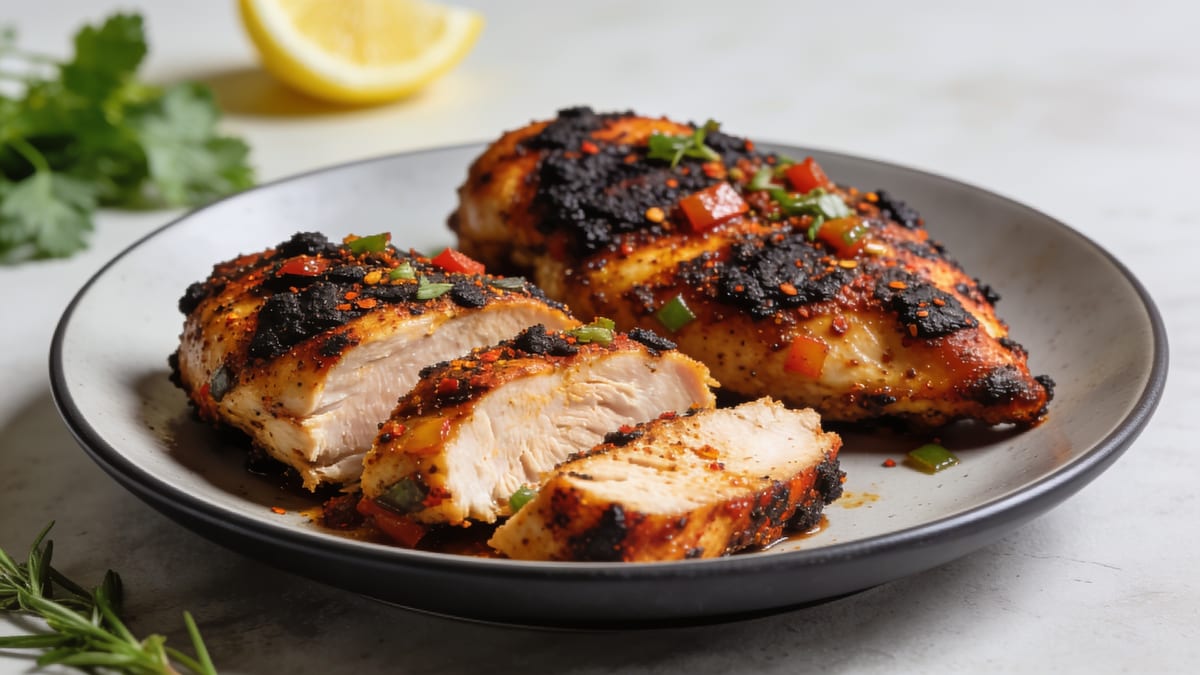
Stir together a blackening blend of paprika, garlic and onion powders, thyme, oregano, cayenne, black and white pepper, and salt. Pound 4 boneless chicken breasts to an even 1.5 cm (5/8 inch), pat them very dry, dip in melted butter, and press the spice blend onto every surface. Heat a dry cast-iron skillet over high heat for about 5 minutes until it just starts to smoke, add a slick of high-smoke-point oil, and lay in the chicken. Sear 3-4 minutes per side without moving it, drizzling a little more butter over the top after flipping, until the crust is deep mahogany and the center reaches 74°C (165°F). Rest 5 minutes and serve with lemon wedges.
- Pound the breasts to an even 1.5 cm so the inside finishes cooking in the same few minutes the crust needs to toast — thick, uneven breasts force you to burn the coating.
- The skillet must be genuinely smoking-hot before the chicken goes in; a merely warm pan steams the spices into a soggy paste instead of searing them into a crust.
- Turn on the exhaust fan and crack a window before you start — real blackening makes real smoke, and that is a sign it is working, not burning.
Equipment
- 30 cm (12-inch) cast-iron skillet
- Meat mallet or heavy rolling pin
- Instant-read thermometer
- Small bowl for the spice blend
- Shallow dish for the melted butter
- Tongs
Ingredients
Blackening seasoning
- 16 g sweet paprika, or half sweet, half smoked
- 9 g garlic powder
- 7 g onion powder
- 2 g dried thyme
- 2 g dried oregano
- 2 g cayenne pepper, use 1/2 tsp for a milder version
- 2 g freshly ground black pepper
- 2 g ground white pepper, optional but traditional
- 6 g fine sea salt
Chicken and pan
- boneless, skinless chicken breasts (about 170 g / 6 oz each), patted very dry
- 85 g unsalted butter, melted, divided: most for dipping, a little for basting
- 15 ml avocado or canola oil, high smoke point
- lemon, cut into wedges, for serving
Method
- STEP01
In a small bowl, stir together the paprika, garlic powder, onion powder, thyme, oregano, cayenne, black pepper, white pepper, and salt until evenly combined. Spread it on a plate so you can press the chicken into it easily.
- STEP02
Place each breast between two sheets of plastic wrap or parchment and pound the thick end with a meat mallet or rolling pin until the whole breast is an even 1.5 cm (5/8 inch) thick. Pat every surface completely dry with paper towels — surface moisture is the enemy of a crisp crust.
- STEP03
Pour about two-thirds of the melted butter into a shallow dish. Dip each breast in the butter, let the excess drip off, then press both sides firmly into the spice blend so it clings in an even, complete layer. Set the coated breasts on a plate.
- STEP04
Turn on your exhaust fan and open a window. Set a dry cast-iron skillet over high heat and leave it alone for about 5 minutes, until a wisp of smoke rises from the surface. This preheat is what creates the signature crust, so do not rush it. Add the oil and swirl to coat.
- STEP05
Lay in the chicken (work in two batches if your skillet holds only two breasts without touching). Press down gently and leave the pieces completely undisturbed for 3 to 4 minutes, until the underside is deep mahogany brown, nearly black at the edges, and releases easily from the pan.
- STEP06
Flip with tongs, drizzle the reserved melted butter over the tops, and sear another 3 to 4 minutes, until an instant-read thermometer in the thickest part reads 74°C (165°F). If the crust darkens faster than the inside cooks, drop the heat to medium for the last minute or two.
- STEP07
Transfer the chicken to a cutting board or warm platter and rest for 5 minutes so the juices redistribute. Serve whole or sliced against the grain, with lemon wedges squeezed over the top to cut through the spice.
Make ahead
The blackening seasoning can be mixed in a big batch and stored in a sealed jar away from light for up to 3 months — this recipe's quantity scales up cleanly. You can also pound the breasts and refrigerate them, covered, up to a day ahead; the salt in the coating works best applied just before cooking, so hold off on the butter dip and spice crust until the skillet is heating.
Storage
Refrigerate leftovers in an airtight container for up to 4 days. Reheat gently in a covered skillet over medium-low with a spoonful of water, or in a 150°C (300°F) oven until warmed through — a microwave works but softens the crust. Cold sliced leftovers are excellent on salads and in wraps. Freezing is possible for up to 2 months, though the crust loses its texture after thawing.
Variations
Blackened chicken thighs
Swap in 6 to 8 boneless, skinless thighs. They need no pounding and forgive a little overcooking; sear 4 to 5 minutes per side to 74°C (165°F). The extra fat makes an even deeper, richer crust.
Dairy-free
Replace the butter with 60 ml (1/4 cup) of avocado oil or melted refined coconut oil for dipping. You lose a bit of the toasted milk-solid flavor, but the crust still sets beautifully and the dish becomes dairy-free and paleo-friendly.
Grill-top blackening
Set the cast-iron skillet directly on a hot outdoor grill and cook exactly as written. You get the same crust while all the smoke stays outdoors — the best move for summer or a sensitive smoke alarm.
Serve with
Nutrition per serving
Nutrition values are estimates based on the metric measurements. Adjust as needed.
Frequently asked
Is blackened chicken supposed to be burnt?
No — the dark color comes from butter's milk solids and the paprika-heavy spice coating toasting rapidly against very hot cast iron, which builds a deep mahogany, almost black crust of caramelized spices. Burnt tastes acrid and bitter; properly blackened chicken tastes smoky, buttery, and intensely savory. If yours tastes scorched, the coating likely sat in the pan too long before flipping, or the blend contained sugar, which has no place in a blackening mix.
What's the difference between blackened, grilled, and Cajun-seasoned chicken?
Blackening is a specific technique popularized in 1980s New Orleans: the protein is dipped in melted butter, coated in spices, and seared in a dry, smoking-hot cast-iron pan so the coating itself chars into a crust. Grilled chicken cooks over open flame without that butter-spice shell, and 'Cajun chicken' usually just means chicken dusted with a similar spice mix but cooked at ordinary temperatures. The screaming-hot pan and butter dip are what make blackened chicken its own dish.
Can I make blackened chicken without a cast-iron skillet?
A carbon-steel pan works just as well, and a heavy stainless skillet is an acceptable third choice. Avoid nonstick entirely — the empty-pan preheat exceeds the safe temperature for nonstick coatings. Whatever you use, it must hold high heat without warping, because the stored heat in a thick pan is what sears the crust before the interior overcooks.
How do I keep my kitchen from filling with smoke?
Some smoke is unavoidable and actually signals the technique is working, but you can manage it: run the exhaust fan on high and crack a window before preheating, use a refined high-smoke-point oil like avocado, and wipe any loose spices out of the pan between batches so they don't scorch. If smoke is a dealbreaker indoors, set the skillet on an outdoor grill and blacken there.
How do I know when blackened chicken is done?
Use an instant-read thermometer and pull the chicken at 74°C (165°F) in the thickest spot — with a dark crust, color is useless as a doneness cue. Because the breasts are pounded to an even 1.5 cm, they typically hit temperature in 6 to 8 minutes total. If you have no thermometer, cut into the thickest piece: the meat should be opaque throughout with juices running clear.
Cooked this? Rate it.
Real ratings from real cooks. We only show a score once enough of you have weighed in — no fabricated stars.