Blooming Onion
A whole sweet onion is cut into petals, double-dredged in paprika-spiked seasoned flour, and deep-fried until it fans open into a crackly golden flower. Each petal pulls away shatteringly crisp outside and silky-sweet inside, ready to drag through a creamy horseradish dipping sauce. An ice-water soak opens the petals, and the flour-egg-flour coating pressed deep between the layers is what keeps every bite crunchy instead of soggy.
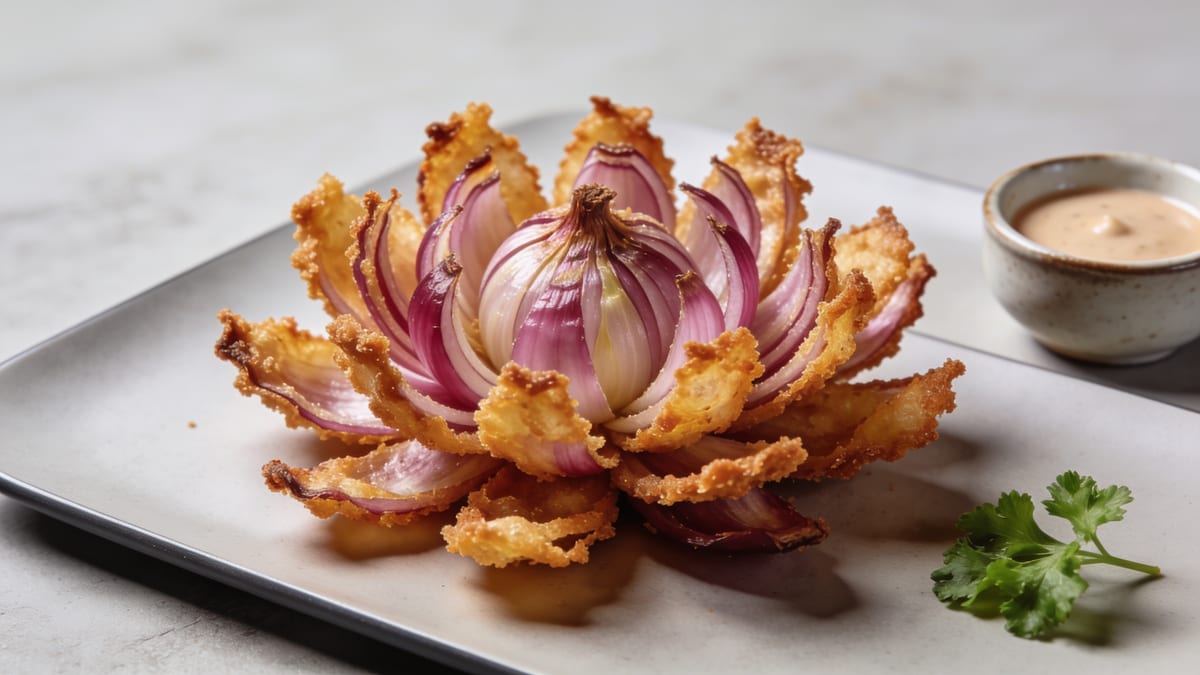
Slice 1 cm (1/2 inch) off the top of a large sweet onion, peel it, and — keeping the root end intact — make 16 evenly spaced vertical cuts from the top down to within 1 cm of the root. Soak it cut-side down in ice water for 15 minutes so the petals relax open, then pat it completely dry. Dredge every petal in flour seasoned with paprika, garlic powder, oregano, cayenne, salt, and pepper; dunk the whole onion in a whisked egg-buttermilk wash; then dredge again, pressing flour between the layers and shaking off the excess. Heat 2.5 L (10 cups) neutral oil to 175°C (350°F) in a large Dutch oven, lower the onion in cut-side down, and fry about 3 minutes; flip and fry 2 minutes more until deep golden. Drain on a rack, sprinkle with salt, and serve hot with a mayo-ketchup-horseradish sauce nestled in the center.
- Leave the root end intact — it is the hinge that holds all sixteen petals together through battering and frying.
- Dry the soaked onion thoroughly before dredging; moisture trapped under the flour is the main reason the coating slides off.
- Hold the oil at 175°C (350°F): hotter scorches the petal tips before the center softens, cooler makes the coating greasy.
Equipment
- 5- to 6-quart Dutch oven or heavy deep pot (or a deep fryer)
- Deep-fry or instant-read thermometer
- Sharp chef's knife
- Three wide, deep bowls for dredging and dipping
- Spider strainer or two large slotted spoons
- Wire rack set over a rimmed baking sheet
- Whisk
Ingredients
Onion and frying
- large sweet onion (Vidalia, Walla Walla, or Maui), about 450-550 g / 1 to 1 1/4 lb, round and firm
- 2.5 L neutral frying oil, canola, peanut, or vegetable oil
- 2 g flaky or fine salt, for finishing
Seasoned coating and batter
- 250 g all-purpose flour
- 14 g sweet paprika
- 9 g garlic powder
- 1 g dried oregano
- 2 g cayenne pepper, reduce to 1/2 tsp for mild
- 12 g fine salt
- 2 g freshly ground black pepper
- large eggs
- 240 ml buttermilk, or whole milk
Horseradish dipping sauce
- 115 g mayonnaise
- 34 g ketchup
- 15 g prepared horseradish, drained
- 1 g smoked paprika
- 0.5 g cayenne pepper
- 1.5 g fine salt
Method
- STEP01
Whisk the mayonnaise, ketchup, horseradish, smoked paprika, cayenne, and salt in a small bowl until smooth. Cover and refrigerate so the flavors meld while you work.
- STEP02
Slice about 1 cm (1/2 inch) off the top (stem end) of the onion and peel off the papery skin, leaving the root end fully intact. Set the onion cut-side down. Starting 1 cm from the root, make 4 evenly spaced vertical cuts down through the onion, dividing it into quarters that stay attached at the root. Make 3 more cuts inside each quarter for 16 total cuts. Flip the onion over and gently tease the layers apart into petals.
- STEP03
Submerge the onion cut-side down in a big bowl of ice water for 15 minutes. The cold soak relaxes the petals so they fan open and rinses off surface starch. Lift it out, shake well over the sink, and pat it dry inside and out with paper towels — the drier it is, the better the coating sticks.
- STEP04
In a wide, deep bowl, whisk the flour with the paprika, garlic powder, oregano, cayenne, salt, and black pepper. In a second deep bowl big enough to hold the onion, whisk the eggs into the buttermilk until no streaks remain.
- STEP05
Set the onion cut-side up in the seasoned flour and spoon flour over and between every petal, then flip it over and pat off the excess. Lower it into the egg wash and spoon the liquid between the layers so every petal is wet. Return it to the flour and dredge a second time, pressing the coating into each petal, then turn it over and gently shake out loose flour. Set it on a plate while the oil heats.
- STEP06
Pour the oil into a 5- to 6-quart Dutch oven — it should be 8 to 10 cm (3 to 4 inches) deep with at least 8 cm of clearance below the rim. Heat over medium-high to 175°C (350°F) on a deep-fry thermometer. Set a wire rack over a rimmed baking sheet next to the stove.
- STEP07
Using a spider strainer, lower the onion into the oil cut-side down and fry for 3 minutes; the petals will set open. Carefully flip it and fry 2 minutes more, until the whole flower is a deep golden brown and the coating is rigid. Adjust the heat as needed to keep the oil between 165-175°C (330-350°F).
- STEP08
Lift the onion out, letting the oil drain back into the pot, and rest it root-side down on the wire rack for a minute. Sprinkle with flaky salt, transfer to a platter, and use a small knife to open a pocket in the center if needed. Nestle the bowl of horseradish sauce in the middle and serve immediately, pulling petals from the outside in.
Make ahead
The sauce can be made up to 3 days ahead and refrigerated. You can cut the onion and hold it submerged in ice water in the refrigerator up to 24 hours ahead — just dry it very well before coating. Do the flour-egg-flour coating only right before frying; a coated onion that sits longer than 30 minutes turns gummy.
Storage
A blooming onion is at its best within 15 minutes of frying. Refrigerate leftover petals in an airtight container for up to 2 days; re-crisp them in a single layer in a 200°C (400°F) oven or air fryer for 6 to 8 minutes — the microwave will turn them soft. The dipping sauce keeps, covered and refrigerated, for up to 1 week.
Variations
Air-fryer blooming onion
Coat the onion as directed, then spray it generously all over and between the petals with oil. Air-fry at 190°C (375°F) for 18 to 22 minutes, spraying any floury patches halfway through. The petals come out crisp-edged and much lighter, though not as uniformly crunchy as deep-fried.
Gluten-free swap
Replace the all-purpose flour with 200 g (1 1/2 cups) of a cup-for-cup gluten-free blend whisked with 50 g (1/3 cup) white rice flour, which keeps the crust brittle and light. Season identically and confirm your other ingredients are certified gluten-free.
Cajun heat
Swap the paprika, oregano, and cayenne for 3 tablespoons of Cajun seasoning in the flour and add 1 teaspoon of hot sauce to the egg wash. Stir an extra 1/2 teaspoon of Cajun seasoning into the dipping sauce for a spicier, smokier version.
Serve with
Nutrition per serving
Nutrition values are estimates based on the metric measurements. Adjust as needed.
Frequently asked
What kind of onion is best for a blooming onion?
A large sweet onion — Vidalia, Walla Walla, or Maui — in the 450 to 550 g (1 to 1 1/4 lb) range. Sweet varieties are milder and turn almost creamy inside during the fry, and their squat, round shape opens into an even flower. Regular yellow onions work in a pinch but taste noticeably sharper.
Why did my coating fall off in the oil?
Almost always trapped moisture or loose flour. Dry the soaked onion thoroughly with paper towels before dredging, press the second layer of flour firmly into each petal, and shake off any excess that isn't adhered — loose flour lifts away in the oil and takes coating with it. Lowering the onion gently with a spider rather than dropping it also protects the crust.
Can I make a blooming onion without a deep fryer?
Yes — a 5- to 6-quart Dutch oven with 8 to 10 cm (3 to 4 inches) of oil is actually ideal because the heavy pot holds temperature well. The non-negotiable tool is a thermometer: keeping the oil near 175°C (350°F) is what separates a crisp blooming onion from a greasy one. Never fill the pot more than halfway.
How do I cut the petals without slicing through the root?
Leave the root end completely intact and always stop your cuts about 1 cm (1/2 inch) above it. Working with the onion cut-side down makes this easy: gravity keeps the knife from carrying through, and you can watch where each cut ends. If you do sever a few petals, fry them alongside the onion as bonus chips.
Can I bake a blooming onion instead of frying?
You can: coat as directed, spray heavily with oil, and bake at 220°C (425°F) for 25 to 30 minutes on a rack-lined sheet. The flavor is there and it saves oil, but the crust will be more crumbly-crisp than shattering. The air-fryer variation gets meaningfully closer to the deep-fried texture.
Cooked this? Rate it.
Real ratings from real cooks. We only show a score once enough of you have weighed in — no fabricated stars.