Fluffy Flapjack Pancakes
These are the tall, diner-style flapjacks that jiggle a little when they hit the plate: crisp-edged, golden outside and cloud-soft inside, with a gentle buttermilk tang under all that maple syrup. The lift comes from pairing baking powder with a little baking soda, which reacts with the acidic buttermilk, and from mixing the batter only until it is barely combined so the gluten stays relaxed. A short rest while the griddle heats lets the flour hydrate and the leaveners wake up, so the first pancake is as puffy as the last.
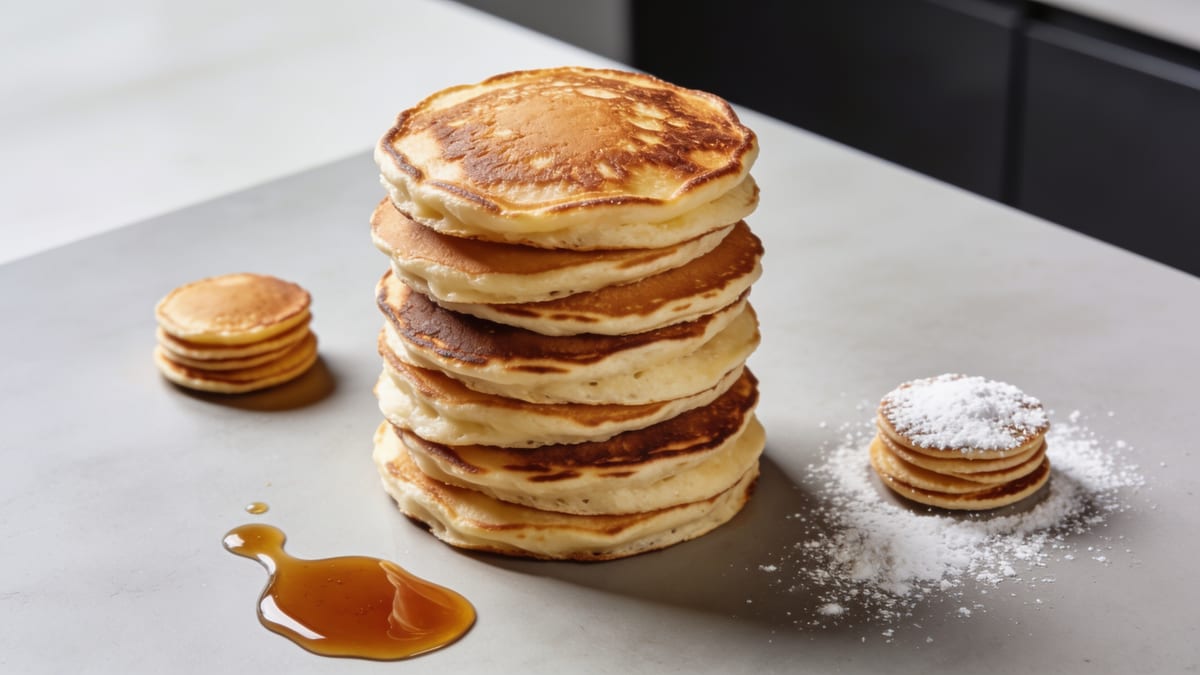
Whisk 250 g (2 cups) flour with 40 g (3 tbsp) sugar, 1 tbsp baking powder, 1/2 tsp baking soda, and 3/4 tsp salt. In a second bowl, whisk 480 ml (2 cups) buttermilk with 2 eggs, 45 g (3 tbsp) melted butter, and 1 tsp vanilla, then fold the wet into the dry just until no dry streaks remain — a lumpy batter is correct. Rest the batter 10 minutes while a griddle or nonstick skillet heats over medium (about 175°C / 350°F). Lightly butter the surface, ladle on 60 ml (1/4 cup) portions, and cook about 3 minutes, until bubbles on top pop and stay open and the edges look set. Flip once and cook 1 1/2 to 2 minutes more, until golden and springy in the center. Hold finished flapjacks on a wire rack in a 95°C (200°F) oven while you cook the rest, then serve hot with butter and maple syrup.
- Stop stirring while the batter is still lumpy — overmixing builds gluten and makes flat, rubbery pancakes.
- Rest the batter 10 minutes so the flour hydrates and the leaveners aerate; the pancakes rise noticeably taller.
- Flip exactly once, when the surface bubbles pop and hold their shape — early or repeated flipping deflates the rise.
Equipment
- Two mixing bowls (one large, one medium)
- Whisk
- Flexible spatula for folding and flipping
- Griddle or large nonstick skillet
- 60 ml (1/4 cup) measuring cup or scoop
- Wire rack set over a baking sheet
Ingredients
Batter
- 250 g all-purpose flour, spooned into the cup and leveled
- 40 g granulated sugar
- 12 g baking powder
- 2 g baking soda
- 4 g fine sea salt
- 480 ml buttermilk, well shaken, at room temperature
- large eggs, at room temperature
- 45 g unsalted butter, melted and slightly cooled
- 5 ml vanilla extract
For the griddle and serving
- 15 g unsalted butter, plus more as needed for greasing the griddle
- 120 ml maple syrup, warmed, for serving
Method
- STEP01
In a large bowl, whisk the flour, sugar, baking powder, baking soda, and salt for a good 20 seconds so the leaveners are evenly distributed — pockets of baking soda taste metallic and brown unevenly.
- STEP02
In a medium bowl, whisk the buttermilk, eggs, and vanilla until smooth. Drizzle in the melted butter while whisking so it disperses instead of seizing into clumps. Room-temperature buttermilk and eggs keep the butter fluid.
- STEP03
Pour the wet mixture into the dry ingredients and fold with a spatula just until no dry streaks of flour remain, about 10 to 15 strokes. The batter should be thick, pourable, and visibly lumpy. Do not try to beat it smooth — those lumps disappear on the griddle.
- STEP04
Set the batter aside for 10 minutes while you heat a griddle or large nonstick skillet over medium heat to about 175°C (350°F). You will see small bubbles forming on the batter's surface as it rests. The pan is ready when a drop of water skitters and evaporates in a couple of seconds. Set the oven to 95°C (200°F) with a wire rack on a baking sheet inside if you want to hold batches warm.
- STEP05
Lightly butter the griddle and wipe away the excess with a paper towel — a thin film gives even browning, a puddle gives blotches. Pour on 60 ml (1/4 cup) portions, leaving room to flip. Cook until bubbles on the surface pop and stay open, the edges look set and slightly dry, and the underside is golden, about 3 minutes.
- STEP06
Slide the spatula fully under each pancake and flip it in one confident motion. Cook until the second side is golden and the center springs back when pressed lightly, 1 1/2 to 2 minutes. Resist pressing down on the pancakes — that squeezes out the air you worked to keep.
- STEP07
Transfer finished flapjacks to the rack in the warm oven in a single layer (stacking traps steam and softens the crust) and repeat with the remaining batter, re-buttering the griddle between batches. Serve hot in tall stacks with butter and warm maple syrup.
Make ahead
Whisk the dry ingredients up to a month ahead and store the mix in a sealed jar — mornings then only need buttermilk, eggs, and butter. The finished batter is at its best within about an hour; it can hold in the fridge that long, but the leaveners fade after that, so for true make-ahead convenience cook the whole batch and freeze the pancakes instead.
Storage
Cool leftovers completely, then refrigerate in an airtight container for up to 3 days with parchment between the layers. To freeze, lay pancakes flat on a baking sheet until solid, then bag them for up to 2 months. Reheat straight from the fridge or freezer in a toaster or a 175°C (350°F) oven for 5 to 8 minutes; the microwave works but softens the edges.
Variations
Blueberry flapjacks
Rather than stirring berries into the batter (they streak it gray), scatter 6 to 8 fresh or frozen blueberries onto each pancake right after you pour it. They sink in slightly, cook to jammy pockets, and the flip covers them completely.
Dairy-free flapjacks
Stir 2 tablespoons (30 ml) of lemon juice or white vinegar into 480 ml (2 cups) of unsweetened soy or oat milk and let it sit 5 minutes to mimic buttermilk's acidity, and swap the butter for 45 ml (3 tbsp) of neutral oil, plus oil for the griddle. The soda still gets the acid it needs, so the pancakes stay tall.
Whole-grain banana flapjacks
Replace half the flour with 125 g (1 cup) of white whole-wheat flour and fold one mashed ripe banana into the wet ingredients. Add a splash more buttermilk if the batter tightens, and cook slightly lower and slower — the extra sugar browns faster.
Serve with
Nutrition per serving
Nutrition values are estimates based on the metric measurements. Adjust as needed.
Frequently asked
Is a flapjack the same thing as a pancake?
In the United States, yes — flapjack, hotcake, and griddlecake are all regional names for the same griddle-cooked breakfast pancake, which is what this flapjack recipe makes. In the UK, a flapjack is something entirely different: a chewy baked oat bar held together with butter and golden syrup. If you're after the oat bar, you need a British recipe; this one is the American stack.
Why aren't my flapjacks fluffy?
Three culprits cover almost every flat flapjack. First, overmixing: stirring until smooth develops gluten, and the batter sets dense and chewy — stop while it's lumpy. Second, tired leaveners: baking powder loses strength after opening, so test a spoonful in hot water; it should fizz vigorously. Third, skipping the rest or letting batter sit for hours: 10 minutes hydrates the flour and builds bubbles, but much longer than an hour and the rise fades.
Can I make this flapjack recipe without buttermilk?
Yes. Stir 2 tablespoons (30 ml) of lemon juice or white vinegar into 480 ml (2 cups) of regular milk and let it stand for 5 minutes until slightly thickened. It supplies the acid the baking soda needs to react, which is the whole reason buttermilk appears in a flapjack recipe in the first place. Thinned plain yogurt (about 360 ml yogurt whisked with 120 ml milk) also works beautifully.
How do I know exactly when to flip?
Watch the bubbles, not the clock. When bubbles rising to the surface pop and the holes stay open instead of closing over, and the edges look matte and set, the underside is golden and the structure is strong enough to flip. Flip once, decisively. Peeking repeatedly or flipping a second time knocks out air and flattens the stack.
Can I keep a whole batch warm without it going soggy?
Hold finished pancakes in a single layer on a wire rack set over a baking sheet in a 95°C (200°F) oven for up to 30 minutes. The rack lets steam escape from underneath, which is the key — stacking hot pancakes on a plate traps moisture and turns the crisp edges limp. Only build the stack at the table.
Cooked this? Rate it.
Real ratings from real cooks. We only show a score once enough of you have weighed in — no fabricated stars.