German Chocolate Frosting
The signature topping for German chocolate cake: a golden, caramel-like custard loaded with sweetened coconut and toasted pecans. Egg yolks and evaporated milk are cooked slowly with butter and sugar until thick and butterscotch-hued, so the frosting sets up spoonable and glossy instead of grainy. Whisking the yolks into the cold milk before any heat touches the pan is the trick that keeps it silky, never scrambled.
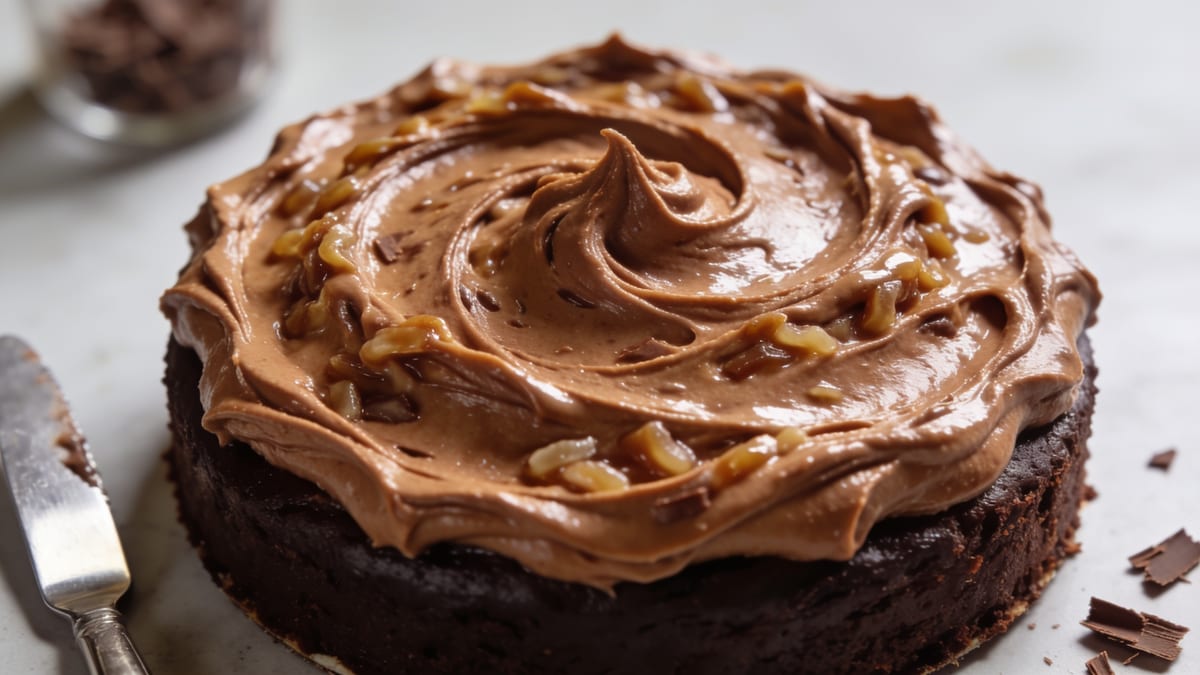
Toast 150 g (1 1/2 cups) chopped pecans at 175°C/350°F for about 8 minutes. In a heavy 3-quart saucepan off the heat, whisk 4 egg yolks into one 12-oz can (354 ml) evaporated milk until smooth, then add 200 g (1 cup) granulated sugar, 55 g (1/4 cup packed) light brown sugar, 113 g (8 tbsp) butter, and 1/4 tsp salt. Cook over medium heat, stirring constantly with a flexible spatula, 10-14 minutes, until the mixture bubbles gently, turns golden tan, and coats the spatula thickly (about 80°C/175°F). Off the heat, stir in 2 tsp vanilla, 200 g (2 2/3 cups) sweetened shredded coconut, and the pecans. Cool 45 minutes, stirring now and then, until spreadable.
- Whisk the yolks into the cold evaporated milk before turning on the burner — tempering is built in and the custard can't scramble.
- Stir constantly and scrape the corners of the pan; the frosting is done when a finger drawn through it on the spatula leaves a clean track.
- It thickens dramatically as it cools, so pull it from the heat when it looks like warm pudding, not spreadable frosting.
Equipment
- Heavy 3-quart (3-liter) saucepan
- Rimmed baking sheet
- Whisk
- Heatproof silicone spatula
- Instant-read thermometer (optional)
- Offset spatula for frosting
Ingredients
Custard base
- 354 ml evaporated milk (one 12-oz can), whole, not sweetened condensed
- large egg yolks, save the whites for another use
- 200 g granulated sugar
- 55 g light brown sugar, deepens the caramel flavor
- 113 g unsalted butter, cut into pieces
- 1.5 g fine sea salt
- 10 ml vanilla extract, stirred in off the heat
Stir-ins
- 200 g sweetened shredded coconut
- 150 g pecans, roughly chopped, toasted for the best flavor
Method
- STEP01
Heat the oven to 175°C/350°F. Spread the chopped pecans on a rimmed baking sheet and toast for 7-9 minutes, shaking the pan once, until fragrant and a shade darker. Set aside to cool. (A dry skillet over medium heat works too — keep them moving.)
- STEP02
In a heavy 3-quart saucepan, off the heat, whisk the egg yolks until smooth, then gradually whisk in the evaporated milk. Starting with everything cold and fully combined means the yolks heat evenly and cannot curdle into scrambled bits later.
- STEP03
Add the granulated sugar, brown sugar, butter pieces, and salt to the pan. Give everything a stir — it will look loose and separated at this point, which is normal.
- STEP04
Set the pan over medium heat and cook, stirring constantly with a heatproof spatula and scraping the bottom and corners, for 10-14 minutes. The mixture will melt together, begin to bubble lazily, and gradually turn from pale cream to a light butterscotch tan. It is done when it thickly coats the spatula and a finger drawn through it leaves a clean track — about 80°C/175°F on an instant-read thermometer. Do not let it come to a hard boil.
- STEP05
Remove the pan from the heat and stir in the vanilla, then the coconut and toasted pecans until everything is evenly coated in the golden custard.
- STEP06
Scrape the frosting into a wide bowl and let it cool at room temperature for about 45 minutes, stirring every 10-15 minutes so it cools evenly. It thickens substantially as it cools; it is ready when a spoonful holds its shape but still spreads easily. For faster cooling, refrigerate and stir every 10 minutes.
- STEP07
Spread roughly 3/4 cup between each cake layer and the rest over the top, using an offset spatula and leaving the sides bare in the classic style. Nudge some coconut and pecans to the edge so they peek over — that rustic look is the signature of this frosting.
Make ahead
This frosting is a great make-ahead candidate: cook it up to 3 days before you bake, refrigerate it, then bring to room temperature (or warm very gently in 10-second microwave bursts, stirring between) until it reaches spreading consistency. You can also toast and chop the pecans up to a week ahead.
Storage
Store in an airtight container in the refrigerator for up to 1 week; the butter firms it up, so let it sit at room temperature for 30-60 minutes and stir before spreading. A frosted cake keeps, covered, 2 days at cool room temperature or 5 days refrigerated. The frosting also freezes well for up to 3 months — thaw overnight in the fridge and stir to re-loosen.
Variations
Dairy-free / vegan version
Swap the evaporated milk for 354 ml (1 1/2 cups) full-fat coconut milk simmered 10 minutes to reduce slightly, use vegan butter, and replace the yolks with 2 tbsp cornstarch whisked into the cold coconut milk. Cook until thick and bubbling, about 8 minutes — the coconut milk doubles down on flavor and no one misses the custard.
Salted caramel style
Use all brown sugar (255 g / 1 1/4 cups packed), brown the butter first, and finish with 1/2 tsp flaky salt stirred in with the coconut. Deeper, toastier, and outstanding on chocolate cupcakes.
Bourbon-pecan
Stir 1 tbsp bourbon in with the vanilla off the heat. The warmth of the whiskey cuts the sweetness and plays beautifully with the toasted pecans. (Skip for an alcohol-free dessert — most of the alcohol remains since it is not cooked off.)
Serve with
Nutrition per serving
Nutrition values are estimates based on the metric measurements. Adjust as needed.
Frequently asked
Why is it called German chocolate frosting if it isn't German?
The name comes from a person, not a country. Samuel German developed a sweet baking chocolate for Baker's in 1852, and the coconut-pecan-topped 'German's chocolate cake' popularized in 1950s Texas newspapers was built around it. The apostrophe-s got dropped over time, but german chocolate frosting has always been a thoroughly American invention.
My frosting never thickened — what went wrong?
Almost always the heat was too low or the cooking too short. The custard needs to reach roughly 80°C/175°F and bubble gently for the yolks to set; that genuinely takes 10-14 minutes of constant stirring over medium heat. If it is still thin, return it to the stove and keep going until it coats the spatula. Also remember it firms up a lot during the 45-minute cool — judge it warm-pudding thick on the stove, not frosting thick.
Does german chocolate frosting need to be refrigerated?
A frosted cake is fine loosely covered at cool room temperature for up to 2 days, even though the frosting contains egg and dairy, because the custard is fully cooked and very high in sugar. Beyond that, refrigerate. Leftover frosting on its own should always go into the fridge, where it keeps about a week.
Can I use sweetened condensed milk instead of evaporated milk?
No — they are not interchangeable here. Condensed milk already contains a large amount of sugar, so the frosting would turn cloyingly sweet and cook up too thick and sticky. Evaporated milk is just concentrated milk with no added sugar, which is what lets you control the sweetness and get the right spoonable texture.
Can I make it without egg yolks?
Yes. Whisk 2 tablespoons of cornstarch into the cold evaporated milk before adding the sugars and butter, then cook until thick and bubbling, about 8 minutes. The flavor is slightly less rich and custardy, but the texture is very close, and it removes the egg allergen entirely.
Cooked this? Rate it.
Real ratings from real cooks. We only show a score once enough of you have weighed in — no fabricated stars.