Beef Brisket
A whole beef brisket rubbed with smoky spices, seared hard, then braised low and slow in the oven on a bed of onions until it slices like butter. Because brisket is packed with collagen, the long covered bake at a gentle 300°F melts all that connective tissue into gelatin, giving you deeply beefy, fork-tender slices and a built-in onion pan sauce — no smoker required.
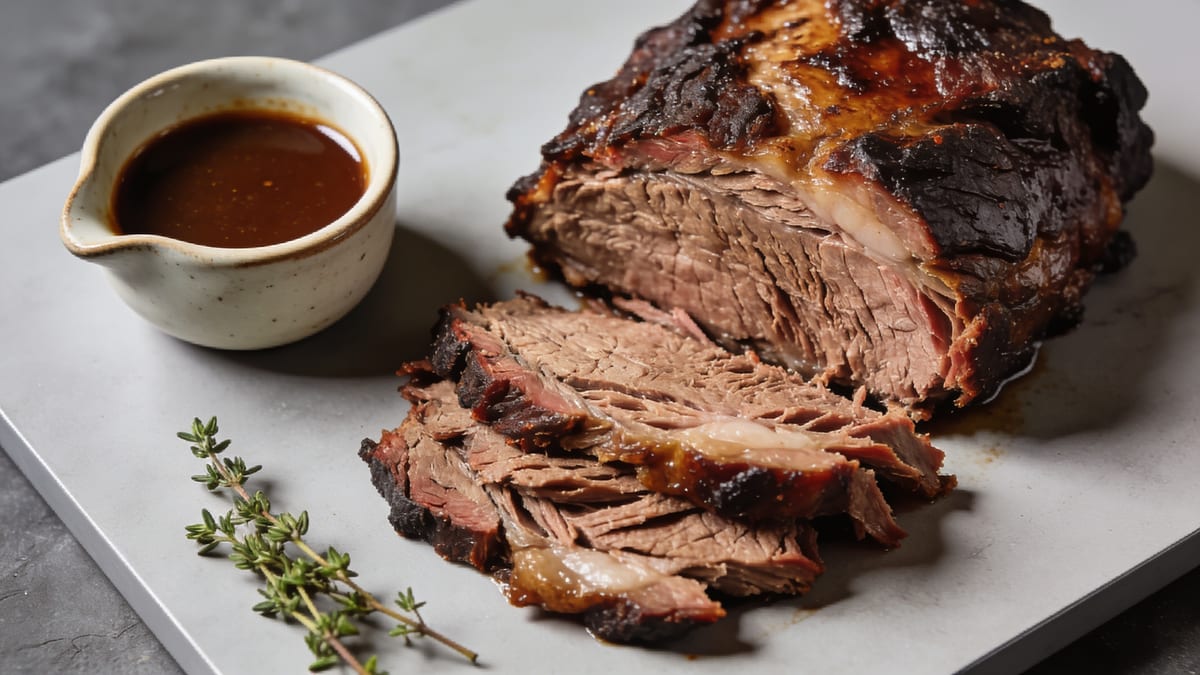
Pat a 4-lb flat-cut brisket dry, trim the fat cap to about 1/4 inch, and massage it all over with a rub of kosher salt, black pepper, smoked paprika, garlic powder, onion powder, and brown sugar. Sear it in an oiled Dutch oven or heavy roasting pan over medium-high heat until deeply browned on both sides, then set it aside while you soften sliced onions in the same pan, stir in garlic and tomato paste, and pour in beef stock, Worcestershire, cider vinegar, and bay leaves. Nestle the brisket fat side up on the onions, cover tightly, and braise at 300°F (150°C) for 3 to 3 1/2 hours until a fork twists in with almost no resistance (about 200-205°F internal), then uncover for a final 30 minutes to concentrate the sauce. Rest at least 30 minutes, slice thinly against the grain, and serve draped in the oniony pan juices.
- Cook to tenderness, not the clock — the brisket is done when a fork slides in and twists easily, usually 200-205°F (93-96°C) internal.
- Always slice against the grain; find the direction of the muscle fibers before cooking and cut perpendicular to them, or even tender brisket will chew like rope.
- Keep the lid or foil sealed tight for the whole covered braise — trapped steam is what keeps a lean flat cut juicy.
Equipment
- Large Dutch oven or heavy roasting pan with a tight lid
- Heavy-duty aluminum foil
- Sturdy tongs
- Instant-read thermometer
- Large cutting board with a juice groove
- Sharp carving knife
מצרכים
Brisket and rub
- 1.8 kg flat-cut (first-cut) beef brisket, fat cap trimmed to 1/4 inch, look for an even, rectangular piece so it cooks uniformly
- 12 g kosher salt
- 5 g coarsely ground black pepper
- 8 g smoked paprika, this brings the barbecue-style smokiness without a smoker
- 6 g garlic powder
- 5 g onion powder
- 12 g packed brown sugar
- 30 ml neutral oil, such as canola or avocado, for searing
Braising liquid
- large yellow onions, sliced into thick half-moons
- garlic cloves, smashed and peeled
- 480 ml low-sodium beef stock, check the label if you need it certified gluten-free
- 30 ml Worcestershire sauce, contains anchovies; use a gluten-free brand if needed
- 30 g tomato paste
- 15 ml apple cider vinegar, brightens the rich pan sauce
- bay leaves
אופן ההכנה
- שלב01
Pat the brisket very dry with paper towels and trim the fat cap down to about 1/4 inch — enough to baste the meat, not so much that the rub never reaches it. Stir together the salt, pepper, smoked paprika, garlic powder, onion powder, and brown sugar, then massage the rub into every surface of the meat. Note which direction the muscle fibers run so you know where to slice later. Let the brisket sit at room temperature while the oven heats.
- שלב02
Heat the oven to 300°F (150°C). Set a large Dutch oven or heavy flameproof roasting pan over medium-high heat and add the oil. When it shimmers, lay in the brisket and sear about 4 minutes per side, until it has a dark mahogany crust. Move it to a platter — those browned bits left in the pan are the backbone of your sauce.
- שלב03
Lower the heat to medium and add the sliced onions with a pinch of salt. Cook, scraping up the browned fond, until they soften and pick up some color, about 5 minutes. Stir in the garlic and tomato paste and cook 1 to 2 minutes more, until the paste darkens a shade. Pour in the beef stock, Worcestershire, and cider vinegar, add the bay leaves, and bring to a simmer.
- שלב04
Nestle the brisket fat side up on the onions along with any juices from the platter; the liquid should come about a third of the way up the meat. Cover with the lid, or seal the pan tightly with a double layer of heavy-duty foil, and slide it into the oven. Braise for 3 to 3 1/2 hours, until a fork slides in and twists with almost no resistance and an instant-read thermometer reads 200-205°F (93-96°C) in the thickest part. If it fights the fork, give it another 30 minutes — brisket forgives overcooking far more than undercooking.
- שלב05
Remove the lid or foil, spoon some of the pan juices over the top of the brisket, and return it to the oven uncovered for a final 30 minutes so the surface glazes and the sauce reduces slightly. Discard the bay leaves and skim excess fat from the surface of the liquid with a spoon or fat separator.
- שלב06
Transfer the brisket to a cutting board, tent loosely with foil, and rest at least 30 minutes so the juices redistribute instead of flooding the board. If you have time, chill the whole brisket in its liquid overnight instead — the fat lifts off in one sheet and cold brisket slices far more cleanly.
- שלב07
Slice the brisket about pencil-width thick, cutting perpendicular to the muscle fibers you noted earlier — on a flat cut the grain usually runs the length of the meat. Shingle the slices on a warm platter and spoon the onions and pan sauce generously over the top.
Make ahead
Two easy wins: apply the dry rub up to 24 hours ahead and refrigerate the brisket uncovered so the salt penetrates like a dry brine. Better yet, braise the whole thing a day before serving, cool it in its liquid, and refrigerate overnight; the next day, lift off the hardened fat, slice the cold brisket cleanly, and reheat the slices in the sauce at 300°F (150°C) for 30-40 minutes until steaming.
Storage
Refrigerate slices submerged in their pan sauce in an airtight container for up to 4 days; the flavor genuinely improves by day two. Freeze sauce-covered slices flat in freezer bags for up to 3 months and thaw overnight in the fridge. Reheat gently, covered, in a 300°F (150°C) oven or a low skillet with a splash of stock — a hard boil or bare microwave will dry the lean flat cut out.
Variations
Sweet-and-smoky BBQ glaze
After the covered braise, brush the top with 120 ml (1/2 cup) of your favorite barbecue sauce whisked into a ladle of the defatted pan juices, then run it uncovered at 350°F (175°C) for 20-25 minutes until sticky and lacquered. Serve extra sauce on the side for a backyard-barbecue feel without a smoker.
Holiday braised brisket with carrots
Add 4 thick-cut carrots and 2 celery stalks to the onion bed and swap 240 ml (1 cup) of the stock for dry red wine, letting it bubble for 2 minutes before the brisket goes in. This turns the pan juices into a glossy, deeply savory gravy in the style of a classic holiday-table brisket.
Fish-free and paleo-friendly swap
Replace the Worcestershire with 30 ml (2 tbsp) coconut aminos plus an extra teaspoon of cider vinegar, and swap the brown sugar for 1 tablespoon of honey or omit it entirely. The result is anchovy-free and refined-sugar-free with nearly identical savory depth.
Serve with
Nutrition per serving
Nutrition values are estimates based on the metric measurements. Adjust as needed.
שאלות נפוצות
Do I need a smoker to make good brisket?
No. Smoking is one path to brisket, but oven braising is the most reliable route for home cooks: the covered pan traps steam so the lean flat cut can spend hours breaking down collagen without drying out. Smoked paprika in the rub and a hard sear supply the smoky, roasty notes you would otherwise get from wood.
What makes this the best brisket recipe for a first-timer?
The honest answer is forgiveness. Searching for the best brisket recipe usually leads to smoker techniques with steep learning curves, while this braise has almost no failure modes: the liquid prevents drying, the low 300°F oven prevents scorching, and doneness is judged by a simple fork test rather than precise timing. Even if you go 30 minutes long, the brisket just gets more tender.
Why did my brisket turn out tough or chewy?
Two culprits cover nearly every case. First, it was pulled too early — brisket passes through a tough stage and only turns tender once the interior reaches roughly 200-205°F and the collagen has fully melted, so if a fork meets resistance, keep cooking. Second, it was sliced with the grain instead of across it; cutting parallel to the fibers leaves long, ropy strands no amount of cooking can fix.
Should I buy a flat cut or a point cut?
For this recipe, the flat (first cut) is ideal: it is uniform, easy to slice into neat, lean pieces, and fits standard pans. The point is fattier and richer but irregular, better suited to chopped brisket or burnt ends. If your butcher only has a whole packer brisket, ask them to separate it and braise the flat, saving the point for another cook.
Can I make this brisket in a slow cooker?
Yes. Sear the brisket and soften the onions in a skillet as written, then transfer everything to a 6-quart or larger slow cooker and cook on LOW for 8 to 9 hours until fork-tender. Because slow cookers barely evaporate liquid, reduce the finished sauce in a saucepan for 10 minutes before serving so it coats the slices properly.
Cooked this? Rate it.
Real ratings from real cooks. We only show a score once enough of you have weighed in — no fabricated stars.