Homemade Phyllo Dough
Phyllo dough is the whisper-thin Greek pastry behind baklava, spanakopita, and countless village pites, made from nothing more than flour, water, olive oil, vinegar, and salt. A splash of vinegar and a full hour of resting relax the gluten so each ball rolls and stretches to near-transparency without snapping back. Homemade sheets are a touch sturdier and more flavorful than boxed phyllo, which makes them forgiving to handle and gorgeously crisp once baked.
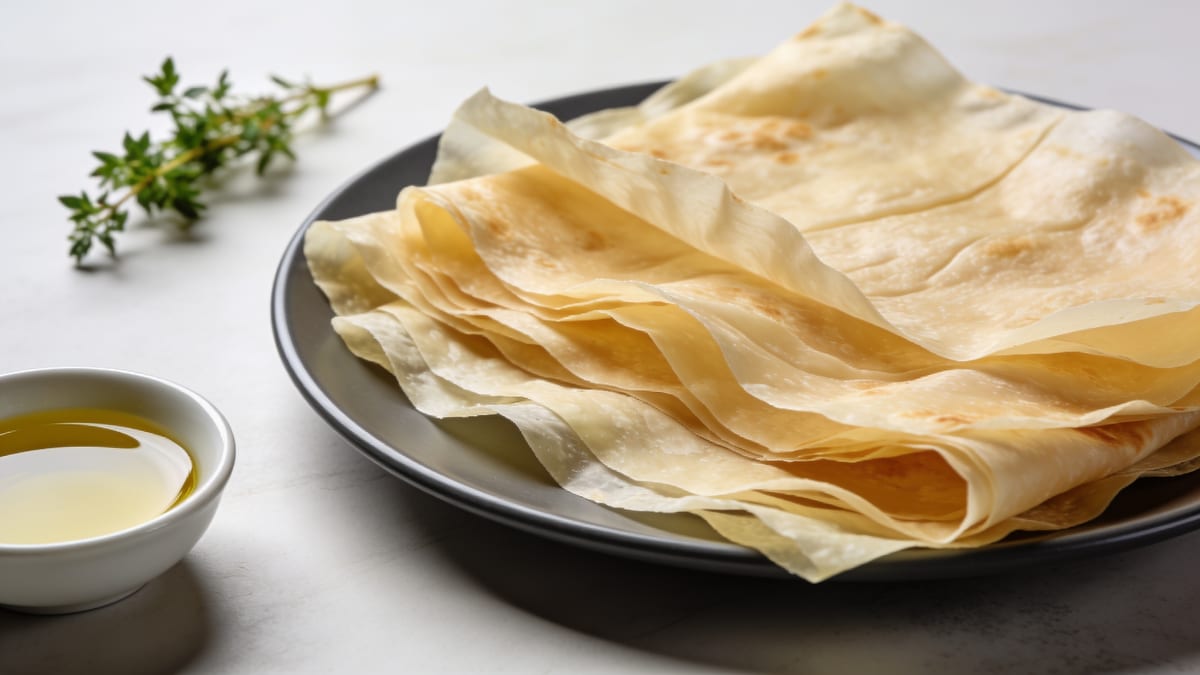
Whisk 360 g (3 cups) all-purpose flour with 1 teaspoon fine salt, then stir in 200 ml lukewarm water, 3 tablespoons olive oil, and 1 tablespoon white wine vinegar until a shaggy dough forms. Knead 10 minutes until silky and elastic, divide into 12 balls (about 50 g each), coat lightly with oil, cover, and rest 1 hour so the gluten relaxes. Working one ball at a time on a surface dusted with cornstarch, roll each into a thin disc with a slender rolling pin or dowel, re-dusting and rotating often, then drape the sheet over the pin or the backs of your hands and gently stretch until you can read text through it. Dust each finished sheet with cornstarch, stack, and keep covered with a barely damp towel until you assemble and bake your pastry.
- Do not shortcut the 1-hour rest — relaxed gluten is the only thing that lets the dough stretch paper-thin instead of springing back.
- Dust with cornstarch, not flour: it keeps sheets from gluing together in the stack without toughening them.
- Small tears are fine — layers overlap in the pan and no one will ever find the hole after baking.
Equipment
- Large mixing bowl
- Thin rolling pin or wooden dowel (about 60 cm/24 in)
- Bench scraper or sharp knife
- Fine-mesh sieve for dusting
- Clean kitchen towels
- Plastic wrap
- Kitchen scale
מצרכים
Dough
- 360 g all-purpose flour, plus a little more if the dough is sticky
- 6 g fine sea salt
- 200 ml lukewarm water, about 38°C/100°F
- 45 ml extra-virgin olive oil, plus extra for coating the dough balls
- 15 ml white wine vinegar, or fresh lemon juice
For rolling
- 60 g cornstarch, for dusting the work surface and finished sheets
אופן ההכנה
- שלב01
In a large bowl, whisk the flour and salt together, then make a well in the center. Pour in the lukewarm water, olive oil, and vinegar and stir with a fork, pulling flour in from the edges, until a shaggy dough forms with no dry pockets.
- שלב02
Turn the dough onto a lightly floured counter and knead for about 10 minutes, until it is smooth, elastic, and just barely tacky — it should spring back slowly when poked. (A stand mixer with a dough hook on medium-low takes 6 to 7 minutes.) Add flour only a teaspoon at a time if it truly sticks.
- שלב03
Divide the dough into 12 equal pieces, about 50 g each, and roll each into a tight ball. Rub the balls lightly with olive oil, set them on a tray, cover with plastic wrap, and rest at room temperature for a full hour. This rest relaxes the gluten so the sheets stretch instead of snapping back.
- שלב04
Clear the largest counter space you have and dust it generously with cornstarch through a fine-mesh sieve. Keep the sieve, the cornstarch, your thin rolling pin or dowel, and a barely damp kitchen towel within reach. Uncover only one dough ball at a time; keep the rest under wrap.
- שלב05
Flatten a ball with your palm, then roll from the center outward, rotating the dough a quarter turn after every couple of strokes and flipping it once or twice, re-dusting with cornstarch as needed. Work each piece to a thin, even round about 20 to 25 cm (8 to 10 in) across.
- שלב06
Loosely roll the disc onto the pin and roll back and forth with your palms moving outward from the center to widen it, or drape it over the backs of your floured hands and gently pull from the edges, rotating as you go. Stop when the sheet reaches roughly 30 x 40 cm (12 x 16 in) and you can read newsprint through it. Small tears don't matter.
- שלב07
Dust each finished sheet lightly with cornstarch, lay it on parchment, and stack the sheets as you go. Keep the stack covered with plastic wrap topped by a barely damp towel — the towel must not touch the dough directly or the sheets will glue together.
- שלב08
Trim the sheets to fit your pan and layer them as your recipe directs, brushing between layers with melted butter or olive oil. If you're not baking right away, wrap the stack tightly and refrigerate up to 2 days or freeze up to 3 months.
Make ahead
The kneaded dough balls can be made a day ahead: coat them with olive oil, cover tightly, and refrigerate overnight — the long, cold rest actually makes them easier to stretch. Bring them back to room temperature for about an hour before rolling, since cold dough resists stretching and tears more readily.
Storage
Stack the sheets with a light dusting of cornstarch between them, roll the stack gently in parchment, and slide it into a zip-top bag. Refrigerate for up to 2 days or freeze for up to 3 months; thaw frozen phyllo overnight in the refrigerator, still wrapped, so condensation forms on the bag rather than the dough. Baked phyllo pastries keep at room temperature, loosely covered, for 2 days.
Variations
Village-Style Thick Phyllo (Horiatiko)
For rustic Greek pites like zucchini or greens pie, divide the dough into 6 balls instead of 12 and roll each only to about 3 mm (1/8 in) thick — no stretching required. The sheets bake up sturdier and more bread-like, perfect for holding a juicy filling with just 2 to 3 layers on the bottom and top.
Whole Wheat Phyllo
Swap 180 g (1 1/2 cups) of the all-purpose flour for white whole wheat flour and add 1 to 2 extra tablespoons of water, since the bran drinks more liquid. Rest the dough 90 minutes instead of 60. The sheets won't stretch quite as thin, so stop at readable-shadow thin rather than newsprint-thin; the nutty flavor is excellent in spanakopita.
Gluten-Free Rustic Sheets
Use 360 g of a gluten-free flour blend that contains xanthan gum, increase the water to about 240 ml (1 cup), and knead just until combined. Without gluten the dough cannot be hand-stretched, so roll it between two sheets of parchment to about 2 mm — expect fewer, thicker, more crumbly-crisp layers, closer to a shortcrust pie than classic phyllo.
Serve with
Nutrition per serving
Nutrition values are estimates based on the metric measurements. Adjust as needed.
שאלות נפוצות
Why does my phyllo dough keep springing back or tearing when I stretch it?
Springing back means the gluten is still tense — the fix is time, not force. Re-ball the piece, cover it, and let it rest another 15 to 20 minutes before trying again. Tearing usually means the dough is too dry or too cold; make sure you kneaded to a supple, slightly tacky texture and that the dough is at room temperature. And remember that small tears are harmless in a layered pastry.
Can I freeze homemade phyllo dough?
Yes, and it freezes well. Dust each sheet with cornstarch, stack them, roll the stack in parchment, and seal it in a freezer bag for up to 3 months. Thaw overnight in the refrigerator without unwrapping, then let it sit at room temperature for 30 minutes before separating the sheets. You can also freeze the unrolled dough balls, oiled and wrapped, and thaw them before rolling.
How thin does homemade phyllo dough really need to be?
The traditional test is being able to read a newspaper through the sheet, but homemade phyllo dough is naturally a little sturdier than the machine-made boxed kind, and that's a feature — it handles without shredding and still bakes crisp. Aim for translucent; if a sheet stalls slightly thicker, just use one fewer layer in your pastry.
Do I need a special rolling pin to make phyllo dough?
Greek cooks use a long, thin dowel called a plasti, and it genuinely helps because you can roll the sheet around it and widen it with your palms. That said, a standard rolling pin plus hand-stretching over your knuckles works fine, and in a pinch a clean broom handle cut to length or even a straight-sided wine bottle will do the job for smaller sheets.
What's the difference between phyllo dough and puff pastry?
Phyllo dough is an unleavened, nearly fat-free dough stretched into individual tissue-thin sheets; you build flakiness yourself by brushing butter or oil between layers as you assemble. Puff pastry is a single slab with a block of butter laminated inside, so it puffs dramatically on its own in the oven. Phyllo bakes up lighter, drier, and more shattering; puff pastry is richer and breadier.
Cooked this? Rate it.
Real ratings from real cooks. We only show a score once enough of you have weighed in — no fabricated stars.