Steak Flat Iron
Flat iron steak comes from the top blade of the chuck, and it is one of the most tender cuts on the whole animal despite its bargain price — deeply beefy, evenly marbled, and shaped like a flat rectangle that sears beautifully edge to edge. A ripping-hot cast iron skillet builds a crackly brown crust while a quick garlic-thyme butter baste seasons the meat from the outside in. Because the muscle fibers run in one obvious direction, a short rest and thin slices against the grain guarantee a fork-tender bite every time.
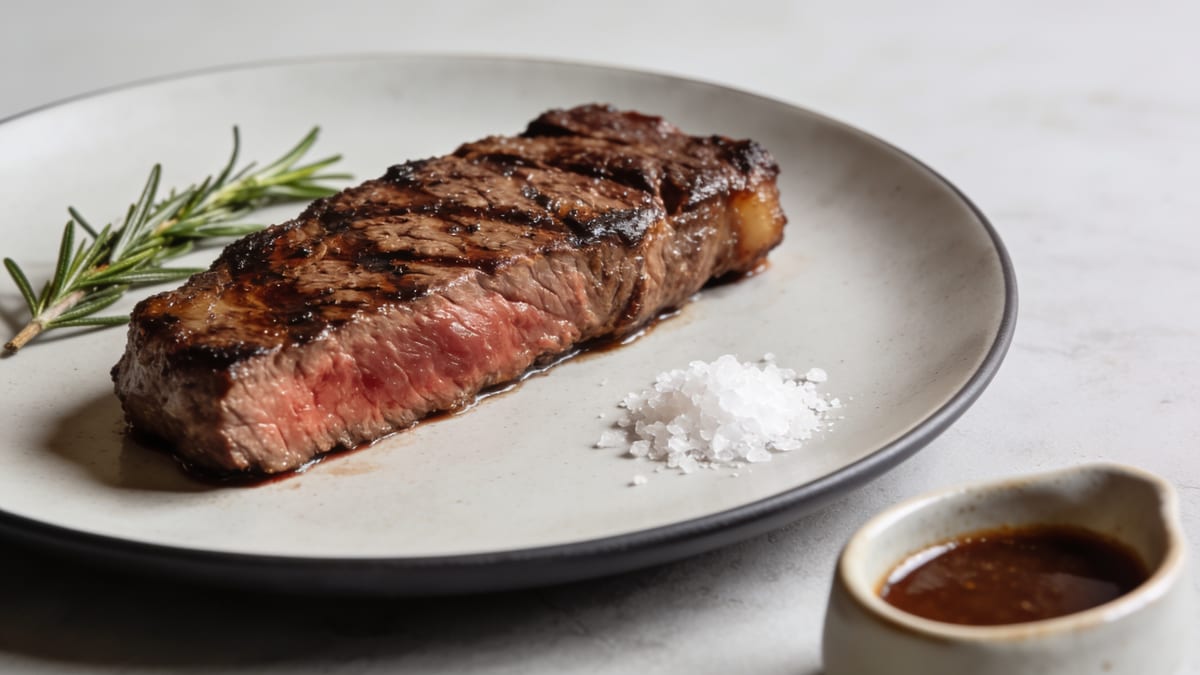
Pat two 1-pound flat iron steaks completely dry, season all over with 2 teaspoons kosher salt and 1 teaspoon black pepper, and let them sit at room temperature for 15 minutes while a cast iron skillet heats over medium-high with 1 tablespoon neutral oil. Sear the first side undisturbed for 3 to 4 minutes until deeply browned, flip and cook 2 to 3 minutes more, then add 3 tablespoons butter, 3 smashed garlic cloves, and 4 thyme sprigs and spoon the foaming butter over the steaks for 1 to 2 minutes, pulling them off the heat at 52 to 54 C (125 to 130 F) for medium-rare. Rest 10 minutes on a cutting board, then slice thinly against the grain — the fibers run lengthwise down the steak, so cut crosswise — and finish with the pan butter and a pinch of flaky salt.
- Dry the surface thoroughly and do not move the steak for the first 3 minutes — moisture and fidgeting are the two things that kill a crust.
- Pull at 52-54 C / 125-130 F on an instant-read thermometer; flat iron turns chewy and livery past medium, so err on the rare side.
- Slice thin and strictly against the grain (crosswise); this one knife decision matters more to tenderness than anything you do at the stove.
Equipment
- 12-inch (30 cm) cast iron or heavy stainless skillet
- Instant-read thermometer
- Tongs
- Large metal spoon for basting
- Cutting board with juice groove
- Sharp slicing knife
Bahan
Steak and seasoning
- 900 g flat iron steaks, two 450 g / 1 lb steaks, about 2.5 cm / 1 inch thick, silver skin removed
- 6 g kosher salt, use about half as much if using fine table salt
- 2 g freshly ground black pepper
- 15 ml neutral high-heat oil, avocado, grapeseed, or canola
Butter baste and finishing
- 42 g unsalted butter, cold, cut into pieces
- garlic cloves, smashed, skins left on
- fresh thyme sprigs, or 2 sprigs rosemary
- flaky sea salt, optional, for serving
Cara membuat
- LANGKAH01
Pat the flat iron steaks very dry with paper towels, then trim off any strip of silver skin your butcher missed — it will not render and turns rubbery. Season all sides evenly with the kosher salt and pepper. Leave the steaks on a plate at room temperature for 15 minutes so the salt starts to dissolve into the surface and the chill comes off; a steak that is not fridge-cold sears more evenly.
- LANGKAH02
Set a cast iron or heavy stainless skillet over medium-high heat and add the oil. Heat until the oil shimmers and just begins to show the first wisp of smoke, about 3 minutes. Turn on your exhaust fan — a proper sear makes some smoke, and that is normal.
- LANGKAH03
Blot the steaks dry one last time and lay them in the pan away from you, leaving space between them (sear in batches if your pan is smaller than 30 cm / 12 inches). Press down gently for the first few seconds for full contact, then do not touch them. Cook undisturbed for 3 to 4 minutes, until the underside releases easily and is deep mahogany brown.
- LANGKAH04
Flip with tongs and cook 2 to 3 minutes more. Use the tongs to hold each steak on its fat edge for 20 to 30 seconds as well, so the sides pick up color. Start checking the temperature toward the end of this step — flat iron is only about 2.5 cm thick and moves fast.
- LANGKAH05
Reduce the heat to medium and add the butter, smashed garlic, and thyme to the pan. When the butter foams, tilt the pan toward you and spoon the fragrant butter over the steaks continuously for 1 to 2 minutes. Pull the steaks when an instant-read thermometer inserted sideways into the center reads 52 to 54 C (125 to 130 F) for medium-rare, or 57 C (135 F) for medium. Do not cook flat iron past medium — the connective tissue in this cut turns chewy.
- LANGKAH06
Transfer the steaks to a cutting board, spoon a little of the garlic-thyme butter over the top, and tent loosely with foil. Rest for 10 minutes; the internal temperature will climb another 3 to 5 degrees and the juices will redistribute so they end up in the meat, not on the board.
- LANGKAH07
Look closely at the steak: the muscle fibers run in one direction down its length. Slice the steak crosswise — perpendicular to those fibers — into strips about 6 mm / 1/4 inch thick, holding the knife at a slight angle for wider slices. Fan onto plates, pour over the remaining pan butter, and finish with flaky salt.
Make ahead
Season the steaks with the salt up to 24 hours ahead and refrigerate them uncovered on a wire rack — this dry brine seasons the meat deeply and dries the surface for an even better crust. Bring the steaks out of the fridge 15 to 20 minutes before cooking. The actual searing should always happen just before serving; this is a cook-to-order cut.
Storage
Refrigerate leftover slices in an airtight container for up to 3 days. Reheat gently in a covered skillet over low heat with a splash of water or butter just until warmed through — a microwave on full power will push the meat to well-done and toughen it. Leftover flat iron is also excellent cold or at room temperature, sliced thin over salads, in tacos, or on a baguette sandwich. Freeze cooked slices up to 2 months, wrapped tightly; thaw overnight in the fridge.
Variations
Chimichurri flat iron (dairy-free)
Skip the butter baste entirely and sear in oil only. While the steak rests, stir together 60 ml / 1/4 cup olive oil, 30 ml / 2 tbsp red wine vinegar, a big handful of finely chopped parsley, 2 minced garlic cloves, 1/2 tsp dried oregano, and a pinch of red pepper flakes. Spoon over the slices. This keeps the recipe completely dairy-free and is the classic South American treatment for blade cuts.
Coffee-chile crusted
Add a dry rub of 1 tbsp finely ground coffee, 2 tsp brown sugar, 1 tsp ancho chile powder, and 1/2 tsp smoked paprika along with the salt. The sugar deepens the crust, so watch the heat and flip 30 seconds earlier — the rub browns faster than bare beef.
Grilled flat iron
Prepare a grill for direct high heat (230-260 C / 450-500 F). Oil the grates, grill 4 to 5 minutes per side to the same 52-54 C / 125-130 F pull temperature, and rest as written. Melt the garlic-thyme butter in a small pan on the cool side and pour it over the slices instead of basting.
Serve with
Nutrition per serving
Nutrition values are estimates based on the metric measurements. Adjust as needed.
Pertanyaan umum
What exactly is a flat iron steak?
Flat iron steak is cut from the top blade muscle in the chuck (shoulder) of the steer, with the tough seam of connective tissue that runs through the middle of the blade removed by the butcher. What is left is a flat, evenly thick, well-marbled steak that consistently ranks among the most tender cuts of beef — often compared to a New York strip in tenderness at a fraction of the price. It may also be labeled top blade steak, butlers' steak, or oyster blade.
What temperature should flat iron steak be cooked to?
Pull a flat iron steak off the heat at 52 to 54 C (125 to 130 F) for medium-rare or 57 C (135 F) for medium, measured with an instant-read thermometer inserted sideways into the thickest part. Carryover cooking during the 10-minute rest adds another 3 to 5 degrees. This cut is at its best rare to medium; past that, the fine connective tissue tightens and the texture turns noticeably chewy.
Do I need to marinate a flat iron steak?
No — unlike flank or skirt, flat iron is naturally tender, so a marinade is purely about flavor, not texture. Salt, pepper, and a hot pan are genuinely enough. If you want a marinade for taco or fajita-style meals, 30 minutes to 2 hours in something with oil, acid, and aromatics is plenty; longer soaks in acidic marinades can make the surface mushy.
How do I know which way the grain runs, and why does it matter?
Look at the surface of the raw or rested steak: you will see fine parallel lines of muscle fiber running lengthwise down the steak. Always slice crosswise, perpendicular to those lines, in thin strips. Cutting against the grain shortens each fiber so your teeth barely have to work; slicing with the grain makes even a perfectly cooked steak eat stringy and tough.
What can I substitute if my store does not carry flat iron steak?
Ask the butcher counter first — it is often sold as top blade steak. Failing that, hanger steak is the closest match in tenderness and beefy flavor and cooks in about the same time. Skirt or flank steak also work with this exact method, but they are thinner, so cut the sear to roughly 2 to 3 minutes per side and skip nothing on the against-the-grain slicing, which matters even more for those cuts.
Cooked this? Rate it.
Real ratings from real cooks. We only show a score once enough of you have weighed in — no fabricated stars.