Pollo alla lattina di birra (Beer Can Chicken)
A whole chicken perched upright on a half-full can of lager, coated in a sweet-smoky rub and roasted over indirect heat until the skin crackles and the meat practically falls off the bone. Standing the bird vertically exposes every inch of skin to circulating hot air, so it browns evenly while the dark meat down near the grate cooks through at the same pace as the breast. It is a low-effort showpiece: fifteen minutes of hands-on work, then the grill does the rest.
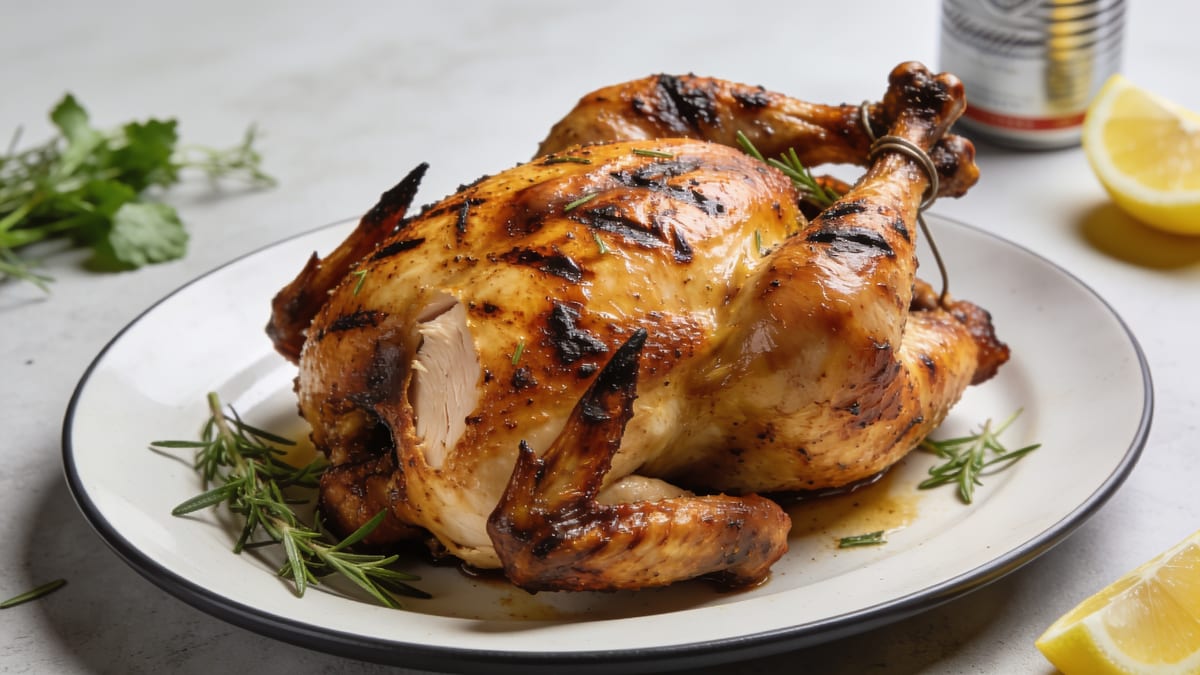
Pat a 4 lb (1.8 kg) whole chicken very dry, rub it inside and out with olive oil and a mix of brown sugar, smoked paprika, salt, pepper, garlic powder, onion powder, thyme, and cayenne, then slide it upright onto an open 12 oz can of lager that you have poured half out of. Set up a grill for indirect heat at 375°F (190°C) — burners lit on one side only, or coals banked to the sides — stand the chicken on the cool zone using its legs and the can as a tripod, close the lid, and roast 75 to 90 minutes until an instant-read thermometer hits 160°F (71°C) in the breast and 175°F (79°C) in the thigh. Rest 15 minutes, then grip the bird with tongs and a wad of paper towels to lift it off the scalding can before carving.
- Dry the skin thoroughly and use a full tablespoon of kosher salt in the rub — moisture is the enemy of crackly, mahogany skin.
- Keep the chicken over indirect heat the entire cook; direct flame under dripping fat causes flare-ups that scorch the skin before the inside cooks.
- Temp the bird, not the clock: pull at 160°F (71°C) in the thickest part of the breast and let carryover heat finish the job during the rest.
Equipment
- Gas or charcoal grill with a lid (or an oven)
- Rimmed sheet pan or shallow roasting pan
- Instant-read thermometer
- Sturdy tongs
- Small mixing bowl
- Paper towels
- Church-key or standard can opener
Ingredienti
Chicken and beer
- 1.8 kg whole chicken, giblets removed, patted very dry
- 355 ml lager or pale ale, in the can, half poured out before cooking
- 30 ml olive oil
Dry rub
- 25 g packed light brown sugar
- 7 g smoked paprika, sweet paprika works too
- 15 g kosher salt, use half if substituting fine table salt
- 4 g freshly ground black pepper
- 6 g garlic powder
- 5 g onion powder
- 1 g dried thyme
- 1 g cayenne pepper, optional, for gentle heat
Preparazione
- PASSO01
Stir the brown sugar, smoked paprika, salt, pepper, garlic powder, onion powder, thyme, and cayenne together in a small bowl, breaking up any sugar clumps with your fingers.
- PASSO02
Remove the giblets and pat the chicken bone-dry inside and out with paper towels — dry skin is what crisps. Rub the olive oil all over the bird, then massage the spice mix over the skin, inside the cavity, and under the skin of the breast where you can loosen it with a finger. Let it sit at room temperature while the grill heats.
- PASSO03
On a gas grill, light half the burners to medium and leave the others off; on charcoal, bank the lit coals to one side. Close the lid and let the temperature settle around 375°F (190°C). Oven method: heat to 375°F (190°C) and set a rack in the lower third so the upright bird clears the top.
- PASSO04
Open the beer, pour out (or drink) half, and punch one or two extra holes in the top with a can opener so steam can escape. Set the can on a rimmed sheet pan and lower the chicken cavity over it until the bird sits upright, legs forward like a tripod. Tuck the wing tips behind the shoulders so they don't scorch.
- PASSO05
Carry the pan to the grill and stand the chicken on the cool side, rotating it 180 degrees halfway through so both sides face the heat evenly. Keep the lid closed and the temperature near 375°F (190°C). Start checking at 65 minutes: the skin should be deep mahogany and the juices should run clear.
- PASSO06
Insert an instant-read thermometer horizontally into the thickest part of the breast without touching bone — you want 160°F (71°C) there and at least 175°F (79°C) in the inner thigh. If the thigh lags, give it another 10 minutes; if the skin darkens too fast, tent loosely with foil.
- PASSO07
Move the whole setup to a heatproof surface and rest 15 minutes; carryover heat will bring the breast to a safe 165°F (74°C). The can and the liquid inside are scalding — grip the bird with tongs and a thick wad of paper towels, twist gently, and lift it straight up off the can. Carve into quarters and serve.
Make ahead
Season the chicken with the rub up to 24 hours ahead and refrigerate it uncovered on a rack-set sheet pan — this works like a dry brine, seasoning the meat deeply and drying the skin for better browning. Mix the rub itself up to a month ahead and store it in a sealed jar. Take the bird out of the fridge 30 minutes before it goes on the grill so it cooks evenly.
Storage
Refrigerate carved meat in an airtight container within 2 hours; it keeps 3 to 4 days. Reheat gently, covered, in a 300°F (150°C) oven with a splash of stock so the breast doesn't dry out, or eat it cold in sandwiches and salads. Freeze picked meat for up to 3 months; the crisp skin does not survive freezing, so plan to use frozen leftovers in soups, tacos, or fried rice.
Variations
Gluten-free (no beer at all)
Swap the lager for a half-full can of lemon-lime soda, ginger ale, or even a soda can filled halfway with chicken stock and a squeeze of lemon. The upright-roasting geometry, not the beer itself, does most of the work, so the results are nearly identical — and the dish becomes safely gluten-free.
Oven roasted
No grill, no problem. Set the mounted chicken on a sheet pan in the lower third of a 375°F (190°C) oven and roast 75 to 90 minutes to the same target temperatures. Scatter halved baby potatoes and onion wedges around the pan to roast in the drippings.
Barbecue glazed
Drop the brown sugar in the rub to 1 tablespoon, then brush the bird with 120 ml (1/2 cup) of your favorite barbecue sauce during the last 10 minutes on the grill. The sauce sets into a sticky, lacquered crust — watch closely, since the sugars can burn fast.
Serve with
Nutrition per serving
Nutrition values are estimates based on the metric measurements. Adjust as needed.
Domande frequenti
Does the beer actually flavor the meat?
Less than the name suggests. Tests by many cooks have shown the beer barely simmers inside the cavity, so only a whisper of malty aroma reaches the meat. The real advantage of beer can chicken is the geometry: the bird roasts vertically, so hot air circulates around all of the skin and the legs sit closest to the heat, which lets dark and white meat finish together. That is also why soda or stock in the can works nearly as well.
What kind of beer should I use?
An inexpensive lager or pale ale is ideal — this is not the place for your best bottle. Avoid heavily hopped IPAs, which can turn faintly bitter as they steam, and skip glass bottles entirely since they can crack from the heat. Whatever you choose, pour out half the can first; a full can can bubble over into the fire, and the extra headspace lets steam escape safely.
Can I make beer can chicken in the oven instead of on a grill?
Yes, and it is arguably more consistent. Stand the mounted bird on a rimmed sheet pan in the lower third of a 375°F (190°C) oven and roast 75 to 90 minutes, until the breast reads 160°F (71°C) and the thigh 175°F (79°C). Measure your oven first — most whole chickens standing on a can need about 40 cm (16 inches) of clearance, so remove the upper racks.
How do I keep the chicken from tipping over?
Position the legs pointing forward and slightly apart so they form a tripod with the can, and always set the can on a rimmed sheet pan rather than directly on the grates — the pan catches drippings, prevents flare-ups, and gives you a stable base to carry. If your bird is on the small side and sits loosely, a purpose-made vertical roaster stand is a cheap, sturdier substitute for the can.
How do I get the chicken off the can without burning myself?
Rest the bird a full 15 minutes first — the can and the liquid inside stay scalding long after the cook. Then hold the can steady with tongs, grip the chicken through a thick wad of paper towels or wear heatproof gloves, twist gently to break the seal, and lift straight up. Do this over the sheet pan so any hot liquid that sloshes out lands safely.
Cooked this? Rate it.
Real ratings from real cooks. We only show a score once enough of you have weighed in — no fabricated stars.