오븐에 구운 버터넛 스쿼시
Cubes of butternut squash tossed with olive oil and roasted hot until the edges caramelize into a deep amber crust while the centers turn silky and sweet. A 220°C (425°F) oven and a single, uncrowded layer are what turn the squash's natural sugars into real browning instead of steam — no glaze required, though a drizzle of maple at the end never hurts.
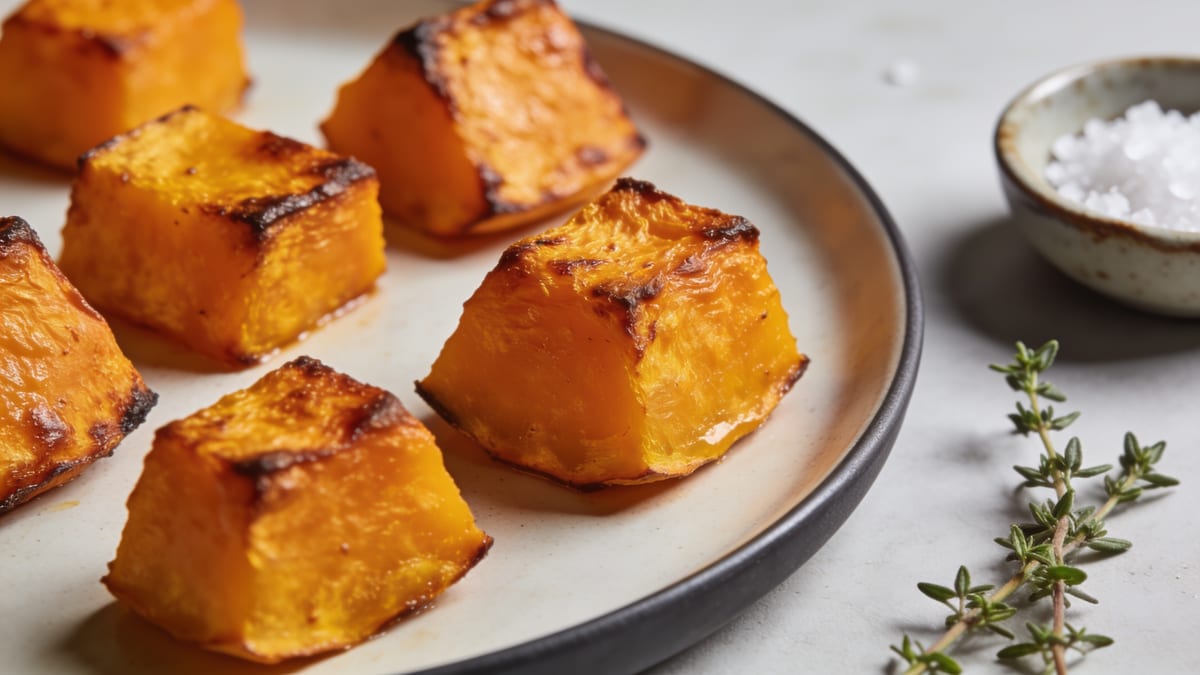
Heat the oven to 220°C (425°F) with a rack in the center. Peel a 900 g (2 lb) butternut squash with a sturdy Y-peeler, halve it lengthwise, scoop out the seeds, and cut it into 2.5 cm (1-inch) cubes. Toss the cubes on a rimmed baking sheet with 30 ml (2 tbsp) olive oil, 3/4 tsp kosher salt, 1/2 tsp black pepper, and 3/4 tsp garlic powder, then spread them into a single layer with a little space between pieces. Roast 15 minutes undisturbed, flip with a thin metal spatula, and roast another 10 to 15 minutes until the edges are deeply browned and a fork slides in with no resistance. Finish with fresh thyme, flaky salt, and an optional drizzle of maple syrup.
- Roast hot — 220°C (425°F) — so the squash caramelizes before it turns mushy; lower temperatures steam it soft and pale.
- Give the cubes room: use a full-size rimmed sheet pan and one layer. Crowded squash releases steam and never browns.
- Flip only once, at the 15-minute mark. Uninterrupted contact with the hot pan is what builds that dark, sweet crust.
Equipment
- Rimmed half-sheet baking pan
- Sharp chef's knife
- Sturdy Y-shaped vegetable peeler
- Large cutting board
- Soup spoon (for scooping seeds)
- Thin metal spatula
- Large mixing bowl (optional, for tossing)
재료
Squash
- medium butternut squash, about 900 g / 2 lb; peeled, seeded, cut into 2.5 cm (1-inch) cubes
Seasonings
- 30 ml extra-virgin olive oil
- 4 g kosher salt, or 1/2 tsp fine sea salt
- 1 g freshly ground black pepper
- 2 g garlic powder, optional but recommended for a savory edge
To finish (optional)
- 2 g fresh thyme leaves, or 1 tbsp chopped flat-leaf parsley
- 15 ml pure maple syrup, for a sweet-savory finish
- 1 g flaky sea salt, for sprinkling at the table
조리법
- 단계01
Set a rack in the center of the oven and heat it to 220°C (425°F). Have a rimmed half-sheet pan ready — bare metal browns better than parchment here, but parchment is fine if you want easier cleanup.
- 단계02
Slice 1 cm off the stem and blossom ends so the squash sits flat. Peel it with a sturdy Y-peeler, taking a second pass anywhere you still see pale green streaks under the skin. Cut the squash crosswise where the narrow neck meets the round bulb, then halve the bulb and scoop out the seeds and strings with a soup spoon.
- 단계03
Cut each piece into 2.5 cm (1-inch) slabs, then sticks, then cubes, keeping them as uniform as you can — even pieces cook at the same rate, so nothing burns while its neighbors stay firm. If the raw squash feels wet, pat the cubes dry with a kitchen towel; surface moisture is the enemy of browning.
- 단계04
Pile the cubes onto the sheet pan (or into a large bowl), add the olive oil, kosher salt, pepper, and garlic powder, and toss until every piece glistens. Spread the cubes into a single layer with a little space between them, turning as many as possible onto a flat cut side. If they don't fit with breathing room, split them between two pans.
- 단계05
Roast for 15 minutes without opening the oven or stirring. The undersides need sustained contact with the hot pan to develop a deep golden crust.
- 단계06
Slide a thin metal spatula under the cubes and flip them — they should release easily once browned. Roast another 10 to 15 minutes, until the edges are caramelized to a deep amber and a fork slides into the largest piece with no resistance.
- 단계07
Taste a cube and adjust the salt. Scatter over the thyme, add a small drizzle of maple syrup if you like a sweet-savory finish, and sprinkle with flaky salt. Serve hot, straight from the pan.
Make ahead
You can peel, seed, and cube the squash up to 3 days ahead; store the raw cubes in an airtight container in the fridge and pat them dry before seasoning. Fully roasted squash can be made a day ahead, cooled, refrigerated, and re-crisped on a hot sheet pan for 5 to 8 minutes just before serving.
Storage
Refrigerate leftovers in an airtight container for up to 4 days. Re-crisp in a 220°C (425°F) oven or an air fryer at 200°C (400°F) for 5 to 8 minutes — the microwave works but leaves the cubes soft. Freezing is possible for up to 3 months, but the texture turns mushy on thawing, so save frozen leftovers for soups, purees, or mashed squash rather than serving them as-is.
Variations
Maple-Cinnamon
Toss the cubes with 30 ml (2 tbsp) maple syrup, 1/2 tsp ground cinnamon, and a pinch of cayenne along with the oil and salt before roasting. The syrup deepens the caramelization, so check a few minutes early and pull the pan once the edges are dark amber rather than blackened.
Garlic-Herb Parmesan
Skip the maple finish. In the last 5 minutes of roasting, sprinkle the squash with 25 g (1/4 cup) finely grated Parmesan and return it to the oven until the cheese melts into a savory crust. This version is vegetarian but no longer vegan or dairy-free — swap in 2 tbsp nutritional yeast to keep it plant-based.
Chili-Lime
Add 1 tsp chili powder and 1/2 tsp ground cumin with the seasonings, then finish the roasted squash with a squeeze of fresh lime juice and chopped cilantro. Excellent tucked into tacos or grain bowls.
Serve with
Nutrition per serving
Nutrition values are estimates based on the metric measurements. Adjust as needed.
자주 묻는 질문
Do I have to peel butternut squash before roasting?
No — the skin is edible and turns tender in the oven, so if you're short on time you can scrub the squash well and roast it skin-on. That said, most people prefer roasted butternut squash peeled: the skin can be papery on larger, older squash, and peeled cubes caramelize more evenly on all sides. If you do peel, take a second pass anywhere you still see greenish streaks, since that layer stays fibrous.
Why did my squash come out mushy and pale instead of caramelized?
Almost always one of three things: the oven was too cool, the pan was too crowded, or the cubes went in wet. Roasted butternut squash needs high heat — 220°C (425°F) — and a single layer with space between pieces so moisture can escape as steam. If cubes touch each other wall-to-wall, they boil in their own vapor. Patting the raw cubes dry and resisting the urge to stir constantly both make a noticeable difference.
Can I use pre-cut butternut squash from the grocery store?
Yes, and it saves the hardest 10 minutes of the recipe. Two adjustments: pat the pieces very dry, since bagged squash tends to be damp, and check the cube size — pre-cut squash is often smaller than 2.5 cm, so start checking for doneness around the 20-minute mark. You'll need roughly 700 to 750 g (about 5 cups) of cubes to match one medium squash.
What's the safest way to cut a whole butternut squash?
Stabilize it first: slice off both ends so it sits flat, and always cut with the flat side down. A sharp chef's knife is safer than a dull one because it won't skate off the hard flesh. If the squash is very hard, microwave it whole for 2 to 3 minutes (poke a few holes in the skin first) to soften it just enough for the knife to pass through easily.
How do I know when roasted butternut squash is done?
Two checks: a fork or paring knife should slide into the largest cube with no resistance, and the edges — especially the sides touching the pan — should be a deep golden-amber. If the squash is tender but still pale, leave it another 3 to 5 minutes; the flavor payoff is in that browning, where the natural sugars concentrate and caramelize.
Cooked this? Rate it.
Real ratings from real cooks. We only show a score once enough of you have weighed in — no fabricated stars.