Bolo Angel Food
Angel food cake is the tall, snow-white American classic made from nothing but whipped egg whites, sugar, cake flour, and a whisper of vanilla — no butter, no oil, no yolks. The crumb is impossibly light and springy, like a sweet cloud with a delicate golden crust. Whipping the whites only to soft, glossy peaks and folding in triple-sifted flour keeps the batter stretchy enough to rise dramatically in an ungreased tube pan, then cooling the cake upside down locks in every bit of that height.
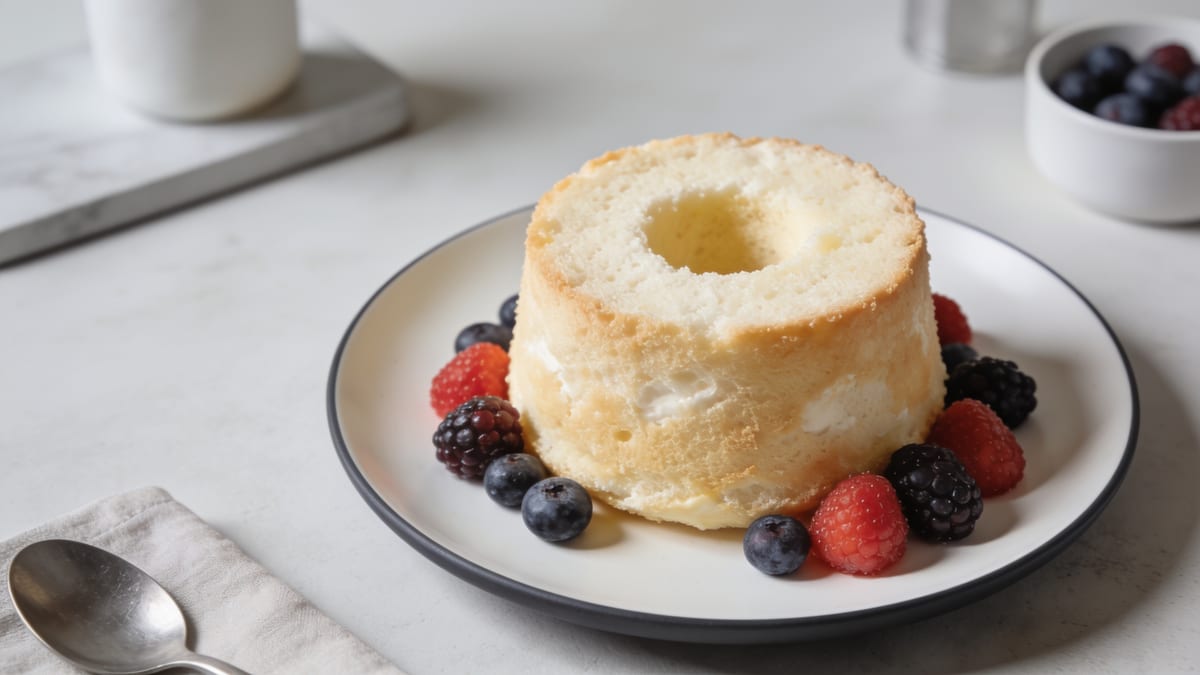
Heat the oven to 165°C (325°F) with a rack in the lower third and set out an ungreased 25 cm (10-inch) two-piece tube pan. Grind 300 g (1 1/2 cups) sugar superfine in a food processor, then sift half of it three times with 110 g (1 cup) cake flour and 1/4 tsp salt. Whip 12 room-temperature egg whites with 1 1/2 tsp cream of tartar to soft peaks, rain in the remaining sugar a spoonful at a time, and whip just until the peaks are soft, glossy, and droop at the tip; beat in the vanilla. Sift the flour mixture over the whites in four additions, folding gently after each, then scrape the batter into the pan, run a knife through it to pop air pockets, and bake 38-42 minutes until the top springs back and the cracks feel dry. Immediately invert the pan over a bottle and cool completely, about 2 hours, before loosening with a thin knife and slicing with a serrated blade.
- Stop whipping at soft, glossy peaks that flop over at the tip — stiff, dry whites can't stretch in the oven and the cake will be dense or collapse.
- Never grease the pan: the batter has to grip the walls to climb, and the cake must cool fully upside down or it will sink under its own weight.
- Grind the sugar superfine and triple-sift the flour so both dissolve into the foam instead of deflating it.
Equipment
- 25 cm (10-inch) two-piece tube pan, ungreased
- Stand mixer or electric hand mixer with whisk attachment
- Food processor or blender (to grind the sugar superfine)
- Fine-mesh sieve or sifter
- Large flexible spatula
- Sturdy bottle or wire rack for inverted cooling
- Long serrated knife
Ingredientes
Flour base
- 110 g cake flour, or 90 g all-purpose flour whisked with 20 g cornstarch
- 150 g granulated sugar, ground superfine, half of the total sugar; pulse all 300 g in a food processor for 1 minute
- 1.5 g fine sea salt
Meringue
- large egg whites, at room temperature, about 420 ml / 1 3/4 cups; separate cleanly, no trace of yolk
- 5 g cream of tartar
- 150 g granulated sugar, ground superfine, the remaining half of the sugar
- 7 ml vanilla extract
- 1 ml almond extract, optional, for the classic bakery flavor
Modo de preparo
- ETAPA01
Heat the oven to 165°C (325°F) with a rack in the lower third. Set out a 25 cm (10-inch) two-piece tube pan and leave it completely ungreased — the batter needs bare metal to climb. Pulse all 300 g (1 1/2 cups) of granulated sugar in a food processor for about 1 minute until superfine; it will dissolve into the egg whites far more easily.
- ETAPA02
Whisk the cake flour, salt, and 150 g (3/4 cup) of the superfine sugar together, then sift the mixture three times onto a sheet of parchment. This aerates the flour so it can be folded into the meringue in feather-light layers instead of clumping and knocking out air.
- ETAPA03
In a scrupulously clean, grease-free mixer bowl, beat the egg whites on medium until foamy, about 1 minute. Add the cream of tartar and continue on medium-high until soft peaks form. With the mixer running, add the remaining 150 g (3/4 cup) sugar one spoonful at a time, then whip just until the meringue is thick, glossy, and forms peaks that gently droop at the tip. Beat in the vanilla and almond extract for a few seconds. Do not take it to stiff peaks — a slightly soft meringue still has room to expand in the oven.
- ETAPA04
Sift one-quarter of the flour mixture over the meringue and fold it in with a large spatula, cutting down the center and sweeping up the sides while rotating the bowl. Repeat in three more additions, folding only until no dry streaks remain. Work with a light hand; every extra stroke costs you height.
- ETAPA05
Gently scrape the batter into the ungreased tube pan and smooth the top. Run a table knife through the batter in a zigzag to burst any large air pockets. Bake for 38-42 minutes, until the top is deep golden, springs back when pressed, and the cracks on the surface look and feel dry. Avoid opening the oven during the first 30 minutes.
- ETAPA06
The moment the pan comes out of the oven, invert it over the neck of a sturdy bottle (or onto its own feet, if it has them) and let the cake hang until completely cool, about 2 hours. Gravity holds the delicate crumb stretched open while it sets; cooling right-side up will compress the cake into a gummy layer.
- ETAPA07
Run a long, thin knife around the outer wall and center tube, pressing against the pan so you don't tear the crust. Lift out the insert, run the knife under the base, and invert the cake onto a platter. Slice with a serrated knife using a gentle sawing motion — pressing straight down squashes the crumb.
Make ahead
Angel food cake is a great day-ahead dessert: bake it, cool it fully upside down, then keep it covered at room temperature and slice just before serving. You can also separate the eggs up to 2 days ahead — store the whites covered in the fridge and bring them fully to room temperature (about 30 minutes on the counter) before whipping, since warm whites whip faster and higher.
Storage
Store the cake in an airtight container or under a cake dome at room temperature for up to 2 days, or refrigerate for up to 5 days (bring slices back to room temperature before serving, as chilling firms the crumb). For longer keeping, wrap individual slices tightly in plastic, then foil, and freeze for up to 3 months; thaw at room temperature for about an hour.
Variations
Lemon angel food cake
Skip the almond extract and fold 1 tablespoon of finely grated lemon zest into the finished batter along with 1 teaspoon of lemon juice added with the vanilla. Serve with lemon curd for a double hit of citrus.
Cocoa-marbled angel food
Sift 20 g (1/4 cup) unsweetened cocoa powder with a quarter of the flour mixture and fold it into one-third of the batter. Alternate scoops of white and chocolate batter in the pan and swirl once with a knife before baking as directed.
Gluten-free swap
Replace the cake flour with 80 g (2/3 cup) fine white rice flour whisked with 30 g (1/4 cup) cornstarch, sifted three times as directed. The structure comes mostly from the egg whites, so this is one of the most forgiving cakes to make gluten-free — just fold especially gently.
Serve with
Nutrition per serving
Nutrition values are estimates based on the metric measurements. Adjust as needed.
Perguntas frequentes
Why did my angel food cake shrink or collapse?
The three usual culprits are a greased pan, overwhipped whites, and skipping the upside-down cool. The batter must cling to bare metal to climb, so never grease or line the pan. Whites whipped to stiff, dry peaks have no elasticity left and tear apart as the cake rises. And the cake must hang inverted until completely cool — its structure is mostly air and egg protein, and it will compress under its own weight if cooled upright or removed from the pan warm.
Can I make this angel food cake recipe without cream of tartar?
Yes. Cream of tartar is an acid that stabilizes the foam and keeps the crumb bright white, but you can substitute 1 tablespoon of fresh lemon juice or white vinegar, added at the same foamy stage. The meringue will take slightly longer to build and the crumb may be a shade creamier in color, but the cake works. Don't omit the acid entirely — the meringue will be noticeably less stable.
Do I really need cake flour?
Cake flour's low protein keeps the crumb tender, but there's an easy pantry fix: whisk 90 g (3/4 cup) all-purpose flour with 20 g (2 1/2 tablespoons) cornstarch and sift the blend three times. Straight all-purpose flour alone makes a noticeably chewier, tighter cake, so the cornstarch dilution is worth the extra minute.
Can I use carton egg whites for angel food cake?
Check the label first. Many pasteurized carton whites are heat-treated in a way that prevents them from whipping to a stable foam, and a few brands say outright that they won't work for meringue. Fresh whites separated from whole eggs are the reliable choice for an angel food cake recipe, and they whip highest at room temperature. Cold eggs separate more cleanly, so separate them straight from the fridge, then let the whites warm up for 30 minutes.
What should I do with the 12 leftover egg yolks?
Treat them as an ingredient, not a byproduct: a dozen yolks is exactly what you need for a batch of crème brûlée, pastry cream, lemon curd, or rich vanilla ice cream base. They also keep for 2 days in the fridge covered with a thin layer of water in a sealed container, or you can whisk them with a pinch of salt and freeze them for up to 3 months.
Cooked this? Rate it.
Real ratings from real cooks. We only show a score once enough of you have weighed in — no fabricated stars.