Homemade Mascarpone Cheese
Mascarpone is Italy's silkiest fresh cheese — a thick, spoonable cream with a gentle sweetness and none of cream cheese's tang. This version needs just heavy cream and a squeeze of lemon juice: warming the cream to 85°C lets the acid tighten its proteins into a lush, velvety curd, and an overnight drain through cheesecloth turns it dense enough to hold a peak. It costs a fraction of store-bought and tastes noticeably fresher in tiramisu, frostings, or simply spooned over berries.
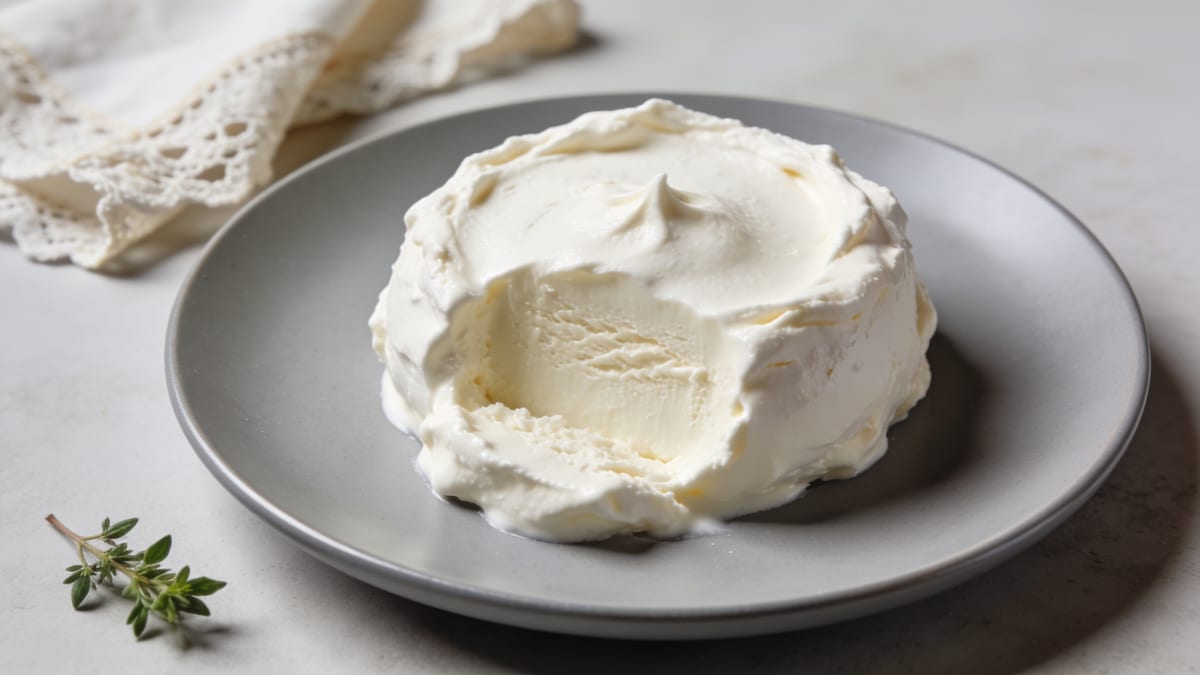
Pour 960 ml (4 cups) of heavy cream into a heavy-bottomed saucepan and warm it over medium-low heat, stirring often, until it reaches 85°C (185°F) — about 12 minutes, with small bubbles at the edges but no boil. Stir in 30 ml (2 tablespoons) of fresh lemon juice and hold the cream at 82–85°C for 3 minutes, stirring gently, until it thickens enough to coat the back of a spoon like custard; it will not form obvious curds, and that is correct. Take the pan off the heat, let it cool at room temperature for about 40 minutes, then pour it into a fine-mesh sieve lined with four layers of cheesecloth set over a bowl. Cover and refrigerate 12 hours (up to 24 for a firmer cheese), then scrape the thick mascarpone off the cloth, whisk it smooth, and store it airtight in the fridge for up to 5 days.
- Use pasteurized — not ultra-pasteurized (UHT) — heavy cream with at least 36% fat; UHT cream sets poorly and drains into a thin, grainy mass.
- Trust the thermometer, not your eyes: the cream only thickens slightly at 85°C. The real transformation happens overnight in the cheesecloth.
- Drain longer for firmer cheese — 12 hours gives a soft, spoonable mascarpone for desserts; 24 hours gives a dense, sliceable one for frostings.
Equipment
- Heavy-bottomed saucepan (2-quart or larger)
- Instant-read or candy thermometer
- Fine-mesh sieve
- Cheesecloth (butter muslin or 4 layers of standard grade)
- Medium mixing bowl
- Silicone spatula or wooden spoon
Ingredientes
Mascarpone
- 960 ml heavy cream (36–40% fat, pasteurized, not UHT), avoid ultra-pasteurized; it resists setting
- 30 ml fresh lemon juice, strained, from about 1 lemon
- 0.5 g fine sea salt, optional, rounds out the flavor
Preparação
- PASSO01
Pour the cream into a heavy-bottomed saucepan and set it over medium-low heat. Stir often with a silicone spatula, scraping the bottom so nothing scorches, until a thermometer reads 85°C (185°F). Small bubbles should ring the edge of the pan, but the cream must never reach a rolling boil — boiling makes the finished cheese grainy.
- PASSO02
Stir in the strained lemon juice. Keep the cream between 82°C and 85°C (180–185°F) and stir gently but constantly for 3 minutes, lowering the heat as needed. The cream will thicken just enough to coat the back of a spoon, like a thin custard. Do not expect chunky curds — mascarpone sets as one smooth mass, not like ricotta.
- PASSO03
Remove the pan from the heat and let the cream sit, uncovered, at room temperature until it is warm rather than hot, about 40 minutes. It will continue to thicken slightly as it cools. Meanwhile, line a fine-mesh sieve with four layers of cheesecloth and set it over a bowl deep enough that the sieve sits well above the bottom.
- PASSO04
Pour the cooled cream into the lined sieve. Do not press or stir it — gravity does the work. Loosely fold the overhanging cheesecloth over the top, or cover the whole setup with plastic wrap, to keep fridge odors out.
- PASSO05
Refrigerate the entire sieve-and-bowl setup for at least 12 hours. A few tablespoons of watery whey will collect in the bowl and the cream will set into a thick, velvety cheese. For a firmer mascarpone — better for piped frostings or stabilizing whipped cream — drain up to 24 hours.
- PASSO06
Scrape the mascarpone off the cheesecloth into a clean bowl and whisk for about 30 seconds until completely smooth and glossy. Taste and stir in the salt if using. Pack into an airtight container, press a piece of parchment or plastic wrap onto the surface, and refrigerate. Use within 5 days.
Make ahead
Mascarpone is a natural make-ahead project: cook the cream in the evening, let it drain overnight, and it is ready by the next afternoon. For tiramisu or frosting, make it 1 to 2 days before assembling — a full day of extra chilling firms it slightly and makes it easier to fold without overworking. Whisk briefly before using to restore its glossy texture.
Storage
Keep homemade mascarpone in an airtight container in the coldest part of the refrigerator for up to 5 days, with parchment or plastic wrap pressed against the surface to prevent a skin. If a little whey pools on top, simply stir it back in. Freezing is not recommended for spreading or frosting — the emulsion breaks and turns grainy on thawing — though frozen-then-thawed mascarpone still works fine whisked into cooked sauces or baked goods.
Variations
Classic Tartaric-Acid Mascarpone
Traditional Lombard mascarpone uses tartaric acid instead of lemon. Dissolve 1/4 teaspoon (about 1 g) powdered tartaric acid (cream of tartar's stronger cousin, sold for winemaking) in 1 tablespoon warm water and stir it into the 85°C cream in place of the lemon juice. The flavor is even more neutral, with zero citrus note — ideal for delicate desserts.
Lactose-Free Mascarpone
Use 960 ml (4 cups) of lactose-free whipping cream with at least 35% fat. The acid coagulation works exactly the same way since it targets proteins, not lactose. Hold, cool, and drain as written; the result is marginally sweeter because the lactose is already split into simpler sugars.
Honey-Vanilla Whipped Mascarpone
Turn the finished cheese into an instant dessert topping: whisk 225 g (1 cup) mascarpone with 2 tablespoons honey, 1/2 teaspoon vanilla extract, and 60 ml (1/4 cup) cold heavy cream until soft peaks form. Spoon over grilled peaches, waffles, or fruit crostata.
Serve with
Nutrition per serving
Nutrition values are estimates based on the metric measurements. Adjust as needed.
Perguntas frequentes
Why didn't my mascarpone cheese thicken?
The usual culprit is ultra-pasteurized (UHT) cream, whose proteins have been heat-damaged and no longer coagulate well with acid. Check the carton for 'pasteurized' rather than 'ultra-pasteurized.' The other common issues are not actually reaching 85°C (185°F) — an accurate thermometer matters more than timing — and cutting the drain short. Remember that the hot cream only thickens to a custard consistency on the stove; the firm texture develops during the 12-hour refrigerated drain.
What's the difference between mascarpone cheese and cream cheese?
Mascarpone is made from pure cream (36–40% fat) coagulated with a mild acid, so it lands around 44% butterfat with a sweet, milky flavor and a texture like softly whipped butter. American cream cheese is made from a milk-and-cream blend, cultured for tang, and stabilized with gums, giving it roughly 33% fat and a noticeably sour edge. They are not interchangeable in tiramisu — cream cheese's tang and stiffness change the dessert's character.
Can I use bottled lemon juice or vinegar instead of fresh lemon?
Yes to both, with small trade-offs. Bottled lemon juice works because its acidity is standardized, though it can leave a faintly processed note. White vinegar or white wine vinegar (the same 30 ml / 2 tablespoons) coagulates just as reliably and its sharpness mostly drains away with the whey. For the most neutral, traditional flavor, use tartaric acid as described in the variations.
How long does homemade mascarpone cheese last, and can I freeze it?
Because it has no preservatives or stabilizers, homemade mascarpone cheese keeps about 5 days refrigerated in an airtight container. Freezing causes the delicate fat-and-protein emulsion to separate, so thawed mascarpone turns grainy — fine for stirring into a hot pasta sauce or a batter, but not for frosting or tiramisu. Make it fresh within a day or two of when you plan to use it.
My finished mascarpone looks slightly grainy — can I fix it?
Usually, yes. Fine graininess almost always comes from overheating (a hard boil) or from over-acidifying the cream. Whisk the cheese vigorously for a minute, or press it through a fine-mesh sieve with a spatula, and it will typically smooth right out. To prevent it next time, hold the cream at 82–85°C rather than letting it climb, and measure the lemon juice precisely.
Cooked this? Rate it.
Real ratings from real cooks. We only show a score once enough of you have weighed in — no fabricated stars.