Olivier Salad (Russian Potato Salad)
Olivier is the Russian potato salad that anchors every New Year's table: a creamy, tangy mosaic of pea-sized potatoes, carrots, eggs, ham, dill pickles, and sweet green peas folded into mustard-spiked mayonnaise. Boiling the potatoes and carrots whole in their skins keeps them firm and unwaterlogged, so every cube stays distinct instead of collapsing into mash. A short chill lets the pickle brine and dill pull the whole bowl together.
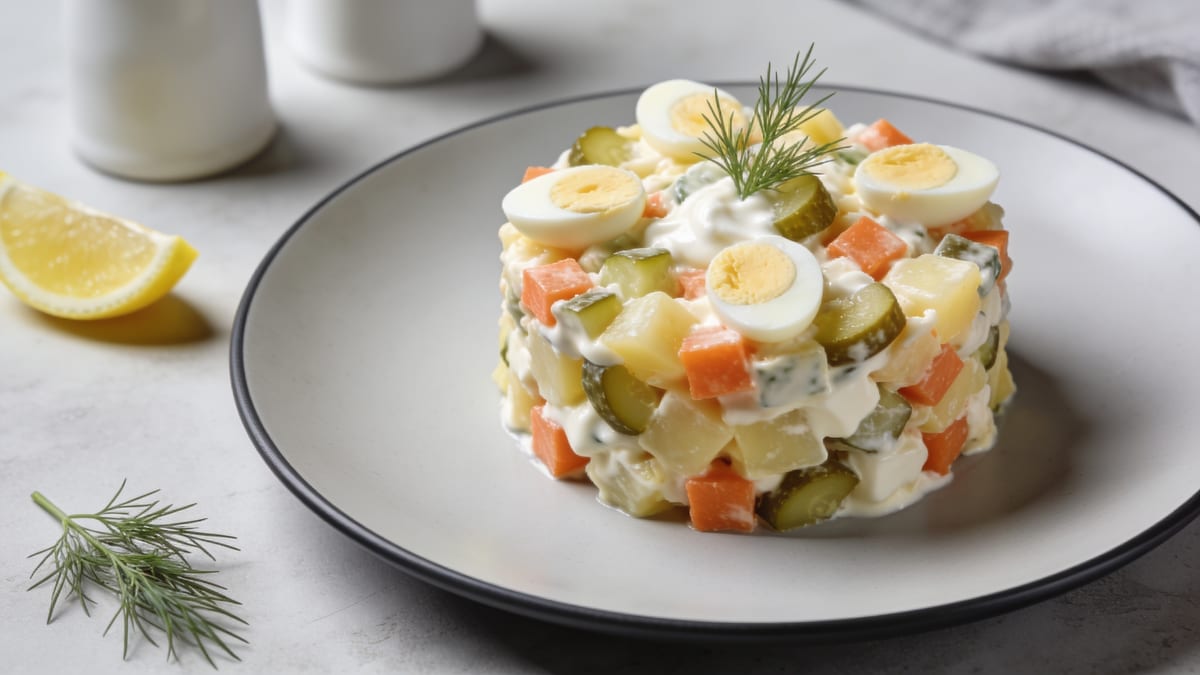
Simmer 700 g whole, unpeeled waxy potatoes and 250 g whole carrots in salted water until just knife-tender (about 20-25 minutes), and hard-boil 4 eggs for 10 minutes; cool everything completely, then peel and dice all of it to the size of a pea, along with 300 g ham or bologna and 200 g patted-dry dill pickles. Fold in 240 g drained canned peas, 3 finely chopped scallions, and fresh dill, then dress with 200 g mayonnaise whisked with 1 tsp mustard and 1 tbsp pickle brine. Season with salt and pepper, chill at least 1 hour, and taste again before serving — cold food needs a touch more salt.
- Boil potatoes and carrots whole in their skins so they stay firm and never get watery — peel only after cooling.
- Cut everything to a uniform pea-sized dice; matching the peas is what gives Olivier its signature texture.
- Pat the pickles dry and dress only after the vegetables are fully cold, or the salad turns loose and soupy.
Equipment
- Large pot
- Medium saucepan
- Colander
- Cutting board
- Chef's knife
- Large mixing bowl
- Flexible spatula
Nguyên liệu
Salad
- 700 g Yukon Gold or other waxy potatoes, whole and unpeeled, about 4 medium; waxy potatoes hold their dice
- 250 g carrots, whole and unpeeled, about 3 medium
- large eggs
- 300 g thick-cut ham or doctor's-style bologna, buy a single thick slab, not thin slices; check the label if you need it gluten-free
- 200 g dill pickles, about 5 medium brined pickles, patted very dry
- 240 g canned green peas, drained, from one 400 g / 15 oz can
- 40 g scallions, finely chopped, about 3; or 1/2 small sweet onion
- 10 g fresh dill, chopped, plus more for serving
Dressing
- 200 g full-fat mayonnaise
- 5 g Dijon or spicy Russian mustard, optional but recommended
- 15 ml pickle brine, straight from the pickle jar
- 3 g fine salt, plus more to taste
- 1 g freshly ground black pepper
Cách làm
- BƯỚC01
Put the unpeeled potatoes and carrots in a large pot, cover with cold water by 3 cm (1 inch), and add a big pinch of salt. Bring to a boil, then reduce to a gentle simmer. Pull the carrots when a knife slides in with slight resistance, about 20 minutes, and the potatoes when just knife-tender, 20-25 minutes. Do not let them get mushy — they should still feel firm at the center.
- BƯỚC02
While the vegetables simmer, lower the eggs into boiling water in a medium saucepan and cook for 10 minutes. Transfer immediately to a bowl of ice water so the yolks stay bright and the shells slip off cleanly.
- BƯỚC03
Drain the potatoes and carrots and spread them out on a tray to cool to room temperature, about 30 minutes (or refrigerate once the steam stops). This step is non-negotiable: warm vegetables absorb mayonnaise, weep liquid, and smear when you cut them.
- BƯỚC04
Peel the cooled potatoes, carrots, and eggs — the skins rub off easily. Cut the potatoes, carrots, eggs, ham, and pickles into a neat 1 cm (roughly pea-sized) dice, patting the pickle cubes dry with a paper towel. Uniform cubes are the heart of this salad, so take your time here.
- BƯỚC05
In a large mixing bowl, gently combine the diced potatoes, carrots, eggs, ham, and pickles with the drained peas, chopped scallions, and dill.
- BƯỚC06
Stir the mayonnaise with the mustard and pickle brine in a small bowl, then add it to the salad. Fold with a flexible spatula from the bottom up until every cube is lightly coated — do not stir hard or the potatoes will break down. Season with the salt and pepper.
- BƯỚC07
Cover and refrigerate for at least 1 hour so the flavors knit together. Before serving, taste and adjust the salt (chilled food reads less seasoned) and loosen with a spoonful of mayonnaise if it has tightened up. Mound into a serving bowl and shower with extra dill.
Make ahead
Boil the potatoes, carrots, and eggs up to 2 days ahead and refrigerate them whole and unpeeled — they actually dice more cleanly when thoroughly chilled. You can also fully assemble and dress the salad up to 24 hours before serving; just hold back a couple of spoonfuls of mayonnaise to fold in right before it hits the table so it looks freshly made.
Storage
Keep tightly covered in the refrigerator and eat within 3 days; because of the mayonnaise and eggs, never leave it at room temperature for more than 2 hours. Do not freeze — the potatoes turn grainy and the dressing splits on thawing.
Variations
Stolichny-Style with Chicken
Swap the ham for 300 g (10 oz) poached, diced chicken breast or thigh — the classic Soviet restaurant version. Poach the chicken in salted water at a bare simmer for 12-15 minutes and cool it in the liquid so it stays juicy.
Vegetarian or Vegan Olivier
For vegetarian, replace the meat with 2 extra hard-boiled eggs plus 150 g (5 oz) sauteed and cooled mushrooms. For vegan, skip the eggs and meat, add 240 g (1 1/2 cups) cooked chickpeas or diced smoked tofu, and dress with vegan mayonnaise — the pickle-and-dill backbone carries it easily.
Lighter Fresh-Cucumber Version
Replace half the pickles with diced fresh cucumber and half the mayonnaise with smetana or full-fat sour cream. The salad turns brighter and less rich; add an extra teaspoon of pickle brine to keep the tang.
Serve with
Nutrition per serving
Nutrition values are estimates based on the metric measurements. Adjust as needed.
Câu hỏi thường gặp
How is Olivier different from American potato salad?
This russian potato salad is built on a fine, uniform pea-sized dice rather than big chunks, and it always includes carrots, sweet green peas, dill pickles, eggs, and some kind of mild cooked meat. The dressing is plain mayonnaise sharpened with pickle brine instead of the sweeter, mustard-and-relish dressings common in the US, so it tastes savory, tangy, and herbal rather than sweet.
What meat is traditional in Olivier salad?
The Soviet-era standard is doctor's sausage (doktorskaya kolbasa), a mild bologna-style sausage, and any good-quality thick-cut bologna or ham works the same way. Poached chicken is the other classic choice, known as Stolichny salad. Whatever you use, buy it as one thick piece so you can cut proper cubes rather than shreds.
Can I make russian potato salad the day before?
Yes — it is one of the best make-ahead salads there is, and many cooks think it tastes better after a night in the fridge. Assemble and dress it up to 24 hours ahead, keep it tightly covered and cold, then refresh it with a spoonful of mayonnaise and a final taste for salt just before serving.
Why do you boil the potatoes and carrots whole in their skins?
The skin acts as a jacket that keeps water out, so the vegetables cook through without getting soggy or breaking apart. Pre-peeled, pre-cut potatoes absorb water at the edges, then shed it into the mayonnaise and turn the salad watery. Whole-boiled and fully cooled vegetables cut into clean, firm cubes that hold their shape when folded.
Should I use canned or frozen peas?
Canned peas are traditional and genuinely better here: they are soft, sweet, and slightly briny, which matches the texture of the boiled vegetables. If you only have frozen peas, blanch them for 2 minutes, chill them in ice water, and drain them very well — but expect a firmer bite than the classic version.
Cooked this? Rate it.
Real ratings from real cooks. We only show a score once enough of you have weighed in — no fabricated stars.