Roasted Rack of Lamb
A classic French carré d'agneau: frenched racks of lamb seared until the fat cap crackles, painted with Dijon and garlic, then packed with an herbed panko crust and roasted hot and fast. The quick sear renders the fat and builds a savory base, while the short 200°C/400°F roast keeps the eye of the meat blushing rosy from edge to edge. You get crisp, mustardy crumbs against tender, medium-rare lamb in about an hour, most of it hands-off.
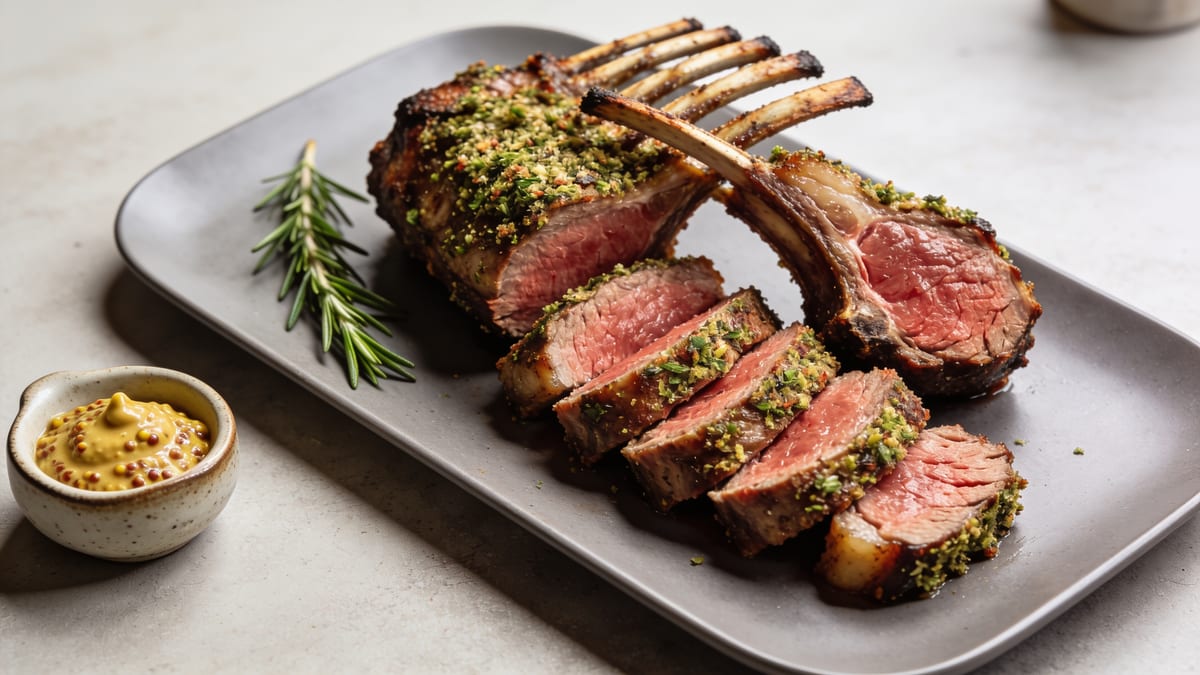
Pat two frenched racks of lamb dry, season all over with salt and pepper, and let them sit at room temperature while the oven heats to 200°C/400°F. Sear the racks fat side down in an oven-safe skillet over medium-high heat for 4-5 minutes until deeply browned, then set them aside to cool for a few minutes. Brush the seared side with a mix of Dijon mustard and grated garlic, press on a crust of panko, parsley, rosemary, thyme, and melted butter, and roast bones down for 18-25 minutes, pulling the racks when an instant-read thermometer hits 52-54°C/125-130°F in the center of the eye for medium-rare. Rest 10 minutes loosely tented, then slice between the bones into chops.
- Pull the lamb at 52-54°C/125-130°F; carryover heat during the rest finishes it at a perfect rosy medium-rare (57-60°C/135-140°F).
- Sear the fat cap first — the crust sticks better to a rendered, browned surface, and unrendered lamb fat is the main reason racks taste greasy.
- Let the seared racks cool 5 minutes before brushing on the Dijon, or the paste will slide off and the crumbs won't anchor.
Equipment
- Large oven-safe skillet (cast iron or stainless steel)
- Rimmed baking sheet or roasting pan
- Instant-read thermometer
- Tongs
- Small mixing bowl
- Sharp carving knife
Nguyên liệu
Lamb
- frenched racks of lamb (8 ribs each), about 700 g / 1½ lb each, fat cap trimmed to about 5 mm / ¼ inch
- 30 ml olive oil
- 10 g kosher salt, or 1¼ tsp fine sea salt
- 3 g freshly ground black pepper
Dijon herb crust
- 45 g Dijon mustard
- garlic cloves, finely grated
- 60 g panko breadcrumbs, or coarse fresh breadcrumbs
- 15 g fresh flat-leaf parsley, finely chopped
- 4 g fresh rosemary, finely chopped
- 3 g fresh thyme leaves
- 30 g unsalted butter, melted
Cách làm
- BƯỚC01
Heat the oven to 200°C/400°F with a rack in the middle. Pat the racks completely dry, then rub them with the olive oil and season on all sides with the salt and pepper. Leave them at room temperature while you make the crust — a slightly tempered rack cooks more evenly than one straight from the fridge.
- BƯỚC02
In a small bowl, toss the panko with the parsley, rosemary, thyme, and a pinch of salt. Pour in the melted butter and stir until every crumb looks lightly coated and the mixture clumps slightly when pressed. In a separate small bowl, stir the grated garlic into the Dijon mustard.
- BƯỚC03
Set a large oven-safe skillet over medium-high heat until shimmering. Lay both racks in fat side down and sear for 4-5 minutes, pressing lightly with tongs, until the fat is deeply browned and has started to render. Briefly sear the ends and bottom, about 30 seconds per side, then transfer the racks fat side up to a rimmed baking sheet and let them cool for 5 minutes.
- BƯỚC04
Brush the garlicky Dijon generously over the seared fat side and the ends of each rack, leaving the bones clean. Press the herbed crumbs firmly onto the mustard in an even layer, using your palm to compact them so they anchor. If the exposed bones are browning too fast later, you can wrap the tips in foil, but it's optional.
- BƯỚC05
Arrange the racks crust side up with the bones curving down, interlocking them slightly if space is tight. Roast for 18-25 minutes, checking at 18: an instant-read thermometer pushed into the center of the eye (avoiding bone) should read 52-54°C/125-130°F for medium-rare, or 57°C/135°F if you prefer medium. If the crumbs need more color, flash them under the broiler for 60-90 seconds, watching constantly.
- BƯỚC06
Transfer the racks to a cutting board and tent very loosely with foil — draping it tightly will steam the crust soft. Rest for 10 minutes; the internal temperature will climb another 3-5 degrees and the juices will redistribute so they stay in the meat, not on the board.
- BƯỚC07
Stand each rack bones-up and slice straight down between the bones into individual chops, or cut into double chops for a more generous presentation. Scatter any crumbs that fall off back over the meat, sprinkle with flaky salt, and serve immediately — two chops per person as a main.
Make ahead
Up to 24 hours ahead, trim and salt the racks, then refrigerate them uncovered — this dry-brine seasons the meat deeply and dries the fat cap for a better sear. The Dijon-garlic mixture and the herbed crumbs (minus the butter) can also be made a day ahead and stored separately; stir the melted butter into the crumbs just before crusting. Sear, crust, and roast the day you serve.
Storage
Refrigerate leftover chops in an airtight container for up to 3 days. Reheat gently in a 120°C/250°F oven for 10-12 minutes until just warmed through — a microwave will push the meat past medium and turn the crust chewy. Cooked lamb can be frozen for up to 2 months, though the crumb topping loses its crispness; thaw overnight in the fridge before reheating.
Variations
Gluten-free crust
Swap the panko for 60 g / 1 cup gluten-free panko, or skip crumbs entirely and finish the Dijon layer with an extra tablespoon each of chopped rosemary and parsley pressed straight into the mustard. Everything else stays the same, and the herb-mustard coat still forms a flavorful crust.
Provençal, no mustard
Replace the Dijon with 2 tablespoons of olive oil mixed with 1 teaspoon of honey to help the crumbs stick, and add 2 finely chopped anchovy fillets and the zest of a lemon to the crumb mixture. It leans salty-bright instead of sharp, closer to a persillade. Note this adds Fish to the allergens.
Garlic-rosemary marinated, crustless
Skip the crumbs and marinate the racks for 2-12 hours in the olive oil, garlic, rosemary, and thyme with the zest of one lemon. Sear and roast exactly as written; the result is leaner-looking and lets the lamb flavor lead. Wipe excess marinade off before searing so the garlic doesn't scorch.
Serve with
Nutrition per serving
Nutrition values are estimates based on the metric measurements. Adjust as needed.
Câu hỏi thường gặp
What is the best way to cook rack of lamb so it isn't tough or gamey?
The core answer to how to cook rack of lamb is high heat for a short time: sear the fat cap on the stovetop, then roast at 200°C/400°F and pull the meat at 52-54°C/125-130°F for medium-rare. Toughness almost always comes from overcooking — the rib eye is a tender, quick-cooking muscle, not a braising cut — and most of the gamey flavor lives in unrendered fat, which is why trimming the cap thin and searing it well matters more than any marinade.
What internal temperature should rack of lamb reach?
Pull it from the oven at 52-54°C/125-130°F for medium-rare or 57°C/135°F for medium, measured in the thickest part of the eye without touching bone. During the 10-minute rest, carryover cooking raises the temperature another 3-5 degrees, landing medium-rare at about 57-60°C/135-140°F. Cooking past 63°C/145°F turns this cut noticeably dry and gray, so a thermometer is the single most useful tool for the job.
What does 'frenched' mean, and do I need to do it myself?
A frenched rack has the fat and sinew scraped from the last few centimeters of the rib bones, leaving them clean for presentation and easy carving. Most supermarket and butcher racks are sold already frenched, so check the label before doing any knife work. If yours isn't, cut along the fat line about 5 cm / 2 inches from the bone tips, then scrape each bone clean with the back of a knife — or simply ask the butcher to do it.
Can I skip the stovetop sear and just roast it?
You can, but the results are noticeably worse for how to cook rack of lamb at home: without the sear, the fat cap stays pale and rubbery in the short roasting window, and the mustard-crumb layer has nothing browned to grip. If you must go oven-only, start the racks fat side up at 230°C/450°F for 10 minutes to jump-start rendering, then crust them and finish at 200°C/400°F, still cooking to temperature rather than time.
How many people does one rack of lamb feed?
A standard 8-rib frenched rack weighs about 700 g / 1½ lb but is mostly bone, yielding roughly 300-350 g / 11-12 oz of meat — enough for two people as a main course at three to four chops each. This recipe uses two racks to serve four. For lamb-loving crowds or a menu without many sides, plan on half a rack per person and consider adding a third rack for six.
Cooked this? Rate it.
Real ratings from real cooks. We only show a score once enough of you have weighed in — no fabricated stars.