Selbstgemachte Hamburgerbrötchen
These homemade hamburger buns bake up tall and golden with a soft, feathery crumb and a lightly sweet, buttery flavor that holds a juicy patty without turning to mush. An enriched dough of milk, butter, and a whole egg gives them a tender, almost brioche-like bite, while a two-stage rise builds the structure that keeps them fluffy for days. A glossy egg wash and a scatter of sesame seeds finish them like the ones from a proper bakery.
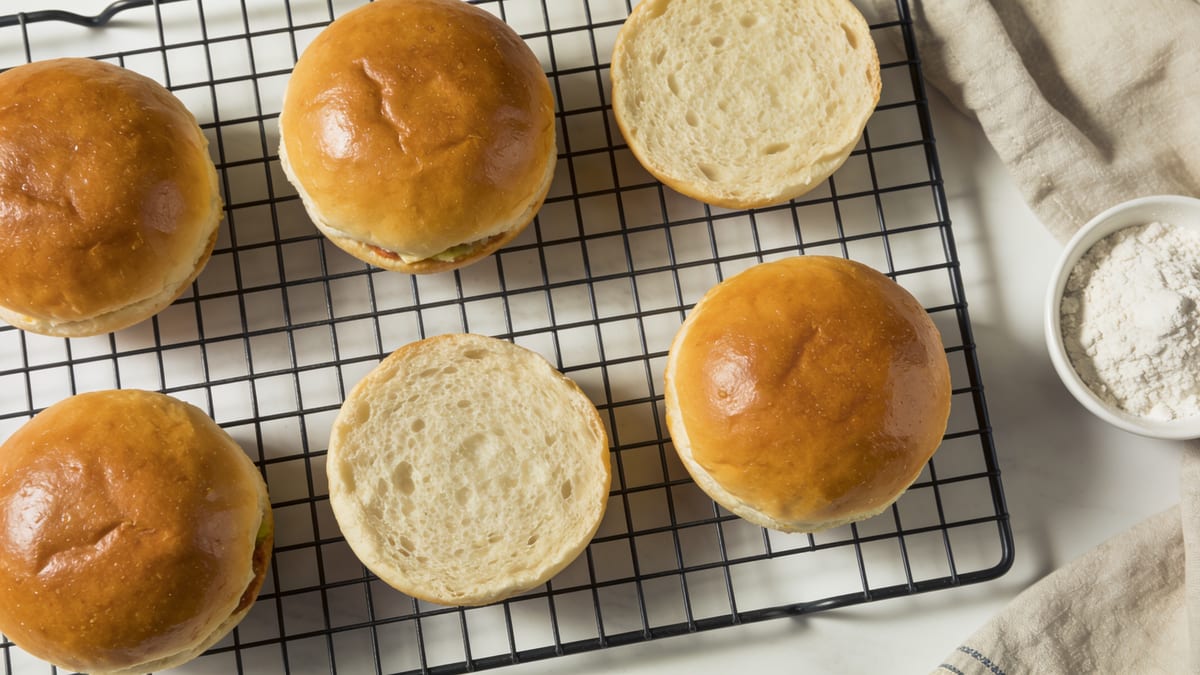
Bloom 7 g active dry yeast with a pinch of the sugar in 240 ml warm milk plus 60 ml warm water until foamy, then mix in 500 g bread flour, the rest of the sugar, 8 g salt, 57 g softened butter, and 1 egg; knead 8-10 minutes until smooth and elastic, let rise until doubled (about 1 hour), divide into 8 pieces of about 95 g each, roll into tight balls and flatten slightly, then proof 45 minutes on a parchment-lined sheet; brush with egg wash, scatter sesame seeds, and bake at 190C/375F for 15-17 minutes until deep golden and 88-90C/190F inside, then cool completely before slicing.
- Weigh your flour — too much flour is the number-one cause of dense, dry buns; 500 g should knead up slightly tacky, not stiff.
- Don't rush the second proof: the shaped buns should look puffy and jiggle when nudged before baking, or they'll come out squat.
- Pull them at 88-90C/190F internal and cool fully on a rack so the crumb sets before you slice.
Equipment
- Stand mixer with dough hook
- Large mixing bowl
- Kitchen scale
- Baking sheet
- Parchment paper
- Pastry brush
- Bench scraper
Zutaten
Dough
- 240 ml whole milk, warm, lukewarm, about 43C/110F
- 60 ml water, warm, lukewarm
- 7 g active dry yeast, 1 standard packet
- 50 g granulated sugar
- 500 g bread flour, spooned and leveled; all-purpose also works
- 8 g fine salt
- 57 g unsalted butter, softened, room temperature
- large egg, room temperature
Egg Wash & Topping
- large egg, for the egg wash
- 15 ml water, for the egg wash
- 15 g sesame seeds, optional
Zubereitung
- SCHRITT01
Warm the milk and water to about 43C/110F — warm to the touch but not scalding. Stir in the yeast and a teaspoon of the sugar and let it sit until foamy and fragrant, about 5 minutes. If it doesn't bubble, the yeast is dead or the liquid was too hot; start over with fresh yeast.
- SCHRITT02
In a stand mixer fitted with the dough hook, combine the bloomed yeast mixture, remaining sugar, bread flour, salt, softened butter, and egg. Mix on low until a shaggy dough forms, then knead on medium-low for 8-10 minutes until smooth, elastic, and slightly tacky. It should pull away from the sides but cling lightly to the bottom of the bowl.
- SCHRITT03
Shape the dough into a ball, place it in a lightly oiled bowl, and cover with a damp towel or plastic wrap. Let it rise in a warm spot until doubled in size, about 1 hour. Poke it gently — the dent should spring back slowly.
- SCHRITT04
Turn the dough onto a lightly floured surface and gently deflate it. Divide into 8 equal pieces, about 95 g each for even baking. Cup each piece under your palm and roll against the counter into a tight, smooth ball, then press to flatten into a 9 cm/3.5 inch disc. Arrange on a parchment-lined baking sheet, spaced 5 cm/2 inches apart.
- SCHRITT05
Loosely cover the shaped buns and proof until puffy and nearly doubled, 40-45 minutes. Meanwhile, set a rack in the center of the oven and preheat to 190C/375F.
- SCHRITT06
Whisk the remaining egg with 1 tablespoon water. Brush a thin, even coat over each bun for that glossy bakery finish, then sprinkle with sesame seeds if using. Brush gently so you don't deflate the risen buns.
- SCHRITT07
Bake for 15-17 minutes, rotating the pan halfway through, until the tops are deep golden brown and the internal temperature reads 88-90C/190F. If they color too fast, tent loosely with foil for the final few minutes.
- SCHRITT08
Transfer the buns to a wire rack and cool completely, at least 20 minutes, before slicing — cutting them warm compresses the crumb. Split with a serrated knife and toast the cut sides for the best burger.
Make ahead
The dough can be mixed a day ahead and cold-proofed overnight in the fridge for the first rise; shape and do the second proof the next day, adding a little extra proofing time since the dough starts cold. Baked buns also freeze beautifully, so you can make a batch weeks before a cookout.
Storage
Store cooled buns in an airtight bag or container at room temperature for up to 3 days; toast the cut sides or warm briefly in the oven to revive softness. Avoid the fridge, which stales bread faster. For longer storage, freeze up to 3 months.
Variations
Whole Wheat Burger Buns
Swap up to half the bread flour (250 g) for whole wheat flour and add 1-2 tablespoons more milk, since whole wheat drinks up more liquid. The buns turn out nuttier and a touch denser — still soft, with a heartier chew.
Dairy-Free & Vegan
Use unsweetened oat or soy milk in place of the dairy milk, vegan block butter for the butter, and skip the egg in the dough (add 2 tablespoons extra plant milk). Brush the tops with plant milk or a little maple syrup instead of egg wash for shine.
Potato Burger Buns
Replace 60 g of the flour with 90 g cooled plain mashed potato and hold back a splash of the water. The extra starch makes exceptionally soft, moist buns that stay fresh an extra day.
Serve with
Nutrition per serving
Nutrition values are estimates based on the metric measurements. Adjust as needed.
Häufige Fragen
Can I make homemade hamburger buns without a stand mixer?
Absolutely. Mix the dough with a wooden spoon until it comes together, then knead by hand on a lightly floured counter for 12-15 minutes until smooth and elastic. It's a workout, but homemade hamburger buns turn out just as soft — since the dough is enriched, keep flouring lightly to manage stickiness rather than adding lots of extra flour.
Why did my homemade hamburger buns turn out dense?
The two usual culprits are too much flour and under-proofing. Weigh your flour if you can, and let both rises finish fully — the shaped buns should look visibly puffy and spring back slowly before they go in the oven. Weak or expired yeast will also give you squat, heavy buns.
What's the best flour for hamburger buns?
Bread flour is ideal because its higher protein builds structure for a tall, chewy-soft bun that stands up to juicy fillings. All-purpose flour works too and gives a slightly more tender, cakey crumb — just knead until the dough is smooth and elastic.
Can I freeze the baked buns?
Yes. Cool them completely, then freeze whole in a zip-top bag for up to 3 months. Thaw at room temperature and refresh in a 150C/300F oven for 5 minutes, or slice them before freezing so you can toast the halves straight from the freezer.
How far ahead can I make the dough?
You can slow the first rise in the fridge overnight, up to 24 hours. Shape the dough cold, then let the buns proof at room temperature, which may take a bit longer. This cold ferment actually deepens the flavor of the finished buns.
Cooked this? Rate it.
Real ratings from real cooks. We only show a score once enough of you have weighed in — no fabricated stars.