Selbstgebackenes Weißbrot
This is the tall, pillowy sandwich loaf that makes store-bought white bread taste like cardboard: a lightly sweet crumb, a thin golden crust, and slices sturdy enough for PB&J but soft enough to squish. A splash of oil keeps it tender for days, and blooming the yeast in sugared warm water guarantees a strong, reliable rise even for first-time bakers. The dough is forgiving, needs no fancy technique, and turns out two loaves — one for now, one for the freezer.
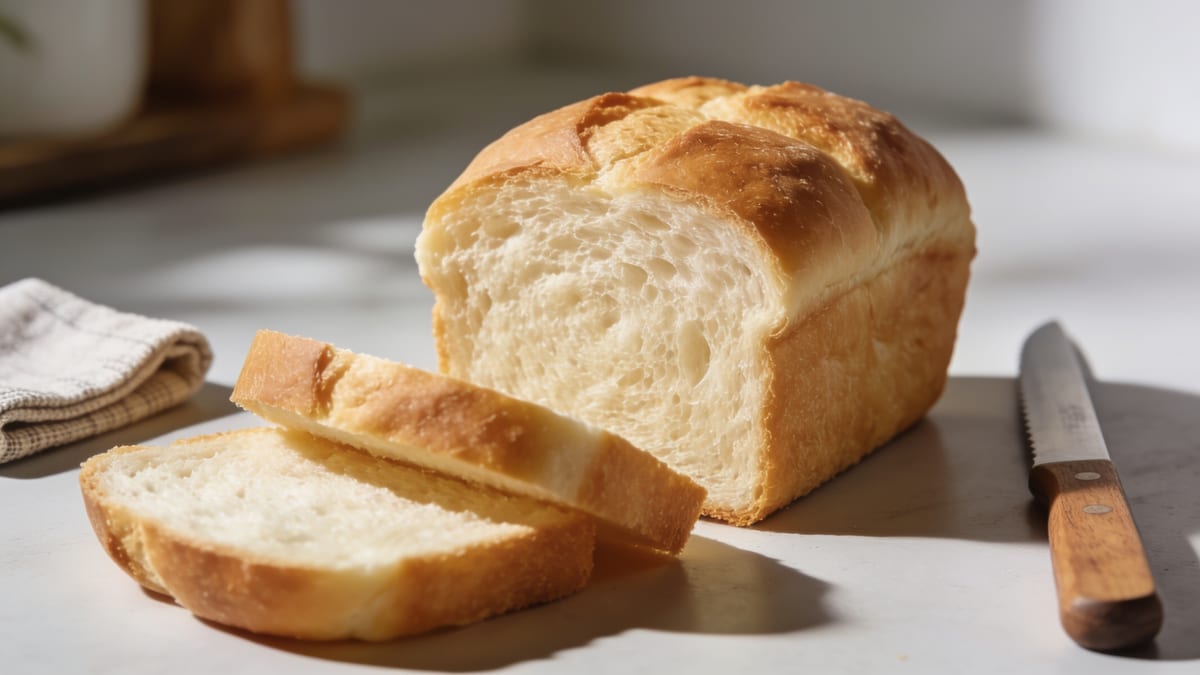
Dissolve 65 g sugar in 480 ml warm water (about 43°C/110°F), sprinkle on 14 g active dry yeast, and wait 10 minutes until foamy. Mix in 60 ml neutral oil, 9 g salt, and 750 g bread flour, then knead 8-10 minutes until smooth and elastic. Let the dough double in an oiled, covered bowl for about 1 hour, punch it down, divide in half, roll each piece into a tight log, and tuck seam-side down into two greased 9x5-inch loaf pans. Rise again 40 minutes until the dough crowns about 2.5 cm above the rims, then bake at 190°C/375°F for 28-32 minutes until deep golden and 90°C/195°F inside. Cool completely on a rack before slicing.
- Water temperature is the make-or-break: 40-46°C (105-115°F) wakes yeast up, while anything hot to the touch kills it — if the mixture isn't foamy after 10 minutes, start over with fresh yeast.
- Weigh the flour (750 g) or spoon-and-level it; scooping packs in up to 20% extra and gives you a dry, dense loaf.
- Roll each loaf into a tight log and pinch the seam firmly closed — a loose shape bakes up with tunnels and a mushroom top.
Equipment
- Stand mixer with dough hook (or large mixing bowl and sturdy spoon)
- Two 9x5-inch (23x13 cm) metal loaf pans
- Digital kitchen scale
- Instant-read thermometer
- Plastic wrap or a clean kitchen towel
- Wire cooling rack
Zutaten
Dough
- 480 ml warm water, about 43°C / 110°F — comfortably warm on your wrist, never hot
- 65 g granulated sugar
- 14 g active dry yeast, or 11 g / 3 1/2 tsp instant yeast
- 60 ml vegetable oil, or any neutral oil, such as canola or sunflower
- 9 g fine salt
- 750 g bread flour, all-purpose works too; the crumb will be slightly softer and less chewy
For the Bowl and Pans
- 15 ml neutral oil, for greasing the rising bowl and loaf pans
Zubereitung
- SCHRITT01
Pour the warm water into the bowl of a stand mixer (or a large mixing bowl) and stir in the sugar until dissolved. Sprinkle the yeast over the surface, give it one gentle stir, and let it sit for 10 minutes. It should look foamy and smell yeasty — if nothing happens, your water was too hot or the yeast is dead; start again before wasting flour.
- SCHRITT02
Add the oil and salt to the yeast mixture, then add the flour about a third at a time, mixing on low with the dough hook (or stirring by hand) until a shaggy dough forms and pulls away from the sides of the bowl. It should feel soft and slightly tacky but not stick to your fingers in gobs; add flour 1 tablespoon at a time only if it's genuinely wet.
- SCHRITT03
Knead on medium-low speed for 8-10 minutes, or turn the dough onto a lightly floured counter and knead by hand for 10-12 minutes. It's ready when the surface is smooth and a small piece stretched between your fingers turns thin and translucent before tearing (the windowpane test).
- SCHRITT04
Shape the dough into a ball and place it in a lightly oiled bowl, turning once to coat. Cover with plastic wrap or a damp towel and let it rise in a warm, draft-free spot until doubled in size, about 1 hour. A finger poked 2 cm deep should leave a dent that fills back slowly.
- SCHRITT05
Grease two 9x5-inch loaf pans. Punch the dough down, turn it onto the counter, and divide it into two equal pieces (a scale helps here). Pat each piece into a rectangle roughly 23 cm (9 inches) wide, then roll it up tightly from a short side like a jelly roll, pinching the seam and ends firmly closed. Place each log seam-side down in a pan.
- SCHRITT06
Cover the pans loosely and let the loaves rise until the dough domes about 2.5 cm (1 inch) above the pan rims, 35-45 minutes. About 20 minutes in, preheat the oven to 190°C / 375°F with a rack in the lower-middle position.
- SCHRITT07
Bake for 28-32 minutes, rotating the pans halfway, until the tops are deep golden brown and an instant-read thermometer inserted into the center reads 90°C / 195°F. The loaves should sound hollow when tapped on the bottom. If they're browning quickly at the 20-minute mark, tent loosely with foil.
- SCHRITT08
Turn the loaves out of their pans onto a wire rack right away so the crusts don't steam and soften. Cool for at least 1 hour before slicing — the crumb is still setting as it cools, and cutting early makes it gummy.
Make ahead
You can slow the first rise in the refrigerator: after kneading, cover the bowl and chill for up to 24 hours, then shape the cold dough and give it a longer second rise (60-90 minutes) before baking — the flavor actually improves. Baked loaves also freeze beautifully whole; wrap tightly in plastic then foil, and thaw at room temperature for a few hours before serving.
Storage
Once fully cool, store in an airtight bag or bread box at room temperature for up to 4 days; do not refrigerate, which stales bread faster. For longer keeping, slice the loaf, freeze the slices flat in a zip-top bag with the air pressed out, and toast straight from frozen — it keeps well for up to 3 months.
Variations
Honey-Butter Crust
Swap the sugar for 85 g (1/4 cup) honey in the dough, and brush the hot baked loaves with 2 tablespoons of melted butter for a glossy, soft, faintly sweet crust. Note this version adds Dairy and is no longer vegan.
Half Whole Wheat
Replace 375 g (3 cups) of the bread flour with whole wheat flour and add 2-3 extra tablespoons of water, since the bran drinks more. Expect a slightly denser crumb and a nuttier flavor; the rises may take 10-15 minutes longer.
Soft Rolls Instead of Loaves
Divide the dough into 24 pieces (about 55 g each), roll into balls, and arrange in two greased 23 cm (9-inch) round pans. Rise 30 minutes and bake at 190°C / 375°F for 18-20 minutes for pull-apart dinner rolls.
Serve with
Nutrition per serving
Nutrition values are estimates based on the metric measurements. Adjust as needed.
Häufige Fragen
Can I use all-purpose flour instead of bread flour?
Yes — this white bread recipe works with all-purpose flour measure for measure. Bread flour has more protein, so it builds a chewier, slightly taller loaf that holds up better for sandwiches, while all-purpose gives a softer, more delicate crumb. Whichever you use, weigh it or spoon it into the cup and level it off so you don't pack in extra.
Why didn't my dough rise?
Nine times out of ten it's the water temperature or old yeast. Water above about 54°C (130°F) kills yeast outright, and yeast past its expiration date may be too weak to leaven. That's exactly why this recipe starts with a 10-minute proof: if the mixture isn't visibly foamy, you've lost only water, sugar, and yeast instead of a whole batch of dough. A cold kitchen also slows rising — give the dough a warm spot, like an oven with just the light on.
Can I halve this white bread recipe to make just one loaf?
Absolutely. Halve every ingredient (use 7 g, about 2 1/4 teaspoons, of yeast — one standard packet) and follow the same steps with a single 9x5-inch pan. Rise and bake times stay essentially the same; start checking the loaf at 26 minutes.
How do I know when the bread is fully baked?
The most reliable check is an instant-read thermometer: slide it into the center of the loaf and look for 90°C (195°F). Without one, tip a loaf out of its pan and knock on the bottom — a hollow, drum-like sound means done, while a dull thud means it needs another 5 minutes. Color alone can fool you, since the sugar in this dough browns the crust before the middle finishes.
Can I use instant yeast instead of active dry?
Yes. Use 11 g (3 1/2 teaspoons) of instant yeast and you can skip the 10-minute blooming step — just whisk it directly into the flour and add the sugared warm water with the oil and salt. Rises may run 10-15 minutes faster, so judge by size (doubled, then 2.5 cm above the pan rim) rather than the clock.
Cooked this? Rate it.
Real ratings from real cooks. We only show a score once enough of you have weighed in — no fabricated stars.