Klassische Scones
Tall, golden British scones with a crisp crust and a soft, cloud-like crumb that splits cleanly for clotted cream and jam. A splash of lemon juice sours the milk so it reacts with the baking powder for extra lift, while cold butter rubbed in with light fingertips keeps the middle tender rather than tough. A quick chill before a hot 220°C oven sets the butter so the scones rise straight up instead of spreading.
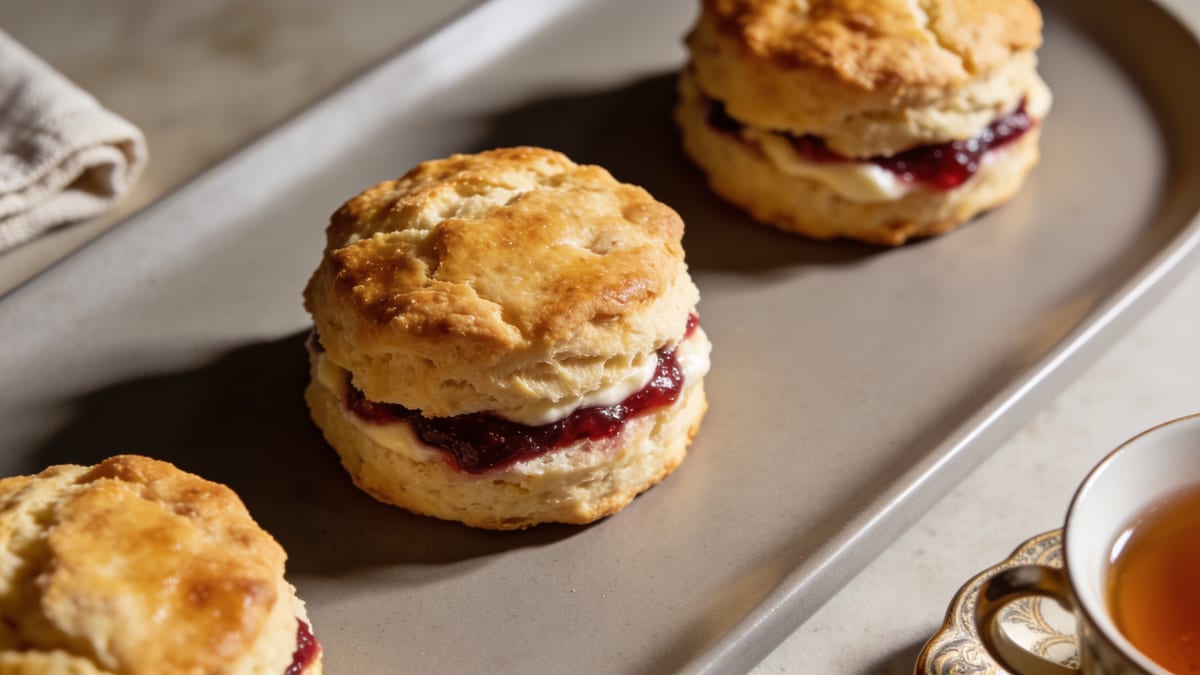
Heat the oven to 220°C (425°F) and stir 2 teaspoons of lemon juice into 175 ml cold milk so it thickens slightly while you work. Whisk 350 g flour with 1 tablespoon baking powder, 1/2 teaspoon salt and 50 g sugar, then rub in 85 g cold cubed butter with your fingertips until it looks like coarse breadcrumbs. Pour in the soured milk and stir with a knife just until a shaggy, slightly sticky dough forms — do not knead. Pat it 3 cm thick on a floured surface, stamp out rounds with a 6 cm cutter pressed straight down, chill the rounds 10 minutes, brush the tops only with beaten egg, and bake 10–12 minutes until tall and deep golden. Cool briefly, split by hand, and serve warm with clotted cream and jam.
- Keep the butter and milk fridge-cold and stop mixing the moment the dough comes together — overworking develops gluten and makes scones dense and bready.
- Push the cutter straight down without twisting; twisting seals the edges and the scones rise lopsided or not at all.
- Glaze only the tops with egg — drips down the sides glue the layers and block the rise.
Equipment
- Large mixing bowl
- 6 cm (2.5 in) round cutter
- Baking sheet
- Parchment paper
- Pastry brush
- Wire cooling rack
Zutaten
Scone dough
- 350 g all-purpose flour (plain flour), plus extra for dusting
- 12 g baking powder, fresh, not expired
- 3 g fine sea salt
- 50 g caster sugar (superfine sugar), granulated works too
- 85 g unsalted butter, cold and cubed, straight from the fridge
- 175 ml whole milk, cold
- 10 ml lemon juice, to sour the milk for extra lift
Glaze and serving
- large egg, beaten, for glazing the tops
- 150 g clotted cream, to serve; whipped cream works
- 160 g strawberry jam, to serve
Zubereitung
- SCHRITT01
Heat the oven to 220°C (425°F), or 200°C fan, and line a baking sheet with parchment. Stir the lemon juice into the cold milk and set it aside — it will thicken slightly and turn faintly lumpy, which is exactly what you want. The acid will react with the baking powder in the oven for a taller rise.
- SCHRITT02
Whisk the flour, baking powder, salt and sugar in a large bowl. Add the cold butter cubes and rub them in with just your fingertips, lifting the mixture and letting it fall back, until it looks like coarse breadcrumbs with a few pea-sized flecks remaining. Work fast so the butter stays cold.
- SCHRITT03
Make a well in the center and pour in almost all of the soured milk, holding back a tablespoon or two. Stir with a table knife using quick cutting strokes just until the dough clumps together, adding the last of the milk only if dry flour remains in the bottom. The dough should feel soft and slightly sticky — stop the moment it holds together.
- SCHRITT04
Tip the dough onto a lightly floured surface. Pat it into a rough rectangle, fold it in half, turn it a quarter and repeat once more — these two folds build flaky layers without kneading. Pat to an even 3 cm (1 1/4 in) thickness. Dip a 6 cm cutter in flour and press straight down without twisting. Re-pat the scraps gently once and cut again for 8 rounds total.
- SCHRITT05
Place the rounds on the lined baking sheet, spaced 3 cm apart, and refrigerate for 10 minutes. This firms the butter and relaxes the dough so the scones climb straight up in the hot oven instead of slumping sideways.
- SCHRITT06
Brush the tops — only the tops — with beaten egg. Bake on the middle shelf for 10 to 12 minutes, until well risen with deep golden lids and pale, dry-looking sides. A scone should feel light for its size and sound faintly hollow when tapped underneath.
- SCHRITT07
Transfer to a wire rack and cool for at least 10 minutes; the crumb finishes setting as steam escapes. Serve warm, split by hand rather than cut, with clotted cream and strawberry jam in whichever order your loyalties dictate.
Make ahead
Cut the unbaked rounds, freeze them solid on a tray, then bag them for up to 1 month. Bake straight from frozen with the egg glaze, adding 3-4 minutes to the baking time — the rise is just as good, so you can have fresh scones for tea with 15 minutes' notice. The rubbed-in flour-and-butter mixture also keeps, covered, in the fridge for a day; just stir in the soured milk when ready to bake.
Storage
Best the day they are baked. Once fully cool, store in an airtight container at room temperature for up to 2 days; refresh in a 160°C (325°F) oven for 5 minutes to revive the crust. For longer keeping, freeze baked and cooled scones in a zip-top bag for up to 3 months and reheat from frozen at 160°C for 10-12 minutes. Avoid the fridge, which stales the crumb quickly.
Variations
Fruit scones
Toss 85 g (1/2 cup) sultanas or raisins into the dry mix after rubbing in the butter. For plumper fruit, soak the sultanas in hot black tea for 10 minutes and pat dry first. Bake exactly as written.
Savory cheese scones
Leave out the sugar, add 100 g (1 cup) grated mature cheddar and 1/2 teaspoon English mustard powder to the dry mix, and scatter a little extra cheese on the egg-glazed tops. Wonderful split and buttered alongside soup.
Dairy-free swap
Use 85 g firm plant-based block butter (kept very cold) and replace the milk with 175 ml unsweetened soy milk soured with the same lemon juice. Soy curdles best of the plant milks, so the lift is nearly identical; glaze with soy milk instead of egg to keep them egg-free too.
Serve with
Nutrition per serving
Nutrition values are estimates based on the metric measurements. Adjust as needed.
Häufige Fragen
Why didn't my scones rise?
The usual culprits are stale baking powder, overworked dough, or a twisted cutter. Baking powder loses strength after opening, so test a pinch in hot water — it should fizz hard. Mix only until the dough holds together, press the cutter straight down, and make sure the oven is fully preheated to 220°C; scones need that immediate blast of heat to climb.
Should scone dough be sticky?
Slightly, yes. A soft, tacky dough bakes into light, moist scones, while a dry, easy-to-handle dough bakes into dense ones. Flour your hands and the work surface rather than adding more flour to the dough itself, and use a floured cutter so the rounds release cleanly.
Can I make scones without a round cutter?
Absolutely. Pat the dough into a 3 cm-thick square and cut it into 8 wedges or squares with a large floured knife, again pressing straight down without dragging. Cut edges rise just as well as stamped ones, and there are no scraps to re-roll.
Can I use self-raising flour instead?
Yes — swap the all-purpose flour for 350 g self-raising flour and reduce the baking powder to 1 teaspoon. British bakers traditionally make scones this way. Keep the salt and lemon-soured milk as written, since they season the crumb and boost the rise.
What is the difference between British scones and American scones?
British scones like these are lightly sweetened, fluffy rounds meant to carry cream and jam, made with less butter and sugar. American scones are richer, sweeter triangles, often loaded with cream, mix-ins, and glazes, with a denser, more cake-like crumb. This recipe is the classic British style served at afternoon tea.
Cooked this? Rate it.
Real ratings from real cooks. We only show a score once enough of you have weighed in — no fabricated stars.