Blackberry Cobbler
A Southern-style batter blackberry cobbler where a vanilla-scented batter is poured over melted butter and the sugared berries are scattered on top — as it bakes, the batter rises up and around the fruit into a golden, crackly-edged crust with a custardy middle. Pouring the batter over hot butter (and never stirring) is what creates those caramelized, almost fried edges people fight over, while a spoonful of cornstarch keeps the jammy berry pockets from turning soupy.
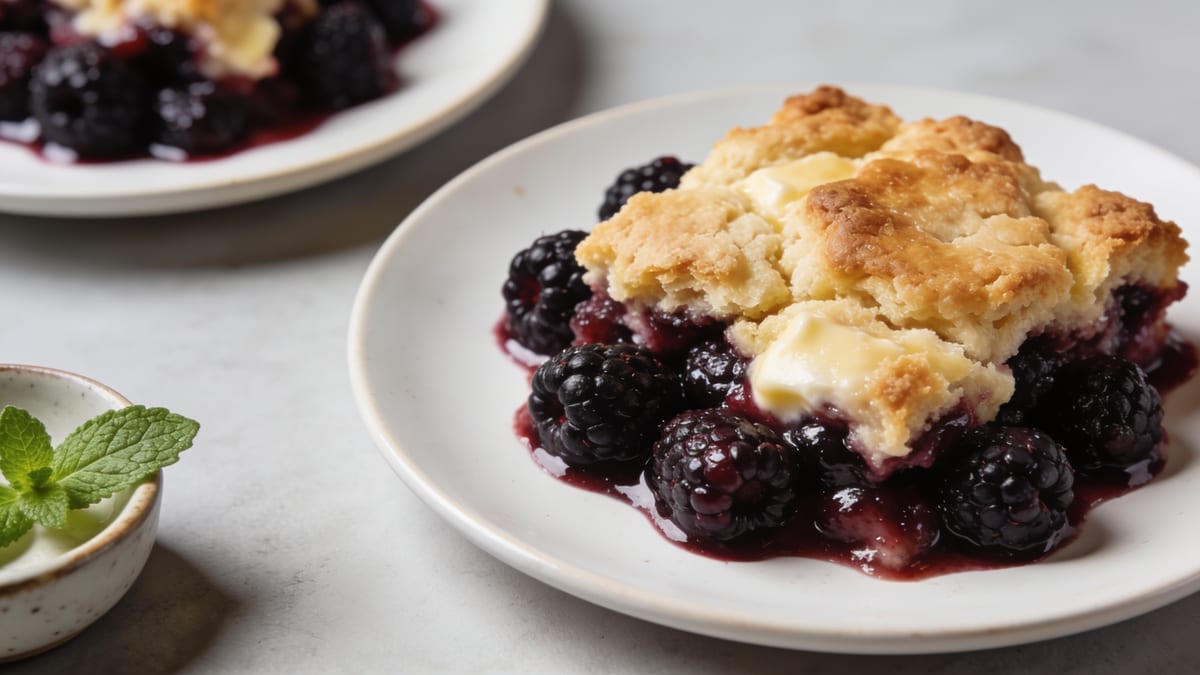
Melt 85 g (6 tbsp) butter in a 23 x 33 cm (9 x 13 inch) dish in a 175°C (350°F) oven while you toss 700 g (5 cups) blackberries with 65 g (1/3 cup) sugar, 2 tbsp cornstarch, and 1 tbsp lemon juice. Whisk 125 g (1 cup) flour with 150 g (3/4 cup) sugar, 2 tsp baking powder, and 1/4 tsp salt, then stir in 240 ml (1 cup) milk and 1 tsp vanilla. Pour the batter straight over the hot butter without stirring, scatter the berries and their juices evenly on top, and bake 50-55 minutes until deeply golden with bubbling edges. Rest 20 minutes so the juices set, then serve warm.
- Do not stir the butter into the batter — the batter must sit on top of it so the edges fry golden as it rises around the fruit.
- Toss the berries with cornstarch, not just sugar, or the finished cobbler will be soupy instead of jammy.
- The 20-minute rest is part of the recipe: the juices thicken as they cool from a rolling boil to spoonable.
Equipment
- 23 x 33 cm (9 x 13 inch) baking dish
- Two mixing bowls
- Whisk
- Flexible spatula
- Measuring cups and spoons (or a kitchen scale)
- Rimmed baking sheet (to catch drips)
- Cooling rack
Ingredients
Blackberry filling
- 700 g fresh blackberries, or frozen, unthawed
- 65 g granulated sugar, use up to 1/2 cup if berries are very tart
- 16 g cornstarch
- 15 ml fresh lemon juice
Batter
- 85 g unsalted butter, melted in the baking dish
- 125 g all-purpose flour
- 150 g granulated sugar
- 8 g baking powder
- 1.5 g fine salt
- 240 ml whole milk, room temperature
- 5 ml vanilla extract
To finish (optional)
- 12 g turbinado or demerara sugar, for a crunchy top
Method
- STEP01
Set a rack in the middle of the oven and heat it to 175°C (350°F). Put the butter in a 23 x 33 cm (9 x 13 inch) baking dish and slide it into the oven while it heats, 5-8 minutes, until the butter is fully melted and just starting to sizzle. Pull the dish out as soon as the butter smells nutty at the edges — you want melted, not browned.
- STEP02
While the butter melts, toss the blackberries in a bowl with 65 g (1/3 cup) sugar, the cornstarch, and the lemon juice until no dry white streaks of cornstarch remain. Let them sit so the sugar starts pulling out their juices; you should see a glossy syrup forming at the bottom of the bowl by the time you assemble.
- STEP03
In a second bowl, whisk the flour, 150 g (3/4 cup) sugar, baking powder, and salt to break up any lumps. Pour in the milk and vanilla and whisk just until smooth — 20 to 30 seconds. A thin, pourable batter about the consistency of pancake batter is exactly right; do not overmix or the crust will be tough.
- STEP04
Pour the batter slowly over the melted butter in the dish. The butter will pool around the edges and float in patches on top — leave it alone. This is the layering that fries the edges golden and crisp. Whatever you do, do not stir.
- STEP05
Spoon the blackberries and every drop of their juices evenly over the batter, leaving a 2 cm (3/4 inch) border of bare batter around the edge so the crust can climb. The berries will look like they are sitting on top; the batter rises around and over them in the oven. Sprinkle with turbinado sugar if using.
- STEP06
Set the dish on a rimmed baking sheet to catch any bubbling juices and bake for 50-55 minutes. The cobbler is done when the crust is a deep golden brown (not pale blond), the berry juices are bubbling thickly at the edges, and a skewer poked into a cakey patch of crust comes out clean. If it is browning too fast at 45 minutes, tent loosely with foil.
- STEP07
Cool the cobbler on a rack for at least 20 minutes. Straight from the oven the juices are thin and scalding; as it rests, the cornstarch sets them to a spoonable, jammy consistency. Serve warm, scooped into bowls.
Make ahead
This cobbler is at its best baked the day you serve it, but you can stage it: mix the dry ingredients and sugar the berries (refrigerated) up to 1 day ahead, then melt the butter, finish the batter, and assemble just before baking. A fully baked cobbler can be made in the morning and rewarmed, uncovered, at 160°C (325°F) for 15-20 minutes before dessert. Do not assemble the unbaked cobbler ahead — the baking powder loses lift and the berries water out the batter.
Storage
Cool completely, then cover the dish and keep at cool room temperature for up to 1 day or refrigerate for up to 4 days. The crust softens as it sits; recrisp individual portions in a 175°C (350°F) oven for 10-12 minutes or an air fryer at 160°C (325°F) for 5-6 minutes rather than the microwave, which turns the crust gummy. Freeze baked portions, well wrapped, for up to 3 months and reheat from frozen, covered, at 175°C (350°F) for about 25 minutes.
Variations
Gluten-free
Swap the all-purpose flour for an equal weight (125 g / 1 cup) of a 1-to-1 gluten-free baking blend that contains xanthan gum. The batter behaves almost identically; check doneness at 50 minutes. Cornstarch is already gluten-free, so no other changes are needed.
Blackberry-peach
Replace 250 g (about 2 cups) of the blackberries with 2 ripe peaches, peeled and sliced 1 cm (1/2 inch) thick. Peaches release less pectin than blackberries, so keep the full 2 tbsp cornstarch. A pinch of cinnamon in the batter is good here.
Dairy-free
Use a stick-style plant butter (not spread, which has too much water) and unsweetened oat milk in place of the butter and whole milk, measure for measure. Oat milk's body keeps the crust tender; the edges brown slightly faster, so start checking at 45 minutes.
Serve with
Nutrition per serving
Nutrition values are estimates based on the metric measurements. Adjust as needed.
Frequently asked
Can I make blackberry cobbler with frozen berries?
Yes, and you do not need to thaw them. Toss the frozen berries with the sugar, cornstarch, and lemon juice exactly as written and scatter them over the batter. Because frozen berries release more liquid, add an extra teaspoon of cornstarch and expect the bake to run 5-10 minutes longer before the juices bubble thickly at the edges.
Why is my blackberry cobbler soupy in the middle?
Three usual causes: the cornstarch was skipped or shorted, the cobbler came out before the juices reached a full bubble at the edges (cornstarch only thickens once it boils), or it was served straight from the oven. Blackberries also vary a lot in juiciness. Bake until the crust is deep golden and the edges are bubbling like slow lava, then give it the full 20-minute rest — the juices tighten noticeably as they cool.
Am I really not supposed to stir the butter, batter, and fruit together?
Really. This is a batter-style (sometimes called Southern or 'lazy') cobbler, and the layering is the whole trick: melted butter on the bottom, batter poured over it, fruit on top. In the oven the batter rises up through the berries while the butter fries the underside and edges golden. Stirring blends everything into a uniform cake and you lose both the crisp edges and the jammy fruit pockets.
My blackberries are very tart. How much should I adjust the sugar?
Taste one raw. If it makes you wince, raise the filling sugar from 65 g (1/3 cup) to 100 g (1/2 cup), but leave the batter sugar alone — that 3/4 cup is calibrated for browning and crust texture, not just sweetness. Very sweet, dead-ripe summer berries can go the other way: drop the filling sugar to 50 g (1/4 cup) and keep the lemon juice, which sharpens the berry flavor.
What is the difference between a cobbler, a crisp, and a crumble?
The topping. A cobbler has a soft, biscuit- or batter-based crust — in this blackberry cobbler the batter bakes into something between cake and dumpling with crisp fried edges. A crisp is topped with a streusel that includes oats; a crumble is the same idea, traditionally without oats. All three sit on the same kind of sweetened, thickened fruit base, so the filling here would work under any of them.
Cooked this? Rate it.
Real ratings from real cooks. We only show a score once enough of you have weighed in — no fabricated stars.