Raspberry Jam
A glossy, deep-red raspberry jam made with just three ingredients — berries, sugar, and lemon juice — and no boxed pectin. Raspberries carry enough natural pectin that a short maceration followed by a hard boil to 220°F sets them into a soft, spoonable spread that tastes intensely of fresh fruit, bright and tart-sweet rather than candy-like.
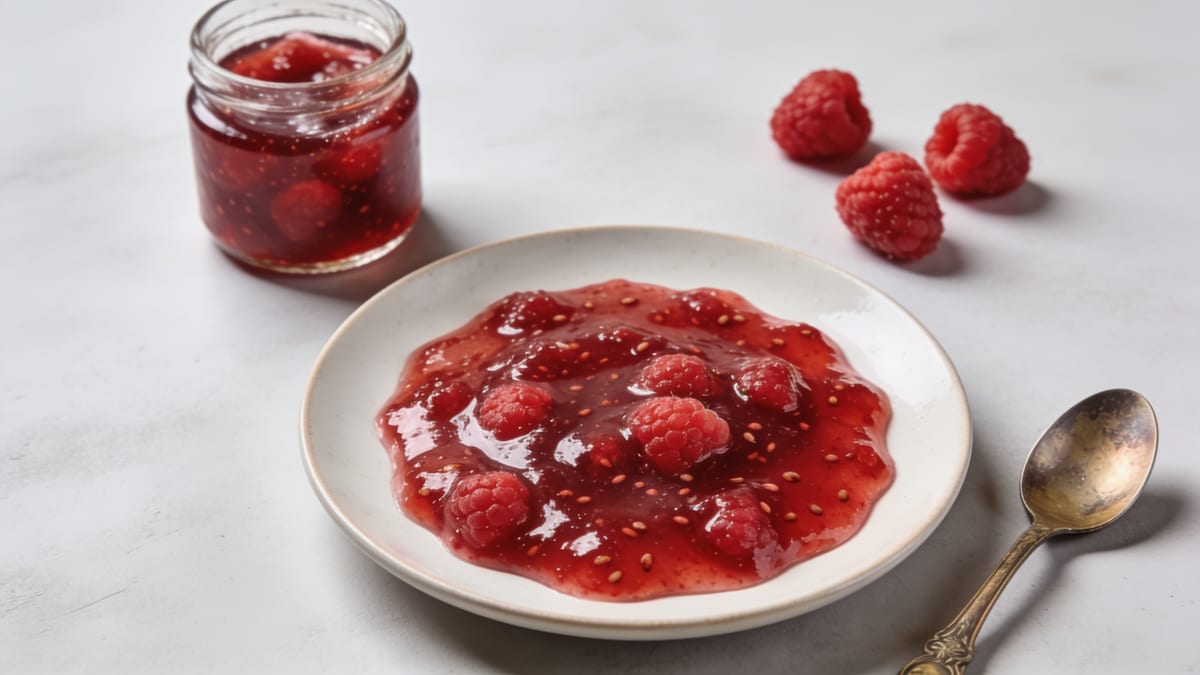
Toss 900 g (2 lb) raspberries with 700 g (3½ cups) sugar and 2 tablespoons lemon juice in a wide, heavy pot, crush lightly, and let them sit 15 minutes until syrupy. Warm over medium heat, stirring until the sugar fully dissolves, then crank to high and boil hard — stirring and scraping the bottom often, skimming foam — until the jam hits 104–105°C (219–220°F), about 10 to 15 minutes. Confirm the set by chilling a spoonful on a frozen plate: if it wrinkles when nudged, it's done. Ladle into hot, clean jars, leaving 6 mm (¼ inch) of headspace, then refrigerate, or water-bath process 10 minutes for a shelf-stable pantry jam.
- Use a wide pot, not a tall one — more surface area means faster evaporation, a quicker set, and fresher berry flavor.
- Dissolve the sugar completely before the mixture boils; undissolved crystals can make the finished jam grainy.
- Trust the frozen-plate wrinkle test over the clock — take the pot off the heat while you test so the jam can't overcook.
Equipment
- Wide, heavy-bottomed 5- to 6-quart pot or Dutch oven
- Instant-read or candy thermometer
- Potato masher
- Heatproof spatula or wooden spoon
- Ladle and canning funnel
- 4 half-pint (250 ml) jars with new lids
- Two small plates, chilled in the freezer
Ingredients
Jam
- 900 g fresh raspberries, ripe but not mushy; frozen work too — add them straight from the freezer
- 700 g granulated sugar
- 30 ml fresh lemon juice, from about 1 lemon; helps the set and balances sweetness
Method
- STEP01
Put two small plates in the freezer for testing the set later. Wash 4 half-pint jars and their lids in hot, soapy water and rinse well. Keep the jars hot in a 120°C (250°F) oven until you're ready to fill them — hot jam should always go into hot jars to avoid cracking.
- STEP02
Combine the raspberries, sugar, and lemon juice in a wide, heavy-bottomed 5- to 6-quart pot. Crush the fruit lightly with a potato masher — you want a rough, chunky pulp, not a purée. Let the mixture stand for 15 minutes, stirring once or twice, until the sugar starts dissolving and the berries look glossy and syrupy. This draws out juice so the fruit cooks in its own liquid.
- STEP03
Set the pot over medium heat and stir gently until every grain of sugar has dissolved — rub a drop of the syrup between two fingers; it should feel completely smooth, with no grit. Don't let it boil yet: sugar that boils before dissolving can crystallize and turn the finished jam grainy.
- STEP04
Raise the heat to high and bring the pot to a full rolling boil — one you can't stir down. Stir frequently with a heatproof spatula, scraping the bottom so nothing scorches, and skim off the pale pink foam that collects at the edges. The bubbles will change from light and frothy to slow, thick, and glassy as the jam approaches 104–105°C (219–220°F).
- STEP05
Slide the pot off the heat. Spoon a little jam onto one of your frozen plates, return the plate to the freezer for 1 minute, then push the blob with a fingertip. If the surface wrinkles and your finger leaves a clean track, the jam is set. If it's still runny, boil 2 to 3 minutes more and test again on the second plate.
- STEP06
Let the jam rest off the heat for 2 minutes, then give it one gentle stir so the seeds and fruit distribute evenly instead of floating. Ladle it into the hot jars through a canning funnel, leaving 6 mm (¼ inch) of headspace. Wipe the rims with a damp cloth and screw on the lids to fingertip-tight.
- STEP07
For shelf-stable jam, process the jars in a boiling water bath for 10 minutes, then let them cool undisturbed for 12 hours and check that the lids have sealed (they shouldn't flex when pressed). Otherwise, simply cool the jars to room temperature and refrigerate. The jam will finish setting as it cools over the next day.
Make ahead
Jam is the ultimate make-ahead project — the flavor actually rounds out after 24 hours, and the set continues to firm for a day or two, so don't judge the texture straight from the pot. You can also macerate the berries with the sugar and lemon juice, cover, and refrigerate overnight before cooking; the extra time draws out more juice and slightly shortens the boil.
Storage
Unprocessed jars keep in the refrigerator for up to 3 weeks, or in the freezer for up to 6 months (leave 1 cm / ½ inch of headspace for expansion). Water-bath-processed, sealed jars keep in a cool, dark pantry for up to 1 year; refrigerate after opening and use within 3 weeks. Always use a clean spoon to avoid introducing mold.
Variations
Seedless raspberry jam
After the sugar dissolves in step 3, press the hot mixture through a fine-mesh sieve to remove all or half of the seeds, return it to the pot, and proceed with the hard boil. Expect the yield to drop by about half a jar, and start checking for the set a couple of minutes earlier since there's slightly less bulk.
Lower-sugar version
Cut the sugar to 450 g (2¼ cups). The jam will be softer, more fruit-forward, and less sweet, but it needs a few extra minutes of boiling to thicken and won't keep as long — refrigerate and use within 2 weeks, or freeze. Don't reduce further without switching to a low-sugar pectin, which is formulated to set without relying on sugar concentration.
Raspberry-vanilla jam
Split a vanilla bean lengthwise, scrape the seeds into the pot, and drop in the pod during maceration. Fish out the pod before jarring. The vanilla softens the raspberries' sharp edge and makes the jam taste almost pastry-like — excellent on scones.
Serve with
Nutrition per serving
Nutrition values are estimates based on the metric measurements. Adjust as needed.
Frequently asked
Why doesn't this raspberry jam recipe use pectin?
Raspberries naturally contain a moderate amount of pectin, and the lemon juice provides the acidity that pectin needs to gel. By boiling the mixture hard to 104–105°C (220°F), you concentrate both the sugar and the fruit's own pectin until they set on their own. The payoff of a no-pectin raspberry jam recipe is flavor: a slightly longer boil deepens the berry taste, and the texture is soft and spoonable rather than bouncy.
Can I make this with frozen raspberries?
Yes, and it works beautifully — frozen berries are often picked riper than fresh ones. Add them to the pot straight from the freezer with the sugar and lemon juice; they'll release juice as they thaw, which replaces the maceration step. The boil may take 3 to 5 minutes longer because of the extra moisture, so rely on the thermometer and plate test rather than the clock.
My jam turned out runny. Can I fix it?
Almost always. Runny jam usually means it didn't quite reach setting temperature. Pour it back into the pot, bring it to a hard boil, and cook 3 to 5 minutes more, checking with the frozen-plate test. Also remember that jam thickens noticeably as it cools and continues to firm for 24 to 48 hours — what looks loose in the pot is often perfect the next morning.
Can I reduce the sugar in this raspberry jam recipe?
You can drop to about 450 g (2¼ cups) and still get a soft set, since the recipe doesn't depend on commercial pectin's strict ratios. Below that, the jam struggles to gel and spoils faster, because sugar is doing double duty as a thickener and a preservative. For a genuinely low-sugar jam, use a pectin labeled low- or no-sugar and follow its ratios instead.
Do I have to water-bath can the jars?
No — canning is only necessary if you want shelf-stable jars that live in the pantry. If you'll eat the jam within 3 weeks, just cool the filled jars and refrigerate them, or freeze extras for up to 6 months. If you do can it, use jars with new lids, process 10 minutes in boiling water, and check the seals once fully cool.
Cooked this? Rate it.
Real ratings from real cooks. We only show a score once enough of you have weighed in — no fabricated stars.