Macaroni and Cheese
A creamy baked macaroni and cheese built on a proper roux and three cheeses, finished with a buttered panko crust that shatters over a molten, deeply savory interior. This is the tested-three-times version that stays silky instead of grainy or greasy.
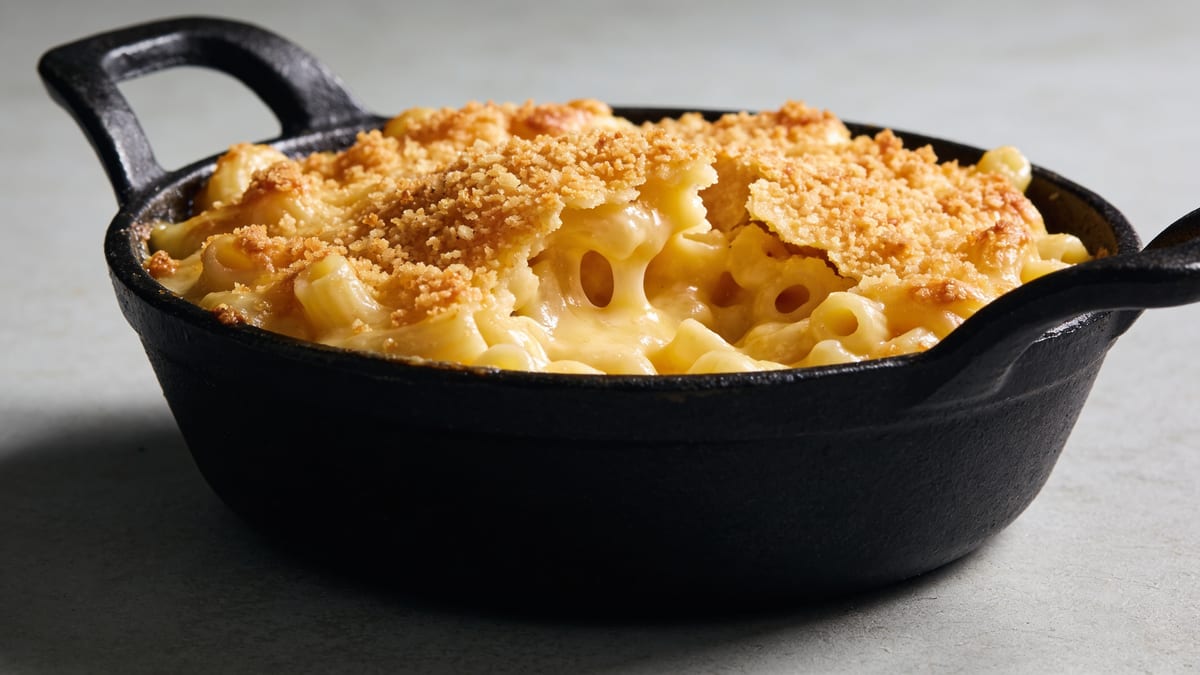
Cook the macaroni one minute shy of al dente, then build a smooth cheese sauce: whisk butter and flour into a blond roux, stream in warm milk and half-and-half until it thickens, kill the heat, and melt in freshly grated sharp cheddar, Gruyere, and a little cream cheese for gloss. Fold in the pasta, spread it into a buttered dish, blanket with buttered panko, and bake at 375F (190C) until bubbling with a golden crust. Rest 10 minutes so the sauce sets to a spoonable, creamy custard.
- Grate your own cheese; pre-shredded bags are coated in anti-caking starch that turns the sauce grainy.
- Take the pan off the heat before adding cheese so it emulsifies instead of breaking into oil.
- Undercook the pasta by a minute because it keeps cooking in the oven and in the hot sauce.
Equipment
- Large pot for boiling pasta
- Heavy-bottomed saucepan or Dutch oven
- Whisk
- Box grater or food processor
- 9x13-inch (3-quart) baking dish
- Colander
Składniki
Pasta
- 450 g Elbow macaroni, or cavatappi/shells for more sauce-catching ridges
- Kosher salt, for the pasta water, water should taste like the sea
Cheese sauce
- 60 g Unsalted butter
- 35 g All-purpose flour
- 480 ml Whole milk, warmed
- 360 ml Half-and-half, or use equal parts whole milk and heavy cream
- 340 g Sharp cheddar, freshly grated; a good aged orange cheddar for color and bite
- 115 g Gruyere, freshly grated; adds nutty depth and melt
- 60 g Cream cheese, softened; keeps the sauce glossy and stable
- 5 g Dijon mustard, sharpens the cheese without tasting of mustard
- Garlic powder
- Onion powder
- Sweet or smoked paprika
- Freshly grated nutmeg, classic with a bechamel; optional but recommended
- Cayenne pepper, optional, for warmth not heat
- Fine sea salt, plus more to taste
- Freshly ground black pepper
Crumb topping
- 60 g Panko breadcrumbs
- 30 g Unsalted butter, melted
- 30 g Sharp cheddar, for the topping
- Paprika, for dusting the top
Przygotowanie
- KROK01
Position a rack in the upper third of the oven and heat to 375F (190C). Butter a 9x13-inch (3-quart) baking dish. Grate all the cheese now and keep it at room temperature; cold cheese shocks the sauce. Bring a large pot of well-salted water to a rolling boil.
- KROK02
Add the macaroni and cook until just shy of al dente, about 1 minute less than the package directions (roughly 6 minutes for most elbows). It should still have a firm bite. Drain in a colander but do not rinse, then set aside; the residual starch helps the sauce cling.
- KROK03
In a heavy saucepan or Dutch oven over medium heat, melt the 4 tablespoons butter. Whisk in the flour and cook, whisking constantly, until it smells nutty and turns pale gold, 1 to 2 minutes. Keep it blond; you want a thickener, not a brown roux.
- KROK04
Slowly stream in the warm milk and half-and-half, whisking hard to prevent lumps. Bring to a gentle simmer and cook, whisking often, until the sauce thickly coats the back of a spoon and leaves a clean line when you swipe a finger through it, 4 to 6 minutes. Whisk in the Dijon, garlic powder, onion powder, paprika, nutmeg, cayenne, salt, and pepper.
- KROK05
Remove the pan from the heat and wait 30 seconds so it stops actively bubbling. Add the cream cheese and whisk smooth, then add the cheddar and Gruyere in three or four handfuls, whisking each addition until fully melted before adding more. Off-heat melting is what keeps the sauce silky instead of grainy or oily. Taste and adjust salt.
- KROK06
Fold the drained macaroni into the cheese sauce until every piece is coated. The mixture should look loose and saucy, almost too wet; it tightens in the oven. Scrape into the buttered baking dish and spread level.
- KROK07
Toss the panko with the 2 tablespoons melted butter and 1/4 cup cheddar, then scatter evenly over the top and dust with paprika. Bake at 375F (190C) until the edges bubble and the crust is deep golden, 22 to 28 minutes. For extra color, broil for the last 1 to 2 minutes, watching closely.
- KROK08
Let the dish rest 10 minutes out of the oven. This is not optional: the sauce sets from soupy to a spoonable, creamy custard, and the crust firms up. Serve warm.
Make ahead
Assemble fully (through topping) up to 24 hours ahead, cover, and refrigerate unbaked; add 8 to 10 minutes to the bake time and start it covered with foil so the center heats through before the top over-browns. The cheese sauce can also be made a day ahead and rewarmed slowly with a little milk before folding in freshly cooked pasta. For freezing, freeze unbaked for up to 2 months, thaw overnight in the fridge, then bake.
Storage
Refrigerate leftovers in an airtight container for up to 4 days. Reheat gently, covered, at 325F (165C) with a splash of milk stirred in to loosen the sauce, or microwave individual portions in 30-second bursts with a teaspoon of milk. Avoid high heat, which can break the sauce.
Variations
Extra-crispy stovetop version
Skip the oven entirely. Cook the pasta fully to al dente, make the sauce, fold everything together, and serve immediately for a looser, creamier mac and cheese. Great when you want it fast and don't care about a crust.
Bacon and jalapeno
Fry 6 slices of bacon until crisp, crumble, and fold half into the pasta with 1 to 2 seeded, minced jalapenos softened in the bacon fat. Scatter the rest over the crumb topping before baking for smoky heat in every bite.
Three-cheese lobster mac
Fold 340 g (12 oz) cooked lobster or crab meat into the finished pasta and swap half the cheddar for Fontina. Finish with chopped chives and a squeeze of lemon for a special-occasion upgrade.
Serve with
Nutrition per serving
Nutrition values are estimates based on the metric measurements. Adjust as needed.
Najczęstsze pytania
Why is my mac and cheese grainy or oily?
Two usual culprits: pre-shredded cheese and too much heat. Bagged shredded cheese is dusted with anti-caking starch that won't melt cleanly, so always grate from a block. And add cheese only after pulling the pan off the burner. Boiling cheese sauce breaks the emulsion, squeezing out oil and leaving grit. This mac and cheese recipe keeps things smooth by melting cheese off the heat and adding a little cream cheese to stabilize the sauce.
What are the best cheeses for mac and cheese?
A sharp aged cheddar for flavor is non-negotiable; it carries the dish. Blend it with a good melting cheese like Gruyere, Fontina, Gouda, or Monterey Jack for stretch and body, and a small amount of cream cheese or American cheese for a glossy, stable sauce. Avoid using only aged hard cheeses, which can turn oily on their own.
Should I use eggs in mac and cheese?
This roux-based (bechamel) recipe doesn't need eggs; the flour thickens the sauce. Custard-style Southern baked mac and cheese does use eggs and evaporated milk, setting into sliceable squares. Both are legitimate. If you want the creamy, saucy texture here, skip the eggs; the cream cheese in the topping ingredients note is what keeps it luscious.
Can I make mac and cheese ahead of time?
Yes. Assemble it completely, cover, and refrigerate up to 24 hours before baking. Bake straight from the fridge, adding 8 to 10 minutes and starting covered with foil so the center heats through without burning the crust. You can also freeze it unbaked for up to 2 months and thaw overnight before baking.
How do I keep baked mac and cheese from drying out?
Make the sauce looser than seems right; it should look almost soupy before baking because the pasta absorbs liquid in the oven. Undercook the pasta by a minute, don't over-bake (pull it when the edges just bubble), and rest it 10 minutes. When reheating, always stir in a splash of milk to bring the creaminess back.
Cooked this? Rate it.
Real ratings from real cooks. We only show a score once enough of you have weighed in — no fabricated stars.