Red Velvet Cake
A crimson, cocoa-kissed Southern layer cake with an ultra-plush crumb and a thick cap of tangy cream cheese frosting. Oil plus buttermilk keeps the layers moist for days, while a splash of vinegar reacting with baking soda gives red velvet its signature fine, velvety texture and deepens the color. Just two tablespoons of natural cocoa deliver that elusive not-quite-chocolate flavor that makes this cake unmistakable.
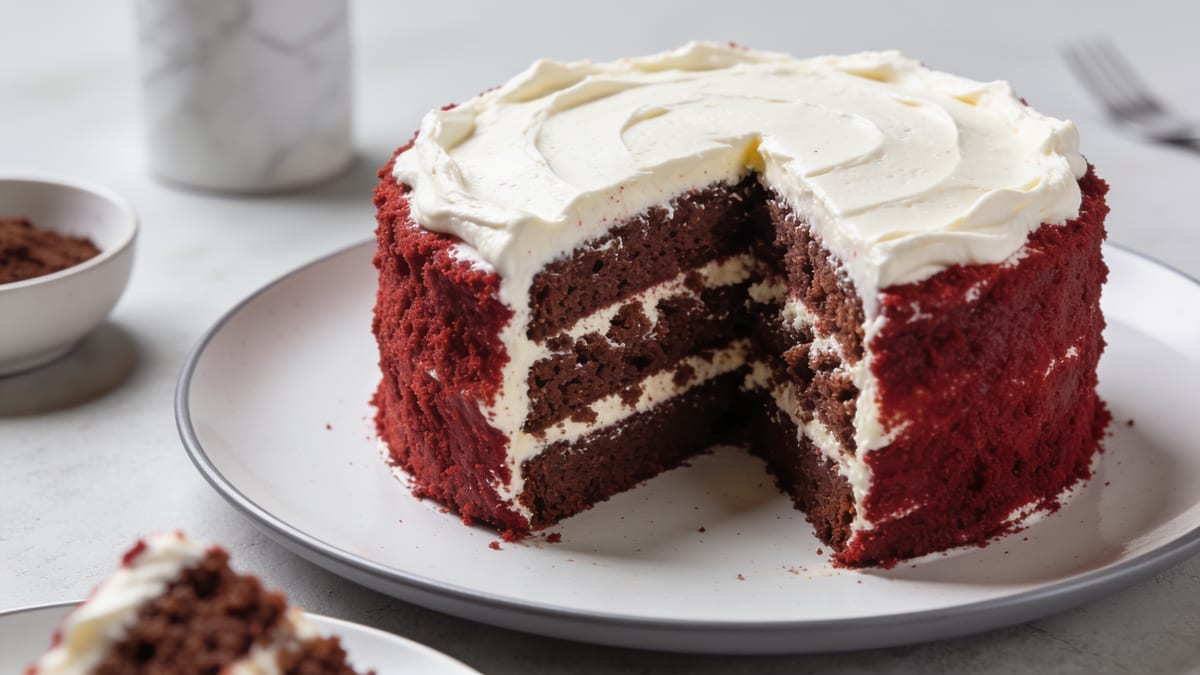
Heat the oven to 175°C (350°F) and grease and line two 23 cm (9-inch) round pans. Whisk 315 g flour, 2 tbsp natural cocoa, 1 tsp baking soda, and 1/2 tsp salt. In a second bowl beat 300 g sugar, 240 ml oil, and 2 eggs until glossy, then mix in 240 ml room-temperature buttermilk, 2 tsp vanilla, 1 tbsp red food coloring, and 1 tbsp white vinegar. Fold the dry mix into the wet just until no flour streaks remain, divide between the pans, and bake 28-32 minutes until a toothpick comes out with a few moist crumbs. Cool 15 minutes in the pans, then fully on a rack (about 1 hour). Beat 450 g cream cheese with 115 g softened butter, then add 420 g powdered sugar, 2 tsp vanilla, and a pinch of salt; stack, fill, and frost.
- Use natural (not Dutch-process) cocoa - its acidity works with the buttermilk and vinegar to keep the crumb tender and the color vivid.
- Stop mixing the moment the flour disappears; overworked batter turns red velvet rubbery instead of plush.
- Frost only fully cooled layers - even slightly warm cake melts cream cheese frosting into a slide.
Equipment
- Two 23 cm (9-inch) round cake pans
- Electric hand or stand mixer
- Large mixing bowls
- Whisk
- Silicone spatula
- Wire cooling rack
- Offset spatula
Składniki
Cake layers
- 315 g all-purpose flour, spooned and leveled
- 15 g natural unsweetened cocoa powder, not Dutch-process
- 5 g baking soda
- 3 g fine sea salt
- 300 g granulated sugar
- 240 ml neutral vegetable oil, canola or sunflower
- large eggs, room temperature
- 240 ml buttermilk, room temperature
- 10 ml vanilla extract
- 15 ml liquid red food coloring, or 1 tsp gel coloring
- 15 ml distilled white vinegar
Cream cheese frosting
- 450 g full-fat brick cream cheese, slightly softened, not spreadable-tub style
- 115 g unsalted butter, softened
- 420 g powdered sugar, sifted if lumpy
- 10 ml vanilla extract
- 1 g fine sea salt
Przygotowanie
- KROK01
Heat the oven to 175°C (350°F) with a rack in the center. Grease two 23 cm (9-inch) round cake pans, line the bottoms with parchment rounds, and grease the parchment. Pull the eggs and buttermilk out so they lose their fridge chill - cold dairy can make the oil seize into clumps.
- KROK02
In a medium bowl, whisk together the flour, cocoa powder, baking soda, and salt for a good 30 seconds so the cocoa and leavening are evenly distributed. Set aside.
- KROK03
In a large bowl, beat the sugar, oil, and eggs with a mixer on medium for about 2 minutes, until thick and glossy. Beat in the buttermilk, vanilla, red food coloring, and vinegar on low until the color is uniform. Scrape the bowl - streaks of un-tinted batter hide at the bottom.
- KROK04
Add the dry ingredients to the wet in two additions, mixing on low and stopping as soon as the last flour streak disappears. Finish with a few folds of a spatula. Divide the batter evenly between the pans (about 620 g each if you have a scale) and smooth the tops.
- KROK05
Bake for 28-32 minutes, until the centers spring back when lightly pressed and a toothpick comes out with a few moist crumbs but no wet batter. Avoid opening the oven before the 25-minute mark or the centers can dip.
- KROK06
Cool the layers in their pans on a wire rack for 15 minutes, then run a thin knife around the edges, turn them out, peel off the parchment, and cool completely, about 45 more minutes. Warm layers will melt the frosting, so do not rush this.
- KROK07
Beat the cream cheese and butter on medium until completely smooth, about 2 minutes. Add the powdered sugar in two batches with the vanilla and salt, mixing on low until incorporated, then beat on medium just until fluffy - overbeating cream cheese thins it out. Chill 10 minutes if it feels loose.
- KROK08
If the layers domed, level them with a serrated knife (crumble the trimmings for garnish). Set one layer on a plate, spread about a third of the frosting to the edges, top with the second layer cut-side down, and frost the top and sides with the rest. Scatter reserved red crumbs over the top if you like, then slice with a clean, warm knife.
Make ahead
Bake the layers up to 2 days ahead: cool completely, wrap tightly in plastic, and hold at room temperature (or freeze, wrapped, up to 2 months - they level and frost more neatly when chilled). The frosting can be made 3 days ahead and refrigerated; let it soften for 30 minutes and re-beat briefly before spreading. A fully assembled cake is at its best made the day before and refrigerated overnight, which also makes for cleaner slices.
Storage
Because of the cream cheese frosting, store the cake covered in the refrigerator for up to 4 days; a cake keeper or an inverted bowl prevents the frosting from absorbing fridge odors. The crumb tightens when cold, so let slices sit at room temperature for 30-45 minutes before serving. Frosted slices also freeze well: freeze uncovered until firm, then wrap in plastic and freeze up to 2 months, thawing overnight in the fridge.
Variations
Red velvet cupcakes
Line 24 muffin cups, fill each two-thirds full, and bake at 175°C (350°F) for 18-20 minutes. Cool completely and pipe the frosting on with a large round tip. Same batter, same frosting, party-friendly format.
Gluten-free swap
Replace the all-purpose flour with an equal weight (315 g) of a 1:1 gluten-free baking blend that contains xanthan gum. The oil-and-buttermilk formula is forgiving here; let the batter rest 10 minutes before baking to hydrate the blend, and expect a bake time at the longer end of the range.
Naturally colored with beets
Skip the food coloring and beat 120 ml (1/2 cup) pureed roasted beets into the wet ingredients, reducing the buttermilk to 180 ml (3/4 cup). The color bakes up more brick-red than scarlet and the crumb stays just as moist, with no detectable beet flavor under the cocoa.
Serve with
Nutrition per serving
Nutrition values are estimates based on the metric measurements. Adjust as needed.
Najczęstsze pytania
Why does this red velvet cake recipe call for both buttermilk and vinegar?
They are doing two different jobs. The buttermilk tenderizes the crumb and adds the subtle tang red velvet is known for, while the tablespoon of vinegar gives the baking soda an immediate acid hit, so the batter aerates quickly and bakes up with that signature fine, velvety texture. The acidic environment also keeps the red color brighter, which is how the cake got its hue in the days before food coloring.
Can I skip the red food coloring?
Yes - the cake will taste identical, just bake up a natural cocoa-brown. If you want color without synthetic dye, use the beet variation, or look for plant-based colorings made from beet or radish concentrate; use about double the amount, since natural colorings fade more in the oven. Gel coloring is the most efficient option if you want a deep scarlet with only a teaspoon.
Is red velvet just chocolate cake with food coloring?
No. A true red velvet cake recipe uses only a small amount of cocoa - two tablespoons here versus 60-90 grams in a chocolate cake - so cocoa is a background note rather than the star. The defining features are the buttermilk-and-vinegar tang, the extra-fine oil-based crumb, and the cream cheese frosting. If you taste it blind, it reads as its own flavor, not as mild chocolate.
Why did my cake turn out dry or dense?
The usual culprits are too much flour and overmixing. Spoon flour into the cup and level it (or better, weigh 315 g) - scooping straight from the bag can pack in 20 percent extra. Once the flour goes in, mix only until it disappears; beating develops gluten and turns the velvet texture gummy. Finally, check doneness at 28 minutes: even 5 extra minutes in the oven noticeably dries an oil-based cake.
My cream cheese frosting is too runny to spread. How do I fix it?
Start with brick-style cream cheese that is cool to the touch, not fully softened - tub-style spread contains more water and rarely thickens properly. If the frosting is already loose, refrigerate it for 15-20 minutes and stir; the butter will firm it up. Resist the urge to fix it with lots of extra powdered sugar, which makes it cloying, and avoid beating on high once the sugar is in, since overwhipping breaks cream cheese down and thins it further.
Cooked this? Rate it.
Real ratings from real cooks. We only show a score once enough of you have weighed in — no fabricated stars.