Carne Asada
Thin skirt steak marinated in citrus, garlic, and toasted chile, then charred fast and hard over a screaming-hot fire until the edges are lacquered and the center still blushes. Sliced against the grain, it's the smoky, juicy heart of every great taco de carne asada.
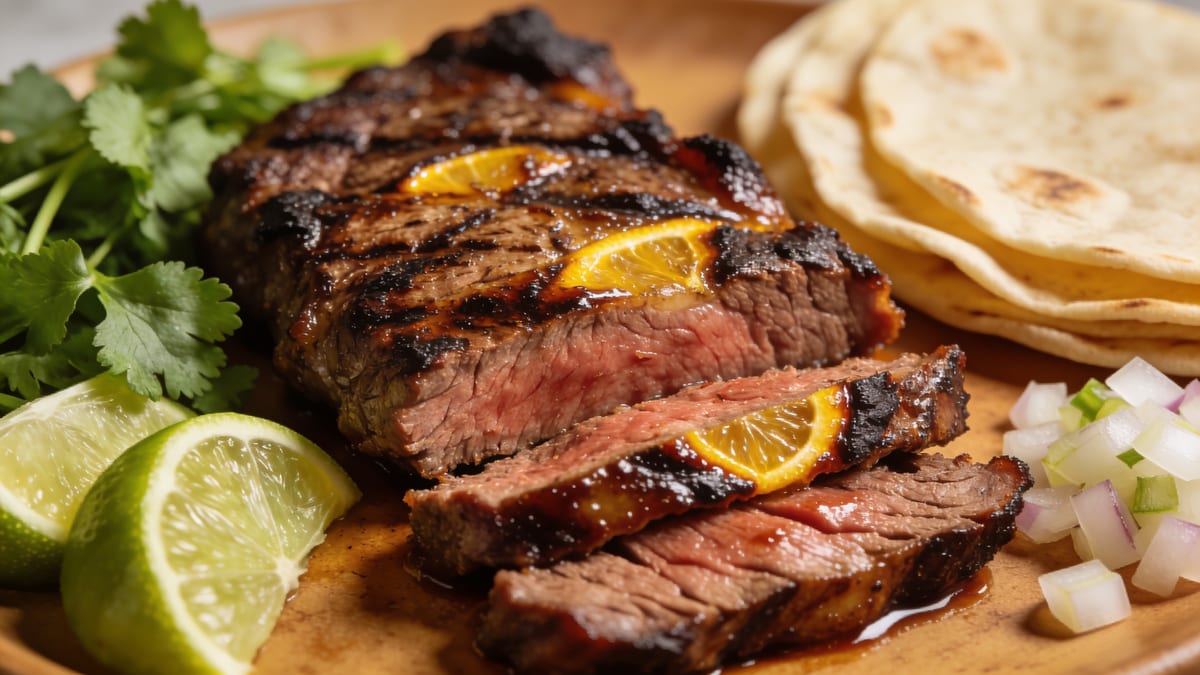
Marinate skirt steak 1-4 hours in a blend of orange and lime juice, garlic, cilantro, cumin, and a little soy sauce, then grill over the hottest fire you can build for 2-3 minutes per side until deeply charred and medium-rare (52°C / 125°F). Rest 10 minutes, then slice thin against the grain.
- Skirt or flank steak is the cut — thin, well-marbled, and built for fast, hot cooking. Nothing else gives the right chew.
- Keep the marinade acid to 1-4 hours max; longer and the citrus 'cooks' the surface into mush.
- The fire must be truly hot. You want char in 2-3 minutes a side, not a slow gray braise. Slice thin against the grain or it eats tough.
Equipment
- Charcoal grill or heavy cast-iron skillet/griddle
- Chimney starter (for charcoal)
- Instant-read thermometer
- Sharp chef's knife or slicing knife
- Blender or molcajete (for the marinade)
- Tongs
Ingredientes
Steak
- 1 kg skirt steak (outside skirt preferred), or flank steak, trimmed of excess surface fat and membrane
- 12 g kosher salt, for finishing, applied just before grilling
Citrus-chile marinade
- 120 ml orange juice, fresh; a Valencia or navel orange
- 60 ml lime juice, fresh, from about 3 limes
- 60 ml neutral oil, avocado or grapeseed
- 30 ml soy sauce, the umami backbone in Northern-Mexico-style asada
- 6 garlic cloves, smashed
- 20 g cilantro, stems and leaves, chopped
- 1 jalapeño, seeded and roughly chopped, or 1 chipotle in adobo for smoke
- 3 g ground cumin, toasted whole then ground, ideally
- 2 g dried Mexican oregano
- 2 g black pepper, freshly ground
To serve
- 12-16 warm corn tortillas
- 1 small white onion, finely diced
- 1 handful cilantro, chopped
- 2 limes lime wedges
- salsa verde or salsa roja, to taste
Preparação
- PASSO01
Blend the orange juice, lime juice, oil, soy sauce, garlic, cilantro, jalapeño, cumin, oregano, and black pepper until mostly smooth. Do not add salt to the marinade — salt draws moisture and, over hours, makes the surface pasty. Taste: it should be bright, garlicky, and savory.
- PASSO02
Pat the steak dry, lay it in a dish or zip-top bag, and pour over all but a few tablespoons of the marinade (reserve those for basting). Turn to coat, cover, and refrigerate 1 hour minimum and 4 hours maximum. Beyond 4 hours the citrus starts to denature the surface proteins and the texture turns mealy.
- PASSO03
Light a full chimney of charcoal and pour it into a single mound for a hot zone plus a small cooler zone. You want the grate ripping hot — hold your hand 10 cm above it and you should last barely 2 seconds. On a stove, heat cast iron over high until it lightly smokes. Skirt steak needs ferocious heat to char before it overcooks.
- PASSO04
Pull the steak from the marinade and pat it thoroughly dry with paper towels — surface moisture is the enemy of char. Season both sides generously with the kosher salt right before it hits the grate. If your skirt is long, cut it into grill-length pieces.
- PASSO05
Lay the steak over the hottest part of the fire. Grill 2-3 minutes per side, undisturbed, until a deep browned-and-blistered crust forms. Baste once with the reserved marinade after the first flip. Thin skirt goes from raw to overdone in under a minute, so stay on it.
- PASSO06
Pull the steak at 52°C / 125°F at the thickest point for medium-rare — it will climb to about 57°C / 135°F while resting. Skirt is best medium-rare to medium; pushed past that it toughens fast. Thin sections cook quickest, so check the fattest part.
- PASSO07
Move the steak to a board and rest 10 minutes, loosely tented. Find the direction of the muscle fibers — on skirt they run the short way across the strip — and slice thin, no thicker than 5 mm, straight across (perpendicular to) those fibers. Cutting with the grain is the single most common reason home carne asada turns out chewy.
- PASSO08
Chop the slices into bite-size pieces for tacos, or leave them long for a platter. Pile into warm corn tortillas with diced onion, cilantro, a squeeze of lime, and salsa. Serve immediately, while the char is still crackling.
Make ahead
The marinade can be blended up to 2 days ahead and refrigerated. Marinate the steak the same day you grill (1-4 hours only). For a party, grill and slice up to 2 hours ahead, keep loosely covered at room temperature, and give the slices a quick sear on a hot comal right before serving to bring back the crust.
Storage
Cooked carne asada keeps 3-4 days airtight in the fridge. Reheat fast and hot — a screaming skillet for 30-60 seconds, or a comal — to re-crisp the edges rather than steam it soft in the microwave. It also freezes well for up to 2 months; thaw overnight before searing.
Variations
Sonoran / Northern-style with beer
Swap the orange juice for 120 ml of a light Mexican lager and add a splash of Worcestershire. This is the classic Norteño move — the beer's malt deepens the char and the meat reads a touch more savory than citrusy.
Dry-rub, no marinade
Skip the wet marinade entirely. Rub the steak with a paste of oil, minced garlic, cumin, ancho powder, oregano, and salt 30 minutes before grilling. Faster, and it gives a drier, more intense crust — closer to Texas-style fajita beef.
Chipotle-orange
Add 2 chipotles in adobo plus a tablespoon of the adobo sauce to the blender. Smokier and gently spicy, with a burnished orange color that lacquers beautifully over the fire.
Serve with
Nutrition per serving
Nutrition values are estimates based on the metric measurements. Adjust as needed.
Perguntas frequentes
What cut of beef is best for carne asada?
Skirt steak (arrachera) is the traditional and best choice for carne asada — it's thin, richly marbled, and full of beefy flavor that stands up to a hot fire and a bold marinade. Flank steak is the most common substitute; it's leaner and a bit chewier but works well. Both must be sliced thin against the grain. Avoid thick cuts like sirloin or ribeye here — they can't char and cook through in the fast, high-heat window that defines carne asada.
How long should I marinate carne asada?
One to four hours is the sweet spot. You need at least an hour for the garlic, citrus, and spices to season the meat, but the acid in the orange and lime juice will start to 'cook' and mush the surface if you go much past four hours. If you're short on time, even 30 minutes adds real flavor. Never marinate overnight in a citrus-heavy marinade.
Why is my carne asada tough?
Almost always one of two things: you cooked it too long, or you sliced it the wrong way. Skirt and flank are best at medium-rare (52°C / 125°F pulled); past medium they seize up and turn leathery. Just as important, slice thin and strictly against the grain — perpendicular to the muscle fibers — which shortens them so every bite is tender. Cutting with the grain will make even a perfectly cooked steak chewy.
Can I make carne asada without a grill?
Yes. A heavy cast-iron skillet or griddle over high heat until it just smokes is the best indoor stand-in — it delivers the same hard sear. Work in batches so you don't crowd and steam the meat, and crack a window or run the fan; it will smoke. A broiler set to high with the rack close to the element also works in a pinch.
What's the difference between carne asada as a dish and as tacos?
Carne asada literally means 'grilled meat' — it refers to the marinated, char-grilled beef itself. Tacos de carne asada are just that meat, chopped and tucked into warm corn tortillas with onion, cilantro, lime, and salsa. The same steak also anchors platters, burritos, fries, and tortas, so nailing the meat is what matters most.
Cooked this? Rate it.
Real ratings from real cooks. We only show a score once enough of you have weighed in — no fabricated stars.