Dongpo Pork — Chinese Red-Braised Pork Belly
A glistening masterpiece of Hangzhou cuisine, named for the Song-dynasty poet Su Dongpo: thick squares of pork belly slow-braised in Shaoxing wine, soy sauce and sugar with ginger and scallion until the meat is meltingly tender and the fat turns silky and jelly-like. The cubes emerge mahogany-glazed and so soft they can be cut with chopsticks, balancing rich and sweet, savoury and aromatic. Cooked low and slow until the sauce reduces to a glossy syrup, Dongpo pork is a celebrated banquet dish — the very definition of luxurious, melt-in-the-mouth red-braised pork.
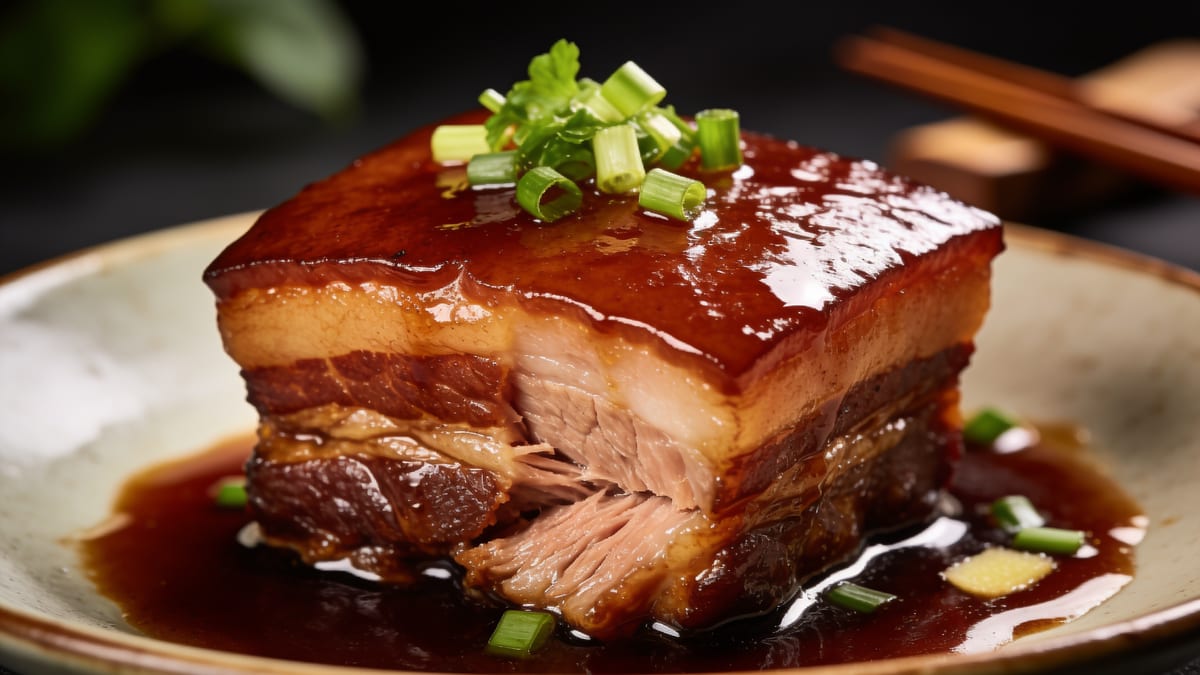
Blanch a piece of skin-on pork belly, then cut it into large thick squares and tie each with kitchen string to hold its shape. Lay a bed of scallions and ginger slices in a heavy pot (this lifts the pork off the base and perfumes it), set the pork on top skin-side down, and add Shaoxing wine, soy sauce (light and dark), rock sugar and a little water. Braise very gently, covered, for a couple of hours — turning once — until the belly is meltingly soft and the fat is jelly-like. Then turn the pieces skin-side up and reduce the sauce to a glossy, syrupy glaze, basting, until the pork is mahogany and shining. Steam briefly to finish and serve.
- Braise low and slow for hours — the soft, jelly-like fat and chopstick-tender meat only come with time.
- Use lots of Shaoxing wine (more than water) and rock sugar for the signature glossy, sweet-savoury glaze.
- Sit the pork on a bed of scallion and ginger so it doesn't catch, and reduce the sauce to a syrup at the end.
Equipment
- Heavy lidded pot or clay pot
- Kitchen string
- Steamer (optional)
Ингредиенты
Pork
- 800 g skin-on pork belly, in one piece
- 6 scallions; a thumb of ginger, sliced
Braising liquid
- 250 ml Shaoxing wine
- 4 tbsp light soy sauce; 1 tbsp dark soy sauce
- 50 g rock sugar
- Water to come partway up; star anise (optional)
Приготовление
- ШАГ01
Blanch the whole piece of pork belly in boiling water for a few minutes to clean it, then drain. Cut it into large thick squares (about 5cm) and tie each square with kitchen string so it holds its shape during the long braise.
- ШАГ02
Lay a thick bed of whole scallions and ginger slices over the base of a heavy pot — this keeps the pork off the bottom so it won't catch, and perfumes it. Arrange the pork squares skin-side down on top.
- ШАГ03
Add the Shaoxing wine, both soy sauces, rock sugar and enough water to come partway up the pork (and star anise if using). Bring to a gentle simmer, cover, and braise very gently for about 2 hours, turning once, until the pork is meltingly tender and the fat is soft and jelly-like.
- ШАГ04
Turn the pork squares skin-side up. Uncover and reduce the braising liquid over higher heat to a glossy, syrupy glaze, spooning it over the pork as it thickens, until the squares are deep mahogany and shining.
- ШАГ05
Transfer the pork (snip off the strings) to a heatproof bowl, pour over the glaze, and steam for 10–20 minutes to finish — this makes it even more tender. Serve each glistening square with steamed rice and greens, spooning the sauce over.
Make ahead
Dongpo pork is excellent made ahead — the long braise can be done a day or two before, and the flavour and texture actually improve as it rests in its sauce overnight. Refrigerate the braised, glazed pork in its liquid, then gently reheat (steaming is ideal) until hot, soft and glossy before serving. This makes it perfect for entertaining, since the time-consuming braising is all done in advance.
Storage
Dongpo pork keeps 3–4 days refrigerated and, like most braises, deepens in flavour overnight — the sauce sets to a jelly when cold (that's the gelatin) and re-melts when warmed. Reheat gently by steaming or simmering in its sauce until hot and glossy again. It freezes well too. The fat is meant to be soft and luscious; reheating restores that silky texture, so it's a great make-ahead dish.
Variations
Hong shao rou
The closely related 'red-braised pork', usually cut into smaller bite-size cubes rather than large tied squares.
With accompaniments
Braise with hard-boiled eggs, tofu knots or dried bamboo, which soak up the rich sauce.
Steamed buns
Tuck the soft pork into folded lotus-leaf buns (gua bao style) for a handheld treat.
Serve with
Nutrition per serving
Nutrition values are estimates based on the metric measurements. Adjust as needed.
Частые вопросы
What is Dongpo pork?
Dongpo pork (东坡肉) is a famous braised pork belly dish from Hangzhou in eastern China, named after the Song-dynasty poet and gourmet Su Dongpo. Large squares of skin-on pork belly are slowly braised in Shaoxing wine, soy sauce and sugar with ginger and scallion until the meat is spoon-tender and the fat turns silky and almost jelly-like, then glazed to a glossy mahogany. It's a celebrated, indulgent banquet dish prized for its melting texture and balance of rich, sweet and savoury flavours.
How is it different from hong shao rou?
They're close relatives — both are red-braised pork belly with the same sweet-savoury soy-and-wine flavour. The main differences are presentation and cut: Dongpo pork uses large, thick squares (often tied with string and sometimes steamed to finish), braised gently to keep their shape and showcased as elegant individual portions; hong shao rou ('red-cooked pork') is typically cut into smaller bite-size cubes and is more of an everyday home dish. Dongpo pork is the more refined, banquet-style version.
Why braise it for so long?
Pork belly is layered with fat and connective tissue, and only long, gentle braising breaks that collagen down into gelatin — which is what makes the meat fall-apart tender and turns the fat soft, silky and jelly-like rather than greasy or tough. Rushing it leaves the fat firm and the meat chewy. Low and slow (around two hours) also lets the pork soak up the wine-and-soy flavour and the sauce reduce to a glaze. Patience is the whole secret to its luxurious texture.
What is Shaoxing wine and can I substitute it?
Shaoxing wine is a Chinese amber rice wine, fundamental to the flavour of Dongpo pork — it adds depth, aroma and a mellow sweetness, and traditionally a generous amount is used (often more wine than water). You'll find it at Chinese groceries. If you must substitute, a dry sherry is the closest match; in a pinch, a dry rice wine or even a splash of mirin (reduce the added sugar) can work, but the dish really benefits from real Shaoxing wine, so it's worth seeking out.
Do I have to tie the pork with string?
Tying each square of pork belly with kitchen string helps it keep its neat, layered shape through the long braise and looks beautiful when served — the meat becomes so tender it could otherwise fall apart. It's traditional for the elegant, banquet-style presentation of Dongpo pork. That said, if you don't mind a more rustic look (or you're making the cubed hong shao rou style), you can skip the string; just handle the soft pork gently when turning and serving so the pieces stay intact.
Cooked this? Rate it.
Real ratings from real cooks. We only show a score once enough of you have weighed in — no fabricated stars.