Haluski
Haluski is the Polish-American answer to a cold night: sweet, butter-browned cabbage and golden onions folded through tender wide egg noodles. Salting the cabbage the moment it hits the pan draws off its water so it fries and caramelizes instead of steaming, which is what turns four humble ingredients into something deeply savory. The noodles go in slightly underdone so they finish in the pan and drink up the buttery cabbage juices.
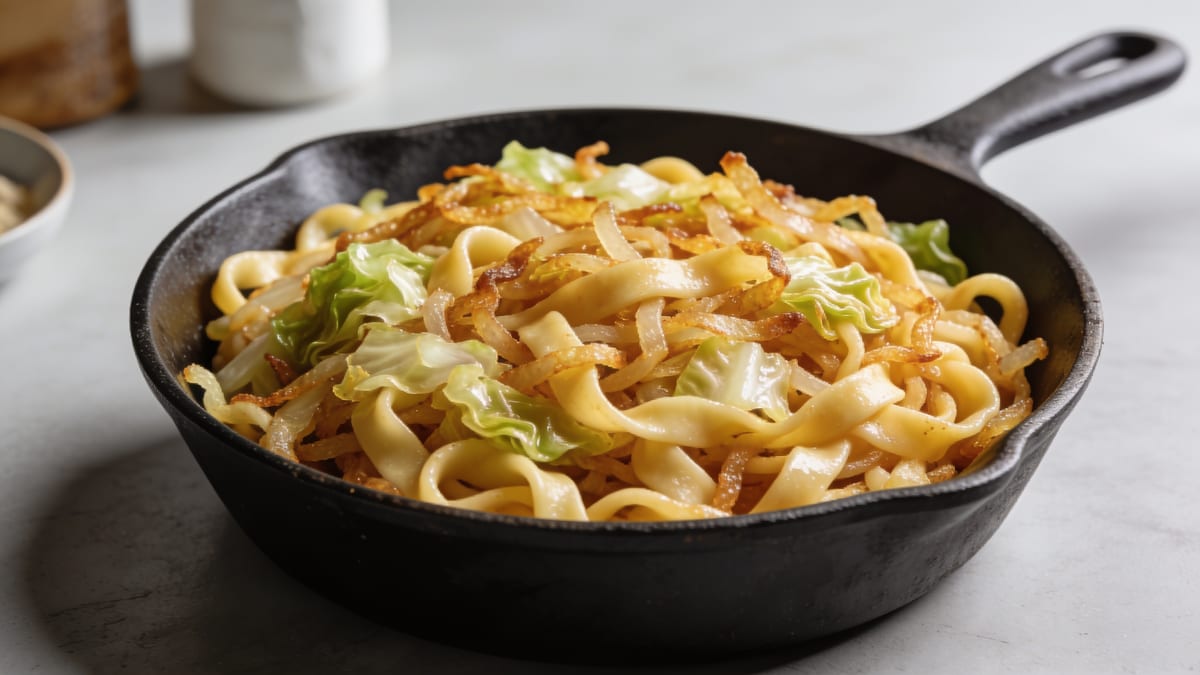
Boil 340 g (12 oz) wide egg noodles in well-salted water until one minute shy of tender and reserve 120 ml (1/2 cup) of the cooking water. Meanwhile, melt 6 tablespoons of butter in a Dutch oven over medium heat and cook one large sliced onion until golden, about 8 minutes; add a chopped medium head of green cabbage in two additions with 1 1/2 teaspoons of salt and cook over medium-high, stirring only occasionally, for 18 to 20 minutes until the cabbage is silky, sweet, and browned at the edges. Fold in the drained noodles, the last 2 tablespoons of butter, a splash of the reserved water, and plenty of coarse black pepper, then spread everything flat and let it sizzle undisturbed for 2 to 3 minutes so the bottom picks up golden, toasty spots before serving hot.
- Salt the cabbage the moment it hits the pan — it pulls out moisture so the leaves fry and caramelize instead of steaming into a soggy pile.
- Undercook the noodles by a minute and never rinse them; they finish in the pan and soak up the buttery cabbage juices without going mushy.
- Stop stirring near the end — 2 to 3 undisturbed minutes over medium-high heat builds the browned, nutty edges that make haluski taste like far more than four ingredients.
Equipment
- Large Dutch oven or 30 cm / 12-inch high-sided skillet
- Large pot for boiling noodles
- Colander
- Chef's knife
- Cutting board
- Wooden spoon or silicone spatula
- Heatproof measuring cup (for reserving noodle water)
Ингредиенты
Cabbage and onions
- 85 g unsalted butter, for the cabbage; more goes in at the end
- large yellow onion, halved and sliced 5 mm / 1/4 inch thick
- 1.2 kg green cabbage, quartered, cored, and chopped into 2.5 cm / 1-inch pieces
- 9 g fine sea salt, plus more for the noodle water
- 2 g caraway seeds, optional but traditional-tasting
Noodles and finishing
- 340 g wide egg noodles, or kluski noodles
- 30 g unsalted butter, stirred in at the end
- 120 ml reserved noodle cooking water, saved before draining
- 2 g freshly ground black pepper, coarsely ground, to taste
Приготовление
- ШАГ01
Quarter the cabbage through the core, cut out the core, and chop the leaves into rough 2.5 cm / 1-inch pieces — you should have about 16 cups. Do not shred it finely; bigger pieces stay silky instead of collapsing. Halve the onion and slice it 5 mm / 1/4 inch thick.
- ШАГ02
Melt 85 g (6 tbsp) butter in a large Dutch oven or 30 cm / 12-inch high-sided skillet over medium heat. Add the onion with a small pinch of salt and cook, stirring now and then, until soft and golden at the edges, about 8 minutes. Golden — not just translucent — onions are the flavor base here.
- ШАГ03
While the onions cook, bring a large pot of generously salted water to a boil. Cook the egg noodles for 1 minute less than the package directs, until just shy of tender. Scoop out 120 ml (1/2 cup) of the cooking water, then drain the noodles. Do not rinse — the surface starch helps the butter cling.
- ШАГ04
Raise the heat to medium-high. Add half the cabbage and half the 1 1/2 teaspoons of salt; stir until it slumps enough to fit the rest, then add the remaining cabbage, remaining salt, and the caraway if using. Cook, stirring only every few minutes, until the cabbage is fully tender, sweet, and browned in spots at the edges, 18 to 20 minutes. If the pan threatens to scorch, lower the heat slightly rather than adding liquid.
- ШАГ05
Reduce the heat to medium. Add the drained noodles, the remaining 30 g (2 tbsp) butter, about 60 ml (1/4 cup) of the reserved noodle water, and the black pepper. Toss with tongs or a wooden spoon until every noodle is glossy and streaked with cabbage.
- ШАГ06
Spread the mixture into an even layer, nudge the heat back to medium-high, and leave it completely alone for 2 to 3 minutes so the bottom develops golden, toasty patches. Fold once and, if you like it extra brown, repeat one more time.
- ШАГ07
Taste and adjust with more salt and a heavy hand of black pepper — cabbage and noodles both need aggressive seasoning. If the pan looks dry, loosen with the last splash of reserved noodle water. Serve hot, straight from the pot.
Make ahead
The cabbage-and-onion base can be cooked up to 2 days ahead and refrigerated; it actually deepens in flavor overnight. When ready to serve, boil the noodles fresh, rewarm the cabbage in a skillet with a little butter, and toss everything together with a splash of the noodle water.
Storage
Refrigerate leftovers in an airtight container for up to 4 days. Reheat in a skillet over medium heat with a small knob of butter and a splash of water, tossing until steaming — the microwave works but softens the noodles. Freezing is possible for up to 2 months, though the noodles come back noticeably softer; thaw overnight in the fridge before reheating in a skillet.
Variations
Kielbasa haluski
Brown 340 g (12 oz) of sliced smoked kielbasa in the pot first, remove it, cook the onions and cabbage in the drippings plus 4 tablespoons of butter (instead of 6), and stir the sausage back in with the noodles. This is how many Polish-American families serve it as a heartier one-pot dinner.
Vegan haluski
Swap the butter for 90 ml (6 tbsp) olive oil or a good vegan butter and use an eggless pasta such as broken pappardelle-style ribbons made from durum wheat, or gluten-free ribbons to also skip the gluten. A teaspoon of white miso stirred in with the noodle water restores some of the savory depth the butter would have provided.
Bacon and caraway
Render 150 g (about 6 slices) of chopped thick-cut bacon until crisp, cook the onions in the fat with only 2 tablespoons of butter, and finish with the crisp bacon and a full teaspoon of toasted caraway. Smoky, salty, and closer to the diner-style versions of western Pennsylvania.
Serve with
Nutrition per serving
Nutrition values are estimates based on the metric measurements. Adjust as needed.
Частые вопросы
What kind of cabbage is best for haluski?
Plain green cabbage is the classic choice for haluski — it holds its structure through 20 minutes of cooking and turns sweet and silky rather than mushy. Savoy cabbage works too but wilts faster, so cut its cooking time by about 5 minutes. Skip red cabbage; it bleeds purple into the noodles and tastes noticeably sharper.
Does authentic haluski have meat in it?
The butter-only version in this recipe is the traditional meatless one, historically served on Fridays and during Lent. That said, bacon and kielbasa versions are just as common on Polish-American tables, especially around Pittsburgh and Cleveland. Worth knowing: in Slovakia, halušky refers to small potato dumplings, while the cabbage-and-noodle dish most Americans call haluski is largely a Polish-American tradition.
Why did my haluski turn out watery and bland?
Three usual culprits. First, an unsalted or overcrowded pan: salt added at the start pulls water out of the cabbage early so it can evaporate and let the cabbage brown, and a wide pot gives that steam room to escape. Second, finely shredded cabbage, which releases its water all at once and collapses. Third, under-seasoning at the end — a big pot of cabbage and noodles absorbs a surprising amount of salt and pepper, so taste and adjust aggressively before serving.
Can I use a different pasta for haluski?
Wide egg noodles or kluski noodles are traditional because their soft, eggy texture matches the tender cabbage. If you cannot find them, break dried pappardelle or fettuccine into 5 cm / 2-inch lengths and cook it a minute shy of al dente. Avoid thin pastas like spaghetti or angel hair — they clump and disappear into the cabbage instead of standing up to it.
How far ahead can I make haluski for a potluck?
The whole dish holds well for a day: refrigerate it once cool, then reheat in a wide skillet with a knob of butter and a few spoonfuls of water, tossing until steaming hot. For the best texture, cook the cabbage base up to two days ahead and boil the noodles the day you serve. In a slow cooker set to warm, finished haluski holds happily for about two hours — stir in a little butter before guests arrive.
Cooked this? Rate it.
Real ratings from real cooks. We only show a score once enough of you have weighed in — no fabricated stars.