Buttermilk Pie
Buttermilk pie is a Southern heirloom dessert: a single flaky crust filled with a silky vanilla custard that gets its gentle tang from full-fat buttermilk. A spoonful of flour stabilizes the eggs so the filling bakes into a smooth, quivery set with a delicate golden top, and a partial blind bake keeps the bottom crust crisp instead of soggy. It tastes far richer than its humble pantry ingredients suggest, with a lemony brightness that keeps all that sugar and butter in check.
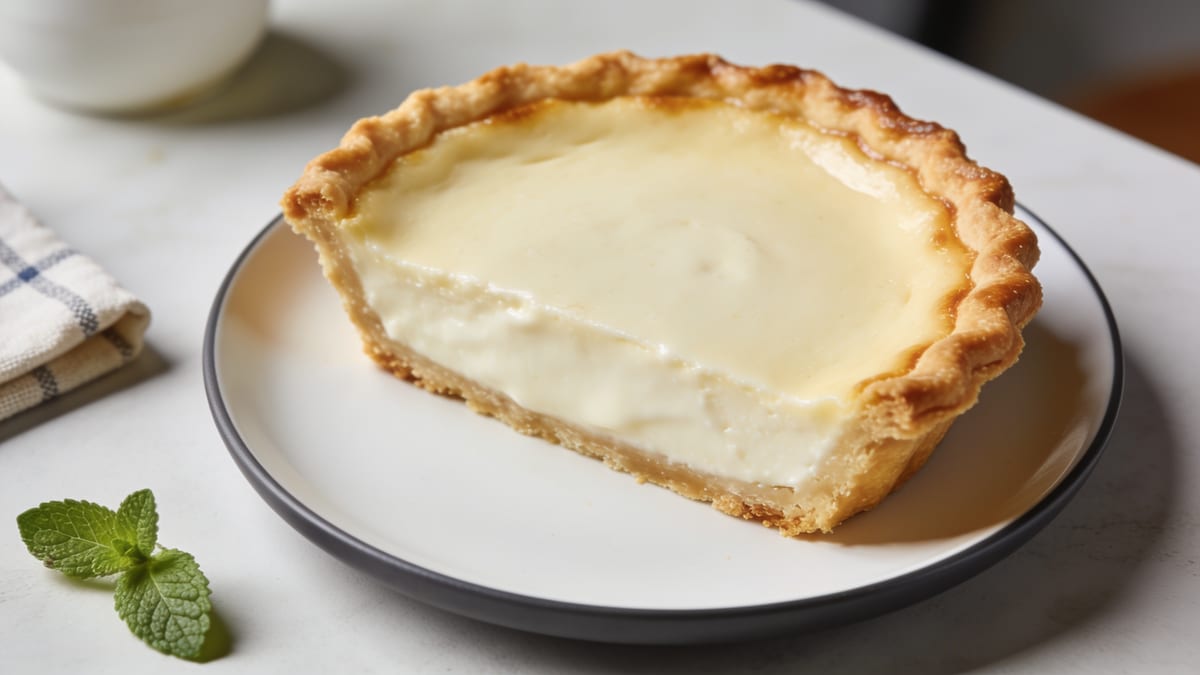
Partially blind-bake a chilled 9-inch crust at 375°F (190°C) — 15 minutes with weights, 5-7 without — then drop the oven to 350°F (175°C). Whisk 300 g (1 1/2 cups) sugar with 25 g (3 tbsp) flour and a pinch of salt, whisk in 3 room-temperature eggs, then 113 g (1/2 cup) melted butter, and finally 240 ml (1 cup) buttermilk, 2 tsp vanilla, 1 tbsp lemon juice, and a little zest. Pour into the warm crust, grate nutmeg over the top, and bake 45-55 minutes until the edges are puffed and the center jiggles like set gelatin. Cool at least 2 hours so the custard finishes setting before you slice.
- Use room-temperature eggs and buttermilk — cold dairy makes the melted butter seize into clumps that bake into a greasy layer.
- Blind-bake the crust first; raw dough under a wet custard is how buttermilk pie ends up with a pale, gummy bottom.
- Pull the pie while the center still wobbles slightly (about 175-180°F / 79-82°C inside); it firms as it cools, and waiting for a fully still center means it's overbaked.
Equipment
- 9-inch pie plate
- Rimmed baking sheet
- Parchment paper and pie weights (or dried beans)
- Large mixing bowl
- Whisk
- Microplane or fine grater
- Wire cooling rack
食材
Crust
- 9-inch unbaked pie crust, homemade or store-bought, well chilled
Buttermilk filling
- 300 g granulated sugar
- 25 g all-purpose flour
- 1.5 g fine sea salt
- large eggs, room temperature
- 113 g unsalted butter, melted and cooled 5 minutes
- 240 ml buttermilk, full-fat, shaken, at room temperature
- 10 ml vanilla extract
- 15 ml fresh lemon juice
- 2 g lemon zest, finely grated
- 0.5 g freshly grated nutmeg, for the top
步驟
- 步驟01
Heat the oven to 375°F (190°C). Fit the chilled crust into a 9-inch pie plate, crimp the edge, and freeze it for 10 minutes while the oven heats. Line the crust with parchment, fill with pie weights or dried beans, and bake 15 minutes. Lift out the parchment and weights and bake 5-7 minutes more, until the bottom looks dry and just barely golden. Reduce the oven to 350°F (175°C).
- 步驟02
In a large bowl, whisk the sugar, flour, and salt until no lumps of flour remain. Coating the flour in sugar now is what keeps the finished custard smooth instead of streaky.
- 步驟03
Whisk the eggs into the sugar mixture until fully combined and slightly pale, about 30 seconds. Slowly whisk in the melted butter. If the butter is warm rather than hot and the eggs are at room temperature, the mixture will stay glossy and emulsified.
- 步驟04
Whisk in the buttermilk, vanilla, lemon juice, and lemon zest just until smooth. Stop as soon as it comes together — over-whisking beats in air that bakes into a foamy skin on top of the pie.
- 步驟05
Set the warm crust on a rimmed baking sheet, pour in the filling, and grate the nutmeg evenly over the surface. Bake at 350°F (175°C) for 45-55 minutes. If the crust edge is browning too fast around the 30-minute mark, tent it with strips of foil.
- 步驟06
The pie is done when the outer 5 cm (2 inches) are puffed and set, the top is deep gold, and the very center jiggles like set gelatin when you nudge the pan — not a liquid slosh. An instant-read thermometer in the center should read 175-180°F (79-82°C).
- 步驟07
Cool the pie on a wire rack for at least 2 hours; the custard finishes setting as it cools, and cutting early releases a runny center. For the cleanest slices, refrigerate 1 hour after cooling and wipe the knife between cuts.
Make ahead
This pie is genuinely better made a day ahead: an overnight chill lets the custard set fully and the tangy-vanilla flavor deepen. You can also work in stages — blind-bake the crust up to 1 day ahead and hold it at room temperature loosely covered, or mix the filling up to 24 hours ahead and refrigerate it, then re-whisk gently and let it lose its chill before pouring and baking.
Storage
Once fully cool, cover the pie loosely with plastic wrap or foil and refrigerate — it is an egg custard, so it should not sit at room temperature for more than 2 hours. It keeps well for up to 4 days chilled; the flavor is best on days 1 and 2, after which the crust slowly softens. Serve cold or let slices stand 20-30 minutes to take the chill off. Whole cooled pie or individual slices can be frozen, well wrapped, for up to 2 months; thaw overnight in the refrigerator.
Variations
Extra-lemon buttermilk pie
Double the lemon juice to 30 ml (2 tbsp) and the zest to 2 tsp, and skip the nutmeg. The result leans brighter and tarter, closer to a lemon chess pie's cousin, and is especially good with fresh berries.
Toasted coconut buttermilk pie
Fold 60 g (3/4 cup) unsweetened shredded coconut into the finished filling and swap the vanilla for 1 tsp vanilla plus 1/2 tsp coconut extract. The coconut rises to form a lightly chewy, toasty top layer as it bakes.
Gluten-free swap
Use a gluten-free pie crust and replace the flour in the filling with 20 g (2 tbsp) cornstarch. The custard sets just as smoothly — whisk the cornstarch thoroughly into the sugar first so it doesn't clump when the buttermilk goes in.
Serve with
Nutrition per serving
Nutrition values are estimates based on the metric measurements. Adjust as needed.
常見問題
What does buttermilk pie taste like?
Think of a cross between crème brûlée custard and cheesecake filling, baked in a flaky crust. Buttermilk pie is sweet and vanilla-forward, but the cultured buttermilk and lemon juice add a gentle tang that keeps it from tasting flat or cloying. The texture is smooth and quivery in the center with a thin, lightly caramelized golden top.
What is the difference between buttermilk pie and chess pie?
They are close relatives from the same Southern tradition. Chess pie is typically thickened with cornmeal (and often a splash of vinegar), which gives it a slightly grainy, chewier top layer, while buttermilk pie relies on flour and a full cup of buttermilk, so it bakes up softer, tangier, and more custard-like. If you like chess pie but wish it were creamier, buttermilk pie is the one to make.
Can I make buttermilk pie without real buttermilk?
In a pinch, stir 1 tablespoon of lemon juice or white vinegar into 240 ml (1 cup) of whole milk and let it sit 10 minutes before using. It provides the acidity the recipe needs, though the filling will be slightly thinner and less tangy than one made with cultured full-fat buttermilk. Avoid low-fat milk here — the richness matters to the set.
Why is my buttermilk pie runny or weeping in the middle?
Almost always underbaking. The center should jiggle like set gelatin when you nudge the pan, not ripple like liquid, and an instant-read thermometer should show 175-180°F (79-82°C). The other culprit is slicing too soon: the custard needs a full 2 hours of cooling to finish setting. Cracks and watery pockets at the edges, on the other hand, signal overbaking — pull it while the very center still wobbles.
Does buttermilk pie need to be refrigerated?
Yes. Because the filling is an egg-and-dairy custard, it should go into the refrigerator once it has fully cooled and should not sit out longer than about 2 hours. Covered and chilled, it keeps up to 4 days, and many people prefer the flavor and clean-slicing texture on day two.
Cooked this? Rate it.
Real ratings from real cooks. We only show a score once enough of you have weighed in — no fabricated stars.