Green Juice
A bright, faintly sweet green juice built on kale, cucumber, celery, and tart apple, with ginger and lemon keeping every sip lively instead of grassy. Blending everything smooth and then straining through a nut milk bag gives you silky, pulp-free juice with no juicer required. The apple and lemon are calibrated to tame kale's bitterness, so it tastes fresh and clean rather than like lawn clippings.
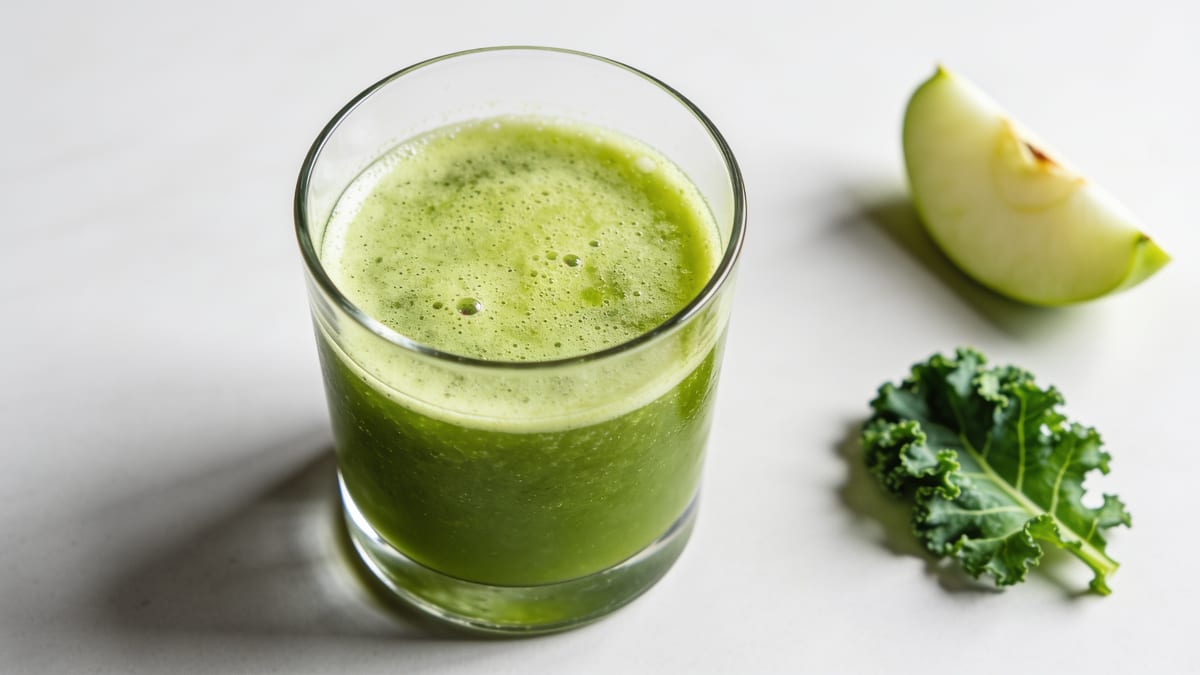
Scrub and prep the produce: strip 100 g kale leaves from their stems, core and chunk 1 large green apple, cut 1 medium English cucumber and 2 celery stalks into pieces, peel a 15 g knob of ginger, and slice the peel and white pith off 1 lemon. Add 240 ml cold water to a blender with the ginger, lemon flesh, apple, cucumber, and celery; blend until liquid, then add the kale in handfuls and blend on high for 45 to 60 seconds until completely smooth. Pour the mixture through a nut milk bag or fine-mesh sieve set over a bowl, then twist the bag or press the pulp with a spatula until it is nearly dry. Taste, brighten with an extra squeeze of lemon if needed, and pour over ice. Drink right away or refrigerate in a sealed jar for up to 24 hours.
- Blend the hard, watery produce with the liquid first, then add kale last so the blades can pull it down and break it fully smooth.
- Press or wring the pulp hard after straining; that last squeeze yields several extra tablespoons of the most concentrated juice.
- Cut away the lemon's peel and white pith before blending, since blended pith turns the whole batch bitter within minutes.
Equipment
- High-speed blender
- Nut milk bag or fine-mesh sieve
- Chef's knife
- Cutting board
- Large bowl or wide-mouth pitcher
- Vegetable brush
食材
Produce
- 100 g curly kale leaves, stems stripped, about 1 small bunch; lacinato kale works too
- green apple, such as Granny Smith, cored and cut into chunks
- English cucumber, about 300 g, unpeeled, cut into spears
- celery stalks, leaves attached is fine
- 15 g fresh ginger, peeled
- lemon, peel and white pith cut away, seeds removed
Liquid & Serving
- 240 ml cold water, or coconut water for a sweeter, saltier-mineral edge
- ice cubes, for serving, optional
步驟
- 步驟01
Scrub the cucumber and celery under running water with a vegetable brush and rinse the kale leaves thoroughly; grit hides in the crinkles. Strip the kale leaves off their tough center stems and discard the stems, which add bitterness without much juice.
- 步驟02
Core the apple and cut it into rough 2.5 cm (1-inch) chunks, cut the cucumber into spears, and chop the celery into short lengths. Peel the ginger with the edge of a spoon. Slice the peel and all the white pith off the lemon, then quarter the flesh and flick out the seeds.
- 步驟03
Pour the cold water into the blender, then add the ginger, lemon flesh, apple, cucumber, and celery. Blend on medium until the mixture is liquid and the blades spin freely, about 20 seconds.
- 步驟04
With the blender running on low, add the kale a handful at a time, then ramp up to high and blend for 45 to 60 seconds. The mixture should look like a thin, uniform green puree with no visible flecks of leaf; any remaining bits will clog the strainer.
- 步驟05
Set a nut milk bag or fine-mesh sieve over a large bowl or wide-mouth pitcher and pour in the blended mixture in batches. Let each addition drain before adding more so the strainer does not overflow.
- 步驟06
Twist and squeeze the nut milk bag, or press the pulp firmly against the sieve with a silicone spatula, until the pulp feels nearly dry. This final press releases the deepest-flavored juice; you should end up with about 700 ml. Compost the spent pulp or save it for veggie broth.
- 步驟07
Stir the juice and taste it. If it leans bitter, add a squeeze more lemon; if it tastes flat, a splash of cold water opens it up. Pour over ice and drink right away, or seal in a jar filled to the very top and refrigerate up to 24 hours.
Make ahead
Wash, stem, and chop all the produce the night before and store it in an airtight container in the fridge, keeping the cut apple tossed with a little of the lemon juice so it does not brown. In the morning, everything goes straight into the blender and the juice is done in about five minutes. If you must juice fully ahead, do it no more than 24 hours out, fill the jar to the brim, and add the lemon just before drinking to re-brighten the flavor.
Storage
Fresh green juice oxidizes quickly, so store it in a glass jar filled all the way to the rim (less air means slower browning), sealed tightly, and refrigerated for up to 24 hours; 48 hours is the absolute outer limit and the flavor will noticeably dull. Separation is normal, not spoilage; shake well before drinking. Do not leave the juice at room temperature for more than 2 hours, and discard it if it smells sour or fizzy. For longer keeping, freeze in an airtight container with 2.5 cm (1 inch) of headspace for up to 3 months and thaw overnight in the fridge.
Variations
Tropical Green Juice
Swap the apple for 165 g (1 cup) fresh pineapple chunks and use chilled coconut water instead of plain water. The pineapple's acidity and sweetness stand up to the kale even better than apple, giving a juice that tastes like a green pina colada without the cream.
Low-Sugar Version
Skip the apple entirely and add half a cucumber and 2 more celery stalks in its place, plus an extra quarter of lemon. The result is savory, crisp, and hydrating, with roughly half the sugar; a few fresh mint leaves blended in keep it from tasting austere.
Spinach and Pear
Replace the kale with 100 g (about 3 cups) baby spinach and the apple with 1 ripe Bartlett pear. Spinach is milder and blends smoother than kale, making this the gentlest introduction for anyone skeptical of green drinks.
Serve with
Nutrition per serving
Nutrition values are estimates based on the metric measurements. Adjust as needed.
常見問題
Do I need a juicer to make green juice?
No. This recipe makes true, pulp-free green juice with a regular blender: you blend the produce with a cup of water until completely smooth, then strain it through a nut milk bag or fine-mesh sieve and press the pulp dry. A centrifugal or slow juicer works too — feed everything through and skip the added water — but the blender method costs nothing extra and yields nearly as much juice.
Why is my green juice bitter, and how do I fix it?
Bitterness usually comes from one of three places: kale stems (strip them off before blending), lemon pith (cut away every bit of the white layer under the peel), or over-blending warm ingredients (use cold water and cold produce). If a finished batch still tastes harsh, a squeeze of fresh lemon juice or a few extra chunks of apple blended in will round it out.
How long does fresh green juice last in the fridge?
It is best within a few hours and acceptable for up to 24 hours if you store it in a sealed glass jar filled to the very top, which limits the oxygen that dulls both color and flavor. By 48 hours the taste flattens noticeably, so beyond that you are better off freezing it for up to 3 months.
Can I skip the straining step?
You can, but you will have a green smoothie rather than a green juice — thicker, fibrous, and about twice the volume. That is a fine breakfast in its own right and keeps all the fiber, so if you do not mind the texture, drink it unstrained. If you want a light, clear sip, straining and pressing the pulp is what gets you there.
Is spinach or kale better for green juice?
Kale gives a deeper green color and a slightly peppery, mineral backbone; spinach is milder, sweeter, and easier to blend smooth. Kale also holds its flavor better after a night in the fridge, while spinach juice fades faster. Both work at the same 100 g quantity here, so choose based on how assertively green you want the glass to taste.
Cooked this? Rate it.
Real ratings from real cooks. We only show a score once enough of you have weighed in — no fabricated stars.