Adjaruli Khachapuri — Georgian Cheese Bread Boat
Georgia's irresistible cheese bread, in its showstopping Adjaran form: a boat of soft yeasted dough filled with molten salty cheese, baked until golden, then crowned with a raw egg yolk and a knob of butter that you swirl into the bubbling cheese at the table. You tear off the crusty ends and dip them into the rich, gooey centre. Pure indulgence — and the most photogenic bread in the Caucasus.
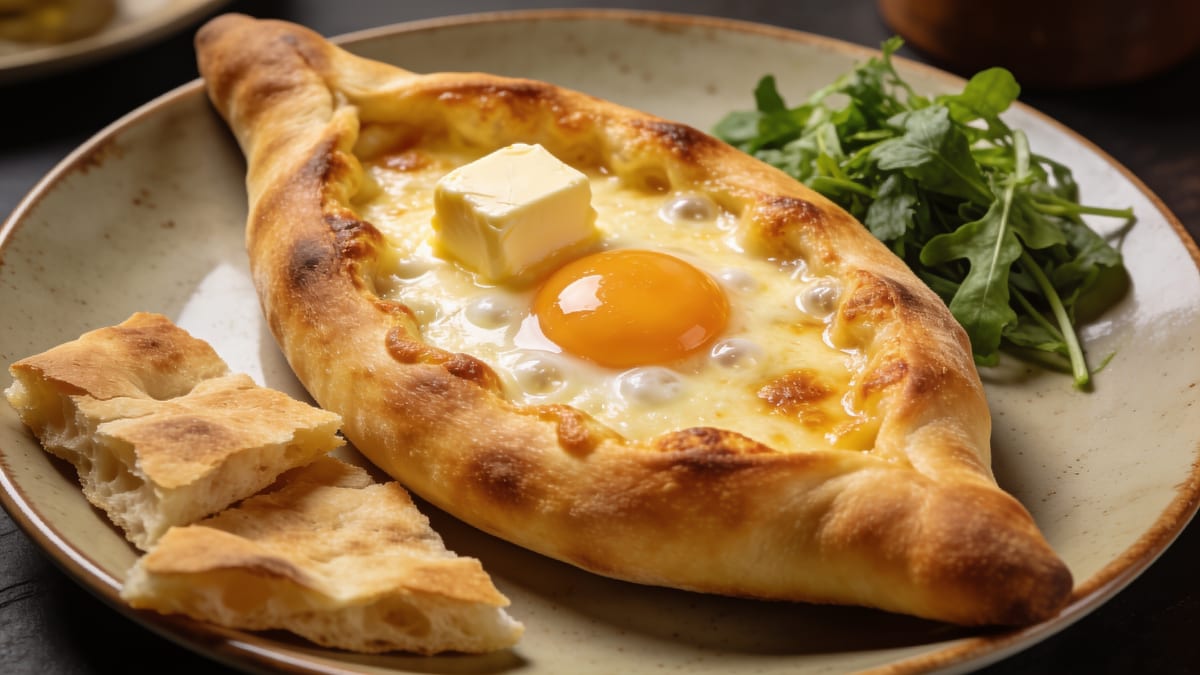
Make a soft yeasted dough and let it rise until doubled. Divide, roll each piece into an oval, and pile a mix of grated cheeses (traditionally sulguni and imeruli, or mozzarella + feta) down the centre. Roll the two long sides inward to make rolled edges and pinch the ends to form a pointed boat, leaving the cheese exposed. Bake hot until the dough is golden and the cheese is bubbling, then pull it out, crack a raw egg yolk into the molten centre, add a pat of butter, and swirl it all together at the table. Tear and dip.
- Use a stretchy salty cheese (sulguni/imeruli, or a mozzarella-feta blend) so the centre is gooey, not greasy.
- Shape a proper boat with rolled edges and pinched ends so it holds the lake of cheese.
- Add the yolk and butter the moment it's out of the oven and swirl — the residual heat lightly cooks the egg.
Equipment
- Baking tray or stone
- Rolling pin
- Bowl
食材
Dough
- 400 g plain (all-purpose) flour
- 240 ml warm milk or water
- 7 g instant yeast
- 1 tsp sugar, 1 tsp salt, 2 tbsp oil
Filling
- 400 g cheese — sulguni & imeruli (or low-moisture mozzarella + feta), grated
To finish
- 4 egg yolks (one per boat)
- Butter, a knob per boat
步驟
- 步驟01
Mix the flour, yeast, sugar and salt, add the warm milk and oil, and knead to a soft, smooth dough. Cover and rise until doubled, about 1–1½ hours.
- 步驟02
Divide the dough into 4. Roll each into an oval. Pile a line of grated cheese along the centre, then roll the two long edges inward toward the middle and pinch the two ends together tightly, twisting, to form a pointed boat with a cheese-filled centre.
- 步驟03
Heat the oven as hot as it goes (250°C/480°F). Fill the boats generously with the remaining cheese. Bake until the dough is deep golden and the cheese is melted and bubbling, 12–15 minutes.
- 步驟04
Pull the khachapuri out. Make a small well in the bubbling cheese, slide in a raw egg yolk, and add a knob of butter alongside.
- 步驟05
At the table, quickly swirl the yolk and butter through the hot cheese so it lightly cooks and turns into a glossy fondue. Tear off pieces of the crusty edges and dip them into the molten centre. Eat at once.
Make ahead
Make the dough ahead (a slow overnight fridge rise deepens flavour) and grate the cheese in advance. Shape, fill and bake fresh to serve, adding the egg and butter at the table. It's meant to be assembled and eaten hot.
Storage
Very much a fresh-from-the-oven dish — the molten cheese and crisp crust don't survive storage well, and the egg is best eaten right away. Leftovers keep a day and can be reheated in a hot oven (skip a fresh egg), but it won't be the same showpiece.
Variations
Imeruli khachapuri
The everyday round version — cheese fully enclosed in the dough like a stuffed flatbread, no egg.
Megruli khachapuri
Like imeruli but with extra cheese melted on top as well as inside.
Cheese blend
Outside Georgia, a mix of low-moisture mozzarella (for stretch) and feta (for salt) mimics sulguni and imeruli well.
Serve with
Nutrition per serving
Nutrition values are estimates based on the metric measurements. Adjust as needed.
常見問題
What cheese is used in khachapuri?
Traditionally Georgian sulguni (a stretchy, brined cheese) and imeruli (a fresh, mild one), often mixed. Outside Georgia, a blend of low-moisture mozzarella (for the stretch and melt) and feta (for the salty tang) is the standard substitute and works beautifully. The goal is a salty, gooey, melting centre.
How do I add the egg without overcooking it?
Crack just the yolk into the centre the moment the khachapuri comes out of the hot oven, add butter, and swirl it through the bubbling cheese right away. The residual heat gently cooks and emulsifies the yolk into a glossy, rich sauce — you don't bake it long with the egg in, or it sets hard.
What's the difference between Adjaruli and other khachapuri?
Adjaruli (Acharuli) is the famous boat shape with the open top, egg and butter, from the Adjara region by the Black Sea. Imeruli is the everyday round version with the cheese sealed inside, and Megruli has extra cheese on top too. The boat is the most dramatic and the one people picture.
Can I make the dough ahead?
Yes — the dough is better for a slow, cold rise. Mix it, then let it prove in the fridge overnight for more flavour and easier handling. Bring it to room temperature, then shape, fill and bake fresh. Grate the cheese ahead too, so assembly is quick.
How do you eat khachapuri?
It's communal and hands-on: once the yolk and butter are swirled into the molten cheese, you tear off pieces of the crusty boat edges and dip them into the rich centre, working your way in. As you near the end, you can fold the softened tips in to scoop the last of the cheese. No cutlery required.
Cooked this? Rate it.
Real ratings from real cooks. We only show a score once enough of you have weighed in — no fabricated stars.