Homemade Poultry Seasoning
This is the sage-and-thyme spice blend that makes roast chicken, turkey, and stuffing taste like a holiday, made in five minutes from dried herbs you already own. Grinding the herbs together instead of just stirring them releases their oils and produces a fine, even powder that clings to skin and dissolves into gravy without leaving woody rosemary needles behind. It is salt-free by design, so you control the seasoning of every dish it touches.
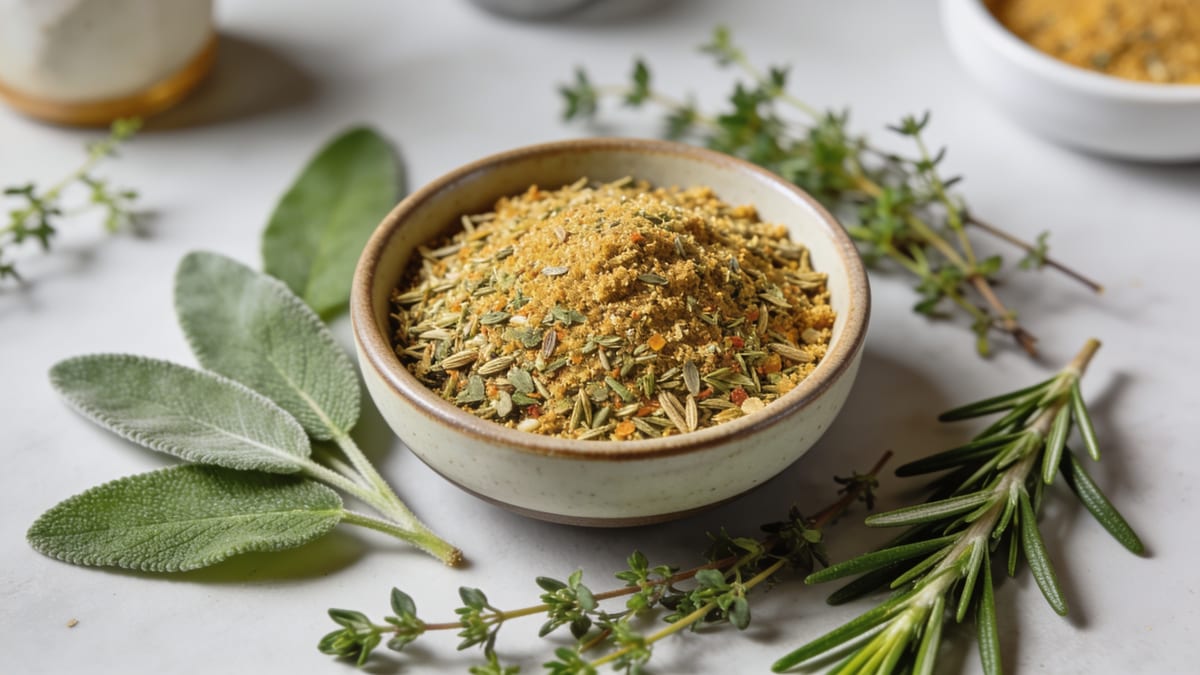
Combine 2 tablespoons dried rubbed sage, 1 1/2 tablespoons dried thyme, 1 tablespoon dried marjoram, 1 tablespoon dried rosemary, 1 teaspoon ground nutmeg, and 1/2 teaspoon black pepper in a spice grinder or mortar. Pulse or pound for 30 to 60 seconds until the rosemary needles disappear into a fine, uniform, sage-green powder, sift out any stubborn bits and regrind them, then transfer to a small airtight jar. Use about 1 teaspoon per pound of chicken or turkey, or 1 to 2 teaspoons per batch of stuffing, and store away from heat and light for up to 6 months at peak flavor.
- Grind, don't just stir — pulverizing the rosemary and thyme releases their oils and gives you a powder that blends evenly instead of a mix with sharp needles in it.
- Smell your sage before you start: if a pinch rubbed between your fingers has no aroma, the finished blend will taste flat no matter what you do.
- Keep it salt-free so one jar works everywhere — season each dish with salt separately and the blend never over-salts a brine, gravy, or stuffing.
Equipment
- Measuring spoons
- Spice grinder or mortar and pestle
- Fine-mesh sieve (optional, for the finest texture)
- Small bowl
- Small airtight jar (about 60 ml / 2 oz)
- Label and marker
食材
Herb base
- 4 g dried rubbed sage, rubbed (fluffy) sage, not powdered; the backbone of the blend
- 5 g dried thyme
- 2 g dried marjoram, or substitute dried oregano for a slightly sharper blend
- 4 g dried rosemary, whole needles are fine; the grinder will pulverize them
Warm spices
- 2 g ground nutmeg, freshly grated if possible
- 1 g finely ground black pepper
- 1 g celery seed, optional; adds a savory, stuffing-like depth
步驟
- 步驟01
Rub a pinch of each dried herb between your fingers and smell it. Sage should smell piney and slightly camphorous, thyme earthy and sharp. Any herb with little or no aroma has faded and will dilute the blend, so replace it before you start — this five-ingredient recipe has nowhere for stale herbs to hide.
- 步驟02
Measure the sage, thyme, marjoram, rosemary, nutmeg, black pepper, and celery seed (if using) directly into the bowl of a spice grinder, clean coffee grinder, or mortar. Level your spoons: with quantities this small, a heaped tablespoon of rosemary can noticeably tilt the balance.
- 步驟03
Pulse in short 3-to-5-second bursts, shaking the grinder between pulses so the light, fluffy sage does not float above the blades while the dense rosemary sits below them. You are done when the mixture is a uniform sage-green powder and no whole rosemary needles remain, usually 30 to 60 seconds total. In a mortar, pound and then grind in circles until you reach the same texture.
- 步驟04
For a powder that disappears completely into gravies and dredges, shake the blend through a fine-mesh sieve into a small bowl, return whatever stays behind to the grinder, and give it a few more pulses. This step is optional — a slightly coarse blend is perfectly good on roast chicken skin.
- 步驟05
Take a tiny pinch on your tongue. Sage should lead, backed by thyme, with nutmeg as a warm background note rather than a dessert flavor. If the blend tastes medicinal, soften it with another 1/2 teaspoon of marjoram; if it is flat, add 1/2 teaspoon more sage; if the nutmeg pushes forward, an extra teaspoon each of sage and thyme will rebalance it.
- 步驟06
Funnel the blend into a small airtight jar, pressing out as much air as you can, and label it with the name and today's date. Store it in a cool, dark cupboard away from the stove. Use about 1 teaspoon per pound (450 g) of poultry, or 1 to 2 teaspoons per batch of stuffing, biscuits, or gravy.
Make ahead
This blend is make-ahead by nature. Mix it up to 6 months before the holidays and it will be ready for turkey day; if you cook poultry often, double or triple the batch in the same grinder load. For gifting, portion into 60 ml (2 oz) jars with the date and a suggested dose (1 tsp per pound of poultry) on the label.
Storage
Keep in an airtight jar in a cool, dark cupboard away from the stove and dishwasher steam. The blend is at its best for about 6 months and still usable for up to a year, though sage and rosemary fade first — if a pinch smells faint, use more per dish or mix a fresh batch. Do not refrigerate; condensation inside the jar will cake the powder.
Variations
Smoky rotisserie-style rub
Add 1 tablespoon smoked paprika, 1 teaspoon garlic powder, and 1 teaspoon onion powder to the finished blend. Mixed with 2 teaspoons of kosher salt per 1/4 cup, it becomes a complete rub for spatchcocked chicken and grilled thighs — no other seasoning needed.
New England-style with ginger
Add 1/2 teaspoon ground ginger and swap the marjoram for dried oregano. The ginger gives the warm, old-fashioned edge many New Englanders expect in their turkey stuffing, and it is especially good in sausage-based dressings.
No-grinder rustic blend
No spice grinder? Buy powdered (not rubbed) sage and ground thyme, chop the rosemary as finely as you can with a heavy knife, and whisk everything in a bowl. The texture is coarser, so it suits stuffing and braises better than delicate pan gravies.
Serve with
Nutrition per serving
Nutrition values are estimates based on the metric measurements. Adjust as needed.
常見問題
Does poultry seasoning actually contain poultry?
No. Despite the name, poultry seasoning is a fully plant-based blend of dried herbs and spices — here, sage, thyme, marjoram, rosemary, nutmeg, and black pepper. It is named for what it seasons, not what it contains, so it is safe for vegetarians and vegans and is excellent in meatless dishes like lentil loaf, mushroom gravy, and vegetable stuffing.
What can I use if I run out of poultry seasoning mid-recipe?
The fastest stand-in is equal parts dried sage and dried thyme, which covers roughly 80 percent of the flavor. If you have marjoram or rosemary, add a small pinch of either, plus a whisper of nutmeg. Herbes de Provence works in a pinch too, though its lavender note reads noticeably more floral than classic poultry seasoning.
How much poultry seasoning should I use per pound of chicken or turkey?
A good baseline is 1 teaspoon per pound (450 g) of meat when rubbing a whole bird, combined with salt at about 3/4 teaspoon kosher salt per pound. For stuffing, start with 1 teaspoon per 4 cups of bread cubes and taste the mix before it goes in the oven. Because this blend is salt-free, you can be generous without over-salting.
Why grind the herbs instead of just stirring them together?
Two reasons. Grinding fractures the dried leaves and rosemary needles, releasing aromatic oils that a gentle stir leaves locked inside, so the blend tastes noticeably fuller. It also creates a uniform powder: stirred whole-leaf blends separate in the jar and leave hard rosemary spikes in the finished dish, while a ground blend disperses evenly through gravies, dredges, and rubs.
Can I make poultry seasoning with fresh herbs instead of dried?
Not for a shelf-stable jar — fresh herbs contain water and will mold within days. If you want fresh-herb flavor tonight, mince fresh sage, thyme, marjoram, and rosemary in a 2:1.5:1:1 ratio and use triple the amount the recipe calls for, since dried herbs are about three times as concentrated. For a jar that keeps, dry the herbs fully first.
Cooked this? Rate it.
Real ratings from real cooks. We only show a score once enough of you have weighed in — no fabricated stars.