Dutch Baby (Panqueque Alemán al Horno)
A Dutch baby is a big, dramatic oven pancake that balloons up the sides of a screaming-hot skillet, then settles into a custardy center with crisp, buttery edges. There is no leavener at all — the rise comes purely from steam, which is why a room-temperature batter, a blazing 220°C (425°F) oven, and a preheated cast-iron pan matter more than anything else. Blend, pour, bake, and you have a showstopper breakfast in under 45 minutes.
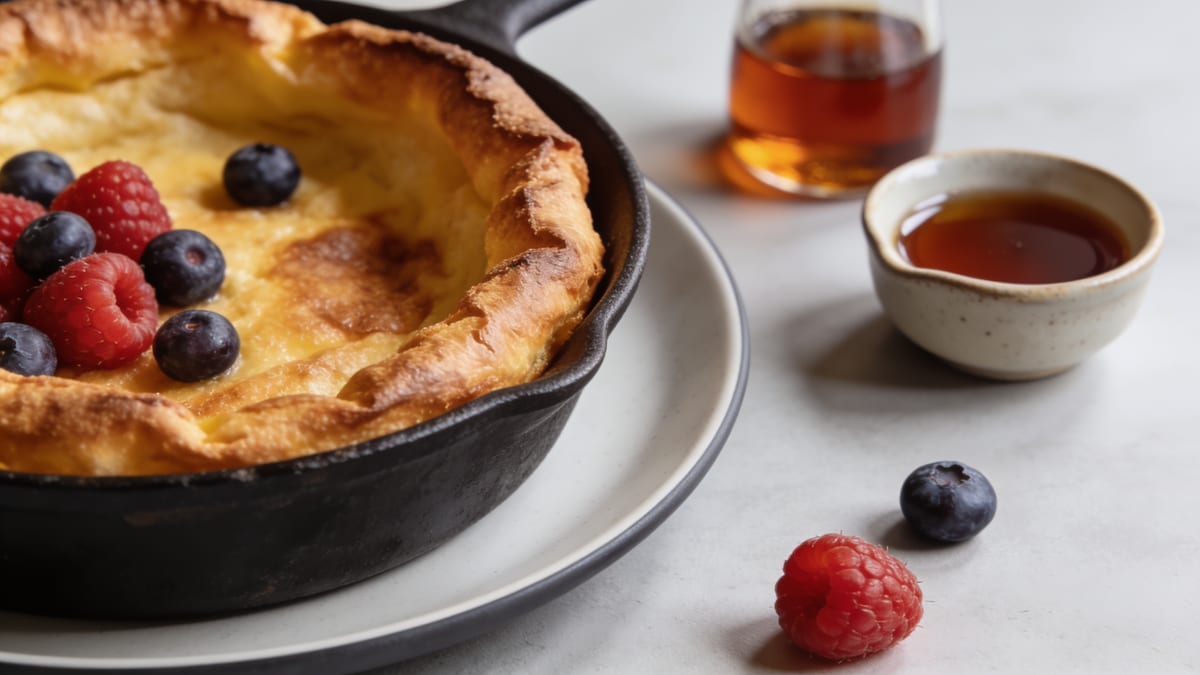
Put a 25 cm (10-inch) cast-iron skillet on the middle rack and preheat the oven to 220°C (425°F). Blend 3 room-temperature eggs until frothy, then blend in 120 ml (1/2 cup) whole milk, 65 g (1/2 cup) all-purpose flour, 1 tbsp sugar, 1 tsp vanilla, and 1/4 tsp salt until completely smooth; let the batter rest 15 minutes while the pan heats. Drop 45 g (3 tbsp) butter into the hot skillet, swirl until foaming, pour the batter into the center, and bake 18-20 minutes without opening the door until the pancake is puffed high and deep golden at the edges. Dust with powdered sugar, squeeze lemon over the top, and serve straight from the pan — it deflates within minutes, and that is normal.
- Room-temperature eggs and milk are non-negotiable — cold batter kills the steam rise before it starts.
- The skillet must preheat with the oven for at least 15 minutes; batter hitting a hot pan is what launches the puff.
- Do not open the oven door before minute 18 — the structure is set by steam and collapses if you vent it early.
Equipment
- 25 cm (10-inch) cast-iron skillet or other heavy oven-safe pan
- Blender (or mixing bowl and whisk)
- Kitchen scale or measuring cups and spoons
- Oven mitts
- Fine-mesh sieve for dusting
- Flexible spatula
Ingredientes
Batter
- large eggs, at room temperature
- 120 ml whole milk, at room temperature
- 65 g all-purpose flour
- 12 g granulated sugar
- 5 ml vanilla extract
- 1.5 g fine sea salt
For the pan
- 45 g unsalted butter, cut into pieces
To serve
- 15 g powdered sugar, for dusting
- lemon, cut into wedges
Elaboración
- PASO01
Set a 25 cm (10-inch) cast-iron skillet on the middle rack and preheat the oven to 220°C (425°F). The pan needs the full preheat to store enough heat to jump-start the puff, so start this before you touch the batter.
- PASO02
Blend the eggs on high for about 30 seconds until pale and frothy — the extra air here translates directly into lift. Add the milk, flour, sugar, vanilla, and salt and blend another 20-30 seconds, scraping down the jar once, until the batter is completely smooth and about the thickness of heavy cream. No blender? Whisk the eggs hard for a full minute, then whisk in the rest until lump-free.
- PASO03
Let the batter sit at room temperature for 15 minutes. This gives the flour time to hydrate (fewer lumps, more even rise) and guarantees the batter is not chilly when it hits the pan. By the time the rest is done, the oven and skillet should be fully heated.
- PASO04
Wearing oven mitts, pull the skillet out and add the butter. Swirl until it melts, foams, and coats the bottom and sides — it should sizzle on contact. If it melts sluggishly, return the pan to the oven for 1-2 more minutes; a lazy sizzle means the pan is not hot enough.
- PASO05
Give the batter one last quick stir, pour it into the center of the bubbling butter, and get the skillet back in the oven within seconds. Speed matters — every moment out of the oven bleeds heat from the pan.
- PASO06
Bake 18-20 minutes without opening the door. The pancake will climb dramatically up and over the sides of the pan; it is done when the rim is deep golden brown and crisp and the center looks set with no wet sheen. If your oven runs hot and the edges darken too fast, drop to 200°C (400°F) for the last 5 minutes.
- PASO07
Bring the whole skillet to the table on a trivet. Dust generously with powdered sugar and squeeze lemon over the top — the sharp-sweet combination is the classic finish for a reason. The tall walls will sink within a few minutes as the steam escapes; that is exactly what a Dutch baby is supposed to do, so slice and eat while the edges are still crackly.
Make ahead
The batter can be blended up to 12 hours ahead and refrigerated in the blender jar. Take it out 30-45 minutes before baking so it loses its chill, then blitz for 10 seconds to re-aerate just before pouring. Do not bake the pancake itself ahead — the puff and crisp edges do not survive a wait.
Storage
A Dutch baby is at its best within 10 minutes of baking, but leftovers keep in an airtight container in the fridge for up to 2 days. Re-crisp wedges in a 180°C (350°F) oven or an air fryer for 4-5 minutes; the microwave makes them rubbery. Freezing is not recommended — the custardy interior turns watery when thawed.
Variations
Savory Gruyere and Herb
Leave out the sugar and vanilla, add a good grind of black pepper to the batter, and scatter 50 g (1/2 cup) grated Gruyere and 1 tbsp chopped chives over the pancake in the last 3 minutes of baking. Top with a fried egg or smoked salmon for a brunch main.
Caramelized Apple (German Apfelpfannkuchen style)
Before adding the batter, saute 1 thinly sliced apple in the skillet butter with 1 tbsp brown sugar and 1/2 tsp cinnamon for 3-4 minutes until softened. Pour the batter directly over the apples and bake as written; the fruit sinks into a caramel layer at the base.
Dairy-Free Swap
Use unsweetened oat milk in place of whole milk and refined coconut oil or a stick-style vegan butter in the pan. The puff is nearly identical since eggs and steam do the lifting. Note it still contains egg and gluten, and skip whipped cream at the table.
Serve with
Nutrition per serving
Nutrition values are estimates based on the metric measurements. Adjust as needed.
Preguntas frecuentes
Why didn't my Dutch baby puff up?
Nine times out of ten it is temperature: cold eggs or milk, a pan that did not preheat long enough, or an oven that had not truly reached 220°C (425°F). This dutch baby recipe has no baking powder — steam is the only leavener, so the batter must be at room temperature and the skillet genuinely hot when the batter hits it. Opening the oven door mid-bake or using a thin, lightweight pan will also cost you the rise.
Can I make a dutch baby recipe without a cast-iron skillet?
Yes. Any heavy, oven-safe vessel works: a stainless steel skillet, an enameled cast-iron pan, a 23 cm (9-inch) metal cake pan, or even a pie plate. Preheat whatever you use right along with the oven. Avoid nonstick pans not rated for 220°C and avoid glass dishes going from cold to hot, which can shatter.
Why did my Dutch baby collapse after it came out of the oven?
That is not a failure — it is the nature of the dish. The dramatic walls are inflated by steam, and once the pancake leaves the oven the steam escapes and the structure relaxes into a shallow, crater-like bowl within a few minutes. That crater is prime real estate for powdered sugar, lemon, and berries, so serve it immediately and enjoy the show while it lasts.
Can I double the recipe?
Double the batter and split it between two 25 cm (10-inch) skillets, or use a single 30 cm (12-inch) skillet with 1.5 times the batter. Do not pour a double batch into the same 25 cm pan — too much batter bakes into a dense, eggy slab instead of puffing. Two pans can share one oven rack; just resist opening the door to peek.
What's the difference between a Dutch baby and a German pancake?
They are essentially the same dish under different names. The eggy oven pancake descends from the German Pfannkuchen, and the 'Dutch' in the name is widely attributed to a corruption of 'Deutsch' popularized by a Seattle cafe in the early 1900s. Some German pancake versions are baked in a rectangular dish rather than a round skillet, but the batter and technique are interchangeable.
Cooked this? Rate it.
Real ratings from real cooks. We only show a score once enough of you have weighed in — no fabricated stars.