Bubble and Squeak
Bubble and squeak is Britain's great leftovers rescue: mashed potato and buttery cabbage pressed into a skillet and fried until the underside turns deep golden and crackly, named for the noises it makes in the pan. The inside stays soft and savoury while the crust shatters, because you fry the cake undisturbed in a mix of butter and oil instead of stirring it. This version works from scratch or from yesterday's mash and greens, so you can make it any day of the week, not just after a roast.
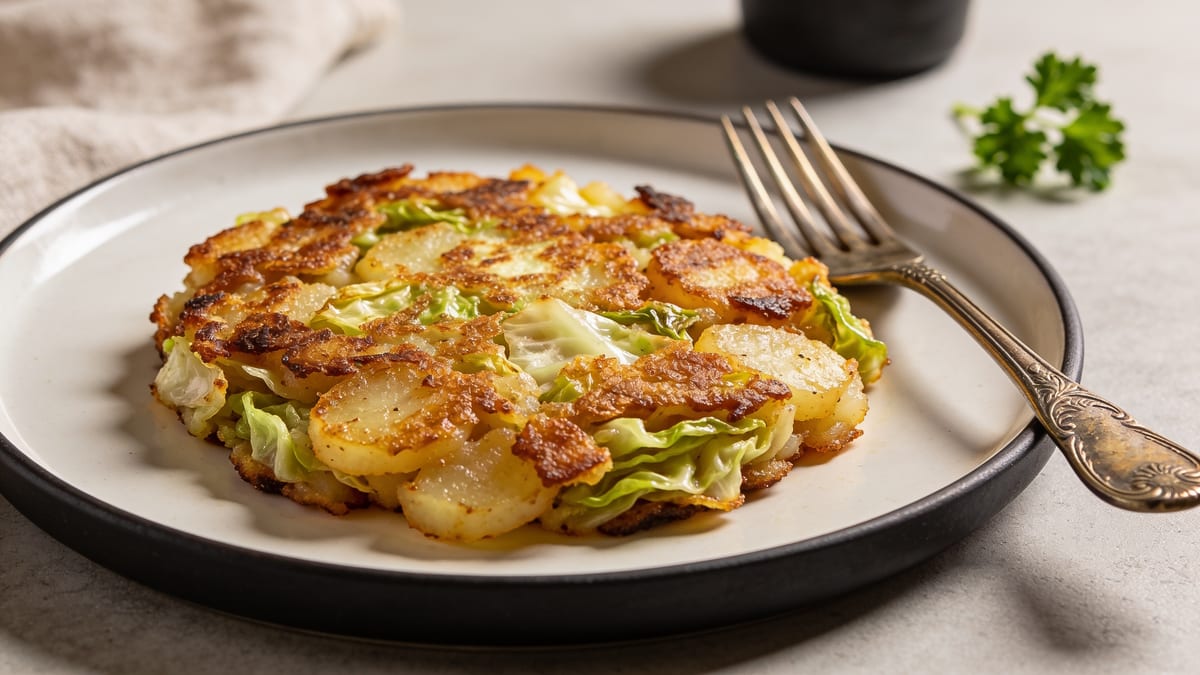
Boil 900 g floury potatoes in salted water until tender (about 18 minutes), drain well, steam-dry, then mash with 30 g butter, salt and pepper. Meanwhile soften a sliced onion and 300 g shredded savoy cabbage in butter until sweet and lightly browned at the edges. Fold the vegetables through the mash, then heat 2 tbsp oil with a knob of butter in a 25 cm skillet over medium heat, press the mixture in firmly, and fry undisturbed for about 10 minutes until the base is deep golden. Flip in sections with a wide spatula, crisp the second side for 8 minutes, rest 5 minutes off the heat, and serve in wedges.
- Steam-dry the drained potatoes for 2 minutes in the hot pan before mashing — a dry mash fries crisp instead of steaming and sticking.
- Press the cake down firmly and leave it alone; moving it early tears the crust before it sets.
- Flip it in quarters with a fish slice rather than attempting one heroic whole-cake flip — the rustic, broken-up look is traditional anyway.
Equipment
- Large saucepan
- Colander
- Potato masher
- Large mixing bowl
- 25 cm (10-inch) nonstick or well-seasoned cast-iron skillet
- Wide flexible spatula (fish slice)
Ingredientes
Potato base
- 900 g floury potatoes (Maris Piper or russet), peeled and cut into chunks, or about 750 g (3 cups) leftover mashed potato
- 30 g salted butter, for the mash
- 6 g fine sea salt, plus more for the boiling water
- 1 g freshly ground black pepper
Greens and frying
- 300 g savoy cabbage, cored and finely shredded, or leftover cooked cabbage or Brussels sprouts, roughly chopped
- yellow onion, thinly sliced, medium
- 30 g salted butter, divided, for the vegetables and the pan
- 30 ml sunflower or vegetable oil, a neutral oil raises the smoke point so the butter browns without burning
Elaboración
- PASO01
Put the potato chunks in a large saucepan, cover with cold water by 2 cm (1 inch), and salt the water generously. Bring to a boil, then simmer until a knife slides through with no resistance, about 15 to 18 minutes. Skip this step if you are using leftover mash.
- PASO02
Drain the potatoes in a colander, then return them to the empty hot pan over the lowest heat for 2 minutes, shaking once or twice, until the surfaces look chalky and dry. Mash with 30 g (2 tbsp) butter, the salt and the pepper until mostly smooth — a few small lumps are fine and give the cake character. Tip into a large bowl.
- PASO03
Set the empty skillet over medium heat and melt half the remaining butter (1 tbsp). Add the onion with a pinch of salt and cook for 3 minutes until translucent, then add the shredded cabbage and cook, stirring often, for another 3 to 4 minutes until wilted, sweet and browned in a few spots. Do not wash the pan.
- PASO04
Scrape the cabbage and onion into the bowl of mash and fold together until the greens are evenly streaked through. Taste and adjust the salt and pepper now — once it is frying you cannot season the inside.
- PASO05
Return the skillet to medium heat with the oil and the last 1 tbsp of butter. When the butter stops foaming, add the potato mixture and press it down firmly with the spatula into an even cake that reaches the edges. Fry undisturbed for about 10 minutes; it should bubble and hiss (that is the name earning its keep). Peek under one edge — you want a deep golden-brown crust.
- PASO06
Cut the cake into quarters in the pan with the spatula and flip each piece, crustier side up. Press back down into a rough cake and fry for another 7 to 8 minutes until the second side is browned and crisp. If the pan looks dry at the flip, add a small extra knob of butter around the edges.
- PASO07
Slide the pan off the heat and let the cake rest for 5 minutes; this sets the crust and lets the inside firm up so wedges hold their shape. Cut into 4 wedges and serve hot, with extra black pepper on top.
Make ahead
The mash-and-cabbage mixture can be made up to 2 days ahead and kept covered in the fridge — in fact, chilled mixture is drier and fries even crispier. You can also shape it into a cake or patties, chill them on a lined tray, and fry straight from the fridge, adding a minute or two per side.
Storage
Cool completely, then refrigerate wedges in an airtight container for up to 3 days. Reheat in a dry nonstick skillet over medium heat for 3 to 4 minutes per side, or in a 200°C (400°F) oven for about 12 minutes, until crisped and hot through — the microwave works in a pinch but softens the crust. Freeze wedges on a tray until solid, then bag for up to 2 months; reheat from frozen in the oven, adding 5 to 8 minutes.
Variations
Boxing Day bubble and squeak
Make it the classic way with whatever survived the roast: swap the cabbage for chopped leftover Brussels sprouts, roast parsnips or carrots (about 300 g / 2 cups total), fold them into leftover mash, and fry as directed. Chopped leftover stuffing is not traditional inside the cake but is excellent crumbled on top — note it usually contains gluten.
Vegan version
Replace the butter with 3 tbsp olive oil or a plant-based block butter throughout. The crust browns just as deeply; add a pinch of nutritional yeast or a little English mustard powder to the mash to make up for the lost dairy savouriness. This also makes the dish dairy-free.
Individual patties
Shape the mixture into 8 palm-sized patties about 2 cm (3/4 inch) thick, chill for 20 minutes so they firm up, then shallow-fry for 4 to 5 minutes per side. Patties give you more crust per bite and are easier to flip — good for topping with a poached egg at breakfast.
Serve with
Nutrition per serving
Nutrition values are estimates based on the metric measurements. Adjust as needed.
Preguntas frecuentes
Can I make bubble and squeak with leftover mashed potato?
Yes — that is really the dish's whole reason for existing. Use about 750 g (3 cups) of leftover mash and skip the boiling and mashing steps entirely. Day-old mash is actually ideal because it has dried out in the fridge, which means less steam in the pan and a crispier crust. If your mash was made very loose with lots of cream, fry the cake a few minutes longer per side and be patient before flipping.
Why is my bubble and squeak soggy or falling apart?
Almost always it is moisture. Wet potatoes steam instead of frying, so the crust never sets and the cake breaks up when you flip it. Steam-dry boiled potatoes in the hot empty pan before mashing, cook the cabbage until it is wilted rather than watery, and make sure the fat is properly hot before the mixture goes in. Then leave the cake completely alone for the first 10 minutes — the crust is the glue that holds everything together.
Should bubble and squeak use cabbage or Brussels sprouts?
Either is authentic, and both were originally whatever greens were left from Sunday lunch or Christmas dinner. Savoy cabbage gives a sweeter, milder result and is easy to find year-round; chopped cooked sprouts give a nuttier, slightly bitter edge that many people consider the true Boxing Day flavour. You can also mix in kale, spring greens or leftover roasted roots — keep the total around 300 g so the potato can still bind it.
Is bubble and squeak gluten-free and vegetarian?
As written, yes to both: it is only potato, cabbage, onion, butter and oil, so it is naturally gluten-free and vegetarian, though the butter means it is not dairy-free. Watch for two common traps — some cooks add flour as a binder (unnecessary if your mash is dry) and some traditional recipes fry it in beef dripping or add bacon. Swap the butter for olive oil and it becomes vegan too.
Where does the name bubble and squeak come from?
It describes the sound the cake makes while it fries — the trapped moisture bubbles and the greens squeak and hiss against the hot pan. The dish dates back to at least the 18th century in Britain, when early versions were made with fried beef and cabbage; the potato-based version became standard later and is now the classic way to use up leftovers from a roast.
Cooked this? Rate it.
Real ratings from real cooks. We only show a score once enough of you have weighed in — no fabricated stars.