Repollo salteado
This is the hand-torn cabbage you get at Chinese home-style restaurants: ragged pieces charred at the edges but still juicy and snappy inside, glossed with garlic, dried chilies, soy, and a hit of black vinegar. Tearing instead of slicing gives you uneven surfaces that catch the sauce and blister in the hot wok, and cooking fast over the highest heat your stove can manage keeps the cabbage sweet instead of sulfurous. It goes from cutting board to table in about 20 minutes with one pan.
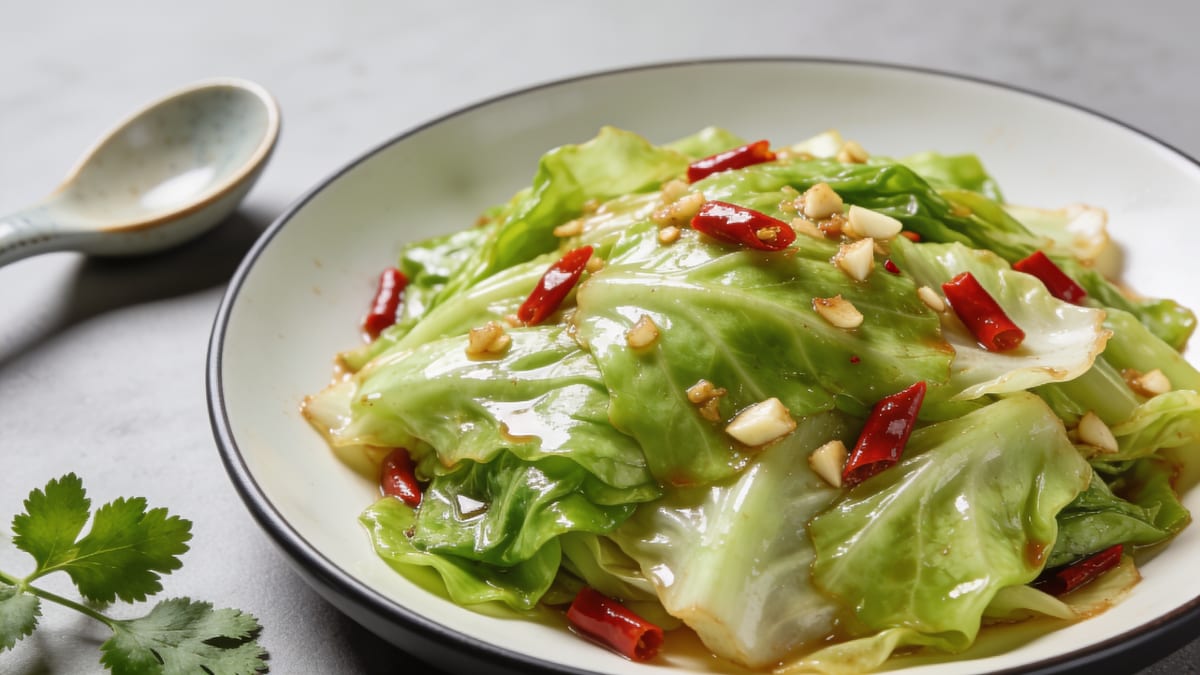
Tear a small green cabbage (about 700 g) into rough 5 cm pieces, discarding the core, and dry the leaves well. Stir together 1 tablespoon light soy sauce, 2 teaspoons Chinkiang black vinegar, 1 teaspoon sugar, and 1/4 teaspoon salt. Heat 2 tablespoons neutral oil in a wok over the highest heat until it just smokes, sizzle 4 sliced garlic cloves and 4-6 snipped dried red chilies for 15-20 seconds, then dump in the cabbage. Stir-fry hard for 3-4 minutes, letting the leaves sit against the metal for 20-30 seconds between tosses so the edges char, then pour the sauce around the rim of the wok, toss for another 30-60 seconds until the leaves are glossy and just tender-crisp, and serve immediately.
- Dry the torn leaves thoroughly (spin or towel them) — surface water turns a stir-fry into a steam-braise and you lose all the char.
- Do not stir constantly: press the cabbage against the hot wok and leave it alone in 20-30 second bursts so it blisters instead of sweating.
- Pour the sauce down the hot side of the wok, not onto the cabbage — it sizzles, reduces on contact, and coats instead of pooling.
Equipment
- Wok or 30 cm (12-inch) cast-iron/carbon-steel skillet
- Wok spatula or sturdy turner
- Cutting board and chef's knife
- Small bowl for the sauce
- Salad spinner or clean kitchen towel
- Kitchen scissors (for snipping dried chilies)
Ingredientes
Cabbage & aromatics
- 700 g small green cabbage (flat Taiwanese cabbage if you can find it), torn into rough 5 cm / 2-inch pieces, thick core discarded
- 30 ml neutral oil (peanut, canola, or avocado)
- garlic cloves, thickly sliced
- dried red chilies, snipped in half, most seeds shaken out
- 2 g Sichuan peppercorns, optional, for a gently numbing version
- scallion, white part only, cut into 2 cm lengths; optional
Sauce
- 15 ml light soy sauce
- 10 ml Chinkiang black vinegar, or rice vinegar in a pinch
- 4 g granulated sugar
- 1.5 g fine salt
Elaboración
- PASO01
Pull off any wilted outer leaves, quarter the cabbage, and cut out the thick core. Working with your hands, tear the leaves into rough 5 cm (2-inch) pieces, separating the layers as you go. Rinse if needed, then dry the pieces very well in a salad spinner or by rolling them in a clean towel — dry leaves are what make the difference between charred and soggy.
- PASO02
Stir the soy sauce, black vinegar, sugar, and salt together in a small bowl until the sugar dissolves. Set the garlic, chilies, and Sichuan peppercorns (if using) next to the stove along with the cabbage and sauce. Once the wok is hot, the whole cook takes under 5 minutes, so there is no time to hunt for ingredients.
- PASO03
Set the wok over your largest burner on the highest heat and let it heat empty for 1-2 minutes, until a drop of water skitters and evaporates instantly. Add the oil and swirl to coat; it should shimmer and show the first wisp of smoke almost immediately.
- PASO04
Add the dried chilies, Sichuan peppercorns, garlic, and scallion. Stir constantly for 15-20 seconds, just until the garlic edges turn pale gold and the chilies darken and smell toasty. Do not let the garlic brown fully — it will keep cooking with the cabbage.
- PASO05
Add all the cabbage at once and toss to coat in the oil. Then resist stirring: press the leaves against the hot metal and leave them for 20-30 seconds before tossing again. Repeat this press-and-toss rhythm for 3-4 minutes, until the leaves are blistered and lightly charred in spots but still crisp at the ribs. If your burner is weak, cook in two batches rather than crowding the pan.
- PASO06
Pour the sauce around the rim of the wok so it sizzles down the hot sides, then toss quickly for 30-60 seconds until every piece is glossy and the liquid has nearly evaporated. Taste — add a pinch more salt or a few extra drops of vinegar if it needs brightness — and slide it onto a platter immediately, before residual heat softens the crunch.
Make ahead
You can tear and dry the cabbage and mix the sauce up to 2 days ahead; store the leaves in a zip-top bag with a paper towel in the fridge. Because the actual cooking takes under 5 minutes, this dish is best fired to order rather than fully cooked in advance.
Storage
Refrigerate leftovers in an airtight container for up to 3 days. Reheat in a hot, dry skillet for 1-2 minutes to revive some texture; the microwave works but leaves the cabbage softer. Freezing is not recommended — the leaves turn watery and limp when thawed.
Variations
Sichuan hand-torn cabbage with pork belly
Render 60 g (2 oz) of thinly sliced pork belly or 2 slices of chopped bacon in the wok before the aromatics, cooking until the fat runs and the edges crisp. Leave the fat in the pan, reduce the added oil to 1 tablespoon, and proceed as written — the smoky pork fat is how many restaurants make this dish taste so rich.
Gluten-free and soy-free
Swap the light soy sauce for gluten-free tamari, or use coconut aminos to drop both gluten and soy (add an extra 1/8 teaspoon of salt, since coconut aminos are milder). Check your black vinegar label too — some brands contain wheat — or use unseasoned rice vinegar.
Mala (numbing-spicy) version
Double the Sichuan peppercorns to 2 teaspoons, bloom them in the oil for 30 seconds before adding the other aromatics, and finish the dish with 1 teaspoon of chili crisp stirred in off the heat. Good with a pinch of ground Sichuan peppercorn dusted over the top.
Serve with
Nutrition per serving
Nutrition values are estimates based on the metric measurements. Adjust as needed.
Preguntas frecuentes
What kind of cabbage works best for stir fried cabbage?
Flat-headed Taiwanese cabbage is the classic choice — its loose, tender leaves char quickly and stay sweet. A standard round green cabbage works very well too; just tear the pieces slightly smaller since the leaves are denser. Napa cabbage is not a good swap here because it releases too much water for a hard, dry sear, and savoy is too delicate and cooks down dramatically.
Why did my stir fried cabbage come out watery and soft instead of charred?
Three usual culprits: wet leaves, a pan that was not hot enough, and constant stirring. Dry the torn cabbage thoroughly, preheat the empty wok until a water droplet evaporates on contact, and let the leaves sit against the metal in 20-30 second stretches so they blister. If your burner is weak, cook in two batches — a crowded pan drops the temperature and steams the cabbage in its own juices.
Why tear the cabbage by hand instead of slicing it?
Tearing follows the leaf's natural structure, so you get ragged edges and separated layers instead of compact knife-cut stacks. Those uneven, roughed-up surfaces char faster and hold onto the sauce better, which is why the dish is called hand-torn cabbage (shou si bao cai) in China. Slicing works if you prefer it, but keep the pieces wide rather than shredded thin.
Can I make stir fried cabbage without a wok?
Yes. Use your widest cast-iron or carbon-steel skillet — 30 cm (12 inches) or larger — and get it properly hot before the oil goes in. Because a flat skillet has less surface area than a wok, cook the cabbage in two batches so every piece touches the metal, then combine both batches for the final toss with the sauce.
Is this dish spicy, and can I tone it down?
As written it has a mild, toasty heat rather than a burn — whole dried chilies flavor the oil more than they scorch. For a gentler version use just 2 chilies and leave them whole so no seeds escape, or omit them entirely; the garlic, soy, and black vinegar still carry the dish. To push it hotter, snip the chilies into small rings, keep the seeds, and add a spoonful of chili crisp at the end.
Cooked this? Rate it.
Real ratings from real cooks. We only show a score once enough of you have weighed in — no fabricated stars.